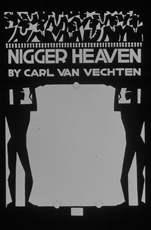
 NIGGER HEAVEN by Carl Van VechtenPublished 1926 by Alfred A. Knopf.
An excerpt from Chapter Three:
Four or five weeks had slipped by almost imperceptibly since the week-end party at Adora's when one day, taking stock, Mary was amazed to discover that, although she had written her mother at least once every week, she had not mentioned the proposal made her by Randolph Pettijohn. Proposals of marriage were rare enough, eventful enough, so that they deserved at least a passing reference in the chronicle of events she sent home, more especially because, till now, her mother had enjoyed what practically amounted to her complete confidence. As a matter of self-discipline and to discover the truth in her own soul, if such a thing were possible, Mary sat down to her desk to repair the omission and tried faithfully to give a true account of what had occurred, with her own reaction to it. After she had penned the last line she realized why she hadn't written about this particular incident before: she had been ashamed. Ashamed to confess to her mother that she had attracted the attention of such a man. She was also, almost mystically, aware of something else: Byron Kasson had enlisted her sympathy, awakened her imagination, to an extraordinary degree. Olive had often assured Mary that she was cold. Everybody says you're cold, that you have no natural feeling, Olive had complained. Why don't you let yourself go once in a while? There was at least this much truth in this criticism, Mary confessed to herself, that she did not let herself go. She had an instinctive horror of promiscuity, of being handled, even touched, by a man who did not mean a good deal to her. This might, she sometimes argued with herself, have something to do wit her white inheritance, but Olive, who was far whiter, was lacking in this inherent sense of prudery. At any rate, whatever the cause, Mary realized that she was different in this respect from most of the other girls she knew. The Negro blood was there, warm and passionately earnest: all her preferences and prejudices were on the side of the race into which she had been born. She was as capable, she was convinced, of amorous emotion, as any of her friends, but the fact remained that she was more selective. Oh, the others were respectable enough; they did not involve themselves too deeply. On the other hand, they did not flee from a kiss in the dark. A casual kiss in the dark was a repellant idea to Mary. What she wanted was a kiss in the light--with the right man, and the right man hitherto had never appeared. Now, thinking of Byron Kasson, she trembled as she gradually became aware of what sort of acknowledgment she was dragging out of her innermost soul. It startled her somewhat to perceive how little unwelcome to her it would be to encounter this man again. She did not mention Byron Kasson in her letter to her mother nor, conscious of this fact, could she bring herself to do so.
It was the middle of September, the sky was overcast with clouds and a slight drizzle was falling. Ollie had not yet returned from the office., Mary, alone, decided that a walk would agree admirably with her mood. Slipping a blue jersey and a raincoat over her woolen frock and pulling a tam-o'-shanter over her head, she started forth. The wind had risen and the raindrops increased in size. They beat against her cheeks and wet her hair and ankles. Tingling with health, she was grateful for this attention of the elements.
It had been, she reflected, a pleasant week. She had principally been occupied in borrowing from several private collections specimens of primitive African sculpture and she had been astonishingly successful--lucky, she called it--in unearthing worthy examples, representing the creative skill of a variety of tribes from different localities in Africa. Moreover, early dates were more of less reasonably ascribed to some of them. One strangely beautiful head was said to have been executed in the tenth century, or even earlier, while a box, exquisite in proportion and design, was said to have been created in the fourteenth century. Mary was beginning to recognize the feel of the older work, the soft, smooth texture, like that of the best Chinese porcelains, of the wood, so different from that of the coarser, later pieces. She knew something too, now, about the more primitive design, lovelier in its conception, because it was more honest, that the more elaborate, later traceries, created under Portuguese influence . . . There had been a pleasant dinner party or two; she recalled with particular pleasure an evening at the Weston Underwoods' when she had met the new secretary to the Haytian consul. He spoke only French and she welcomed this opportunity to practice the language with a young man made more tolerant, perhaps, by his obvious interest in herself. It was agreeable, too, to meet some one who knew a great deal about Cacteau and Moprand and Proust, knew about them, that is, in their relation to French literature in general. Rene Maran, the author of Batoula, he had actually been acquainted with . . . One night, with Howard and Olive, she had witnessed Arms and the Man at the Guild theatre, and another she had attended a rent-party, given by some indigent girl-friends, had paid fifty cents, and had been rewarded by a shower of gin and orange juice over the front of one of her favorite frocks. Carbona, the next morning, had only partially removed the stain. The clumsy young man who had been responsible for the catastrophe had seemed more put out by the loss of the gin -- his carelessness had exhausted the supply--than over the injury to her dress. Otherwise, it had been a gay evening. There had been dancing to the music of a phonograph in a two-room apartment--the dimensions of the largest chamber were about twelve by eight feet--and she had danced until two. Nearly everybody danced every night: why? Mary asked herself. Is it that we want to forget . . .
- Take the audio-visual tour of the nine letters selected to appear here -- to do so, click here or on one of the bits of the letters below.
- Listen to a rich conversation between Emily and Judith Jones, who was Langston Hughes's last editor and who continues to work at Knopf -- Judith served as Emily's editor on this project as well. While you listen to the conversation (about 15 minutes in length), you can still move around the site, look at images and read excerpts and letters. This is a large file to download.
- Hear Emily read several of the letters from the book on Random House's Bold Type.
- Visit the Langston Hughes pages in the Knopf Poetry Center.
- Return to Emily Bernard's main desktop page.




|