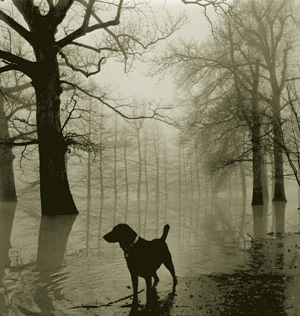
p 84 -- Dog in the Fog
SY -- The dog here is not one of the tough-looking, hard-traveling Delta
strays that Maude has done such a magnificent job of capturing
elsewhere. This dog lives in town and probably belongs to a banker. If
it belongs to a plantation owner who lives in town, he doesn't let it
ride around in the back of his pickup truck when he goes out to look
over his crops. Though it appears to be a black lab (and I have
one--her name is Lucy--lying beside me at this moment), this dog don't
hunt. This dog is at home in the rear of a Volvo wagon.
MSC -- This is indeed a town dog. Cassidy Bayou, purported to be the longest bayou in the world -- 500 winding miles long, I have always heard -- is right beyond my front door, and this was my neighbor's (an insurance agent) sleek Labrador. A fog had obscured most of the background so the bayou seems kind of mystical and swampy, almost spooky. I imagine a city of bodies at the bottom of "the longest bayou in the world ," if only because of an account I once read about the trial of Emmett Till's murderers at the Tallahatchie County courthouse in Sumner in 1955. The tiny Delta town was filled with reporters from all over the world that were here to cover the murder trial of J.W.. Milam and Roy Bryant (at whose wife the 13 -year- old Emmett "Bobo"Till had supposedly wolf whistled ). A New York Times journalist reported one of the local spectators at the trial coming up to him and saying "Why y'all making such a big deal about Emmett Till? There are hundreds of dead niggers in the Tallahatchie River." . I dedicated the Delta Land book to the memory of Emmett Till, mainly because I wanted to remind myself and others that some really terrible things happened in this part of the world. I have a twelve year old son, and I wanted him to know that someone very close to his age, a mere child, was brutally murdered here because he dared to cross one of those uncrossable lines that divided the blacks and whites. I wanted him to think about things like this, so his generation would never have to experience another 45-minute deliberation by the jury and subsequent acquittal of racist child murderers.
SY -- Emmett Till was killed almost exactly one year before I was born, no more than forty miles from the house where I grew
up. Yet I never learned about his murder until I was in graduate school, and I learned it then from a book, not from any of the
many people I grew up around who could have told me about it. It wasn't part of the officially sanctioned history of the
Mississippi Delta. The event that Visible Spirits is loosely based on happened in my hometown, Indianola, Mississippi, in
1902 and 1903, and it involved an African American postmistress named Minnie M. Cox. I first learned what had happened
while reading Richard Schweid's fine nonfiction book Catfish and the Delta, back in the early 90s. Lots of the older folks I
knew when I was a child could have told me the story, but they didn't, because once again it was not "official" Delta history.
Which is to say that it was not white people's history--a very different version of history, I have learned, from the version black
people handed down in oral accounts. (I'm pleased to note that efforts are currently being made to get a commemorative
stamp issued in honor of Mrs. Cox.)