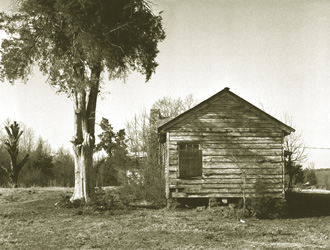
p 54--Wooden House and Tree
SY -- So often, when I look at the photos in Delta Land, I feel as if I've
stood on the very ground where Maude took the shot. This photo is one
of the ones that makes me have this feeling. It was taken somewhere in
Yalobusha County, which is way east of my own part of the Delta, yet
this house and the tree behind it seem so familiar to me. This is the
kind of house that always looks deserted, even if it isn't. These
houses are all over the Delta. When you live there (unless you've got
the kind of eye Maude has) you cease to see them. When you go back,
they're the first thing you notice.
MSC -- The house in this photograph does have a lean, lone, desolate look.
By the time I took it, the people that once inhabited it were long gone.
I don't want to romanticize what was a very hard living situation -- because it must have
been difficult and frightening to be rendered so completely vulnerable, living in these
mostly primitive "shacks" inÊ mid-field -- but the demise of this kind of housing in
the Delta's landscape changed the look of things significantly. Many houses and field
churches simply fell down, some were torn down to make way for cultivating crops.
I made a conscious effort to chronicle the last vestiges of the old Delta ( c.1910-1960)
life here. As depicted in Steve's book, the people who lived in these places had no privacy
or any kind of protection from invasion of their lives by those who did, in effect, "own" them
(and this, long after the official end of slavery): their feelings, relationships, political leanings, outward manner were all monitored with an iron hand. They were supposed to be merely
a work force with no voice. Any dissonant voice that did arise was squelched: killed or "run off."
(I once read, to my utter horror, an interview in the Clarksdale Press Register with a local
blues man who was asked where he grew up. He said Lombardy, Mississippi, but that later his
parents "ran off" from May Brothers Plantation. When asked to define this, his reply was
"you didn't just leave Mr. Lee May (my great uncle's) plantation, you "ran off in the middle
of the night.") What is poignant to me is that the few things that these folks could control,
like neat swept yards, flowers growing in old tires, shards of mirror nailed up on the front
porch, perhaps music of some sort, are all missing from the photograph of this deserted house.
It's deathly still and quiet now, but you know it must have at one time held a kind of
vibrancy connected to the lives lived here, despite all efforts to homogenize and defeat
individuality. And, so hopeful to me, is the tree: a noble, growing, alive and free thing.
It alone witnessed life here, a silent sentinel guarding the ghosts and memories there.
SY -- Houses like this one, as Maude notes, never belonged to the folks who lived in them.
In my novel, one house like this that I can think of is the one where Blueford and Scheider live.
But I think the term that most black people would have used--and this is not insignificant--is not
live but stay. "Where you stay?" If I heard that once when I was growing up, I heard it a million times.
I also heard "ran off." I heard it well into the 60s. A form of slavery was in effect even then.
It worked like this: if a particular black person was living on plantation X and he wanted to move to plantation
Y, the only way the owner of Y would allow him to move there is to first call the owner of X and ask "How much
does he owe you?" Y would pay X whatever that sum happened to be, charge it to the black person's account,
then move him and his family into a house like the one in Maude's photo, and the whole cycle would start over.
Black people were always in debt, because they were paid virtually nothing to begin with, and only during the
time when there was field work. If a black person left by doing anything other than getting Y to pay X, it was said that he had "run off."