|
|
 |
|
|
|

Andrew Weil, Jr.

Rosey Daley |
|
 |
|
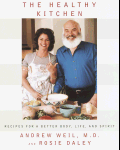
Q. What makes The Healthy Kitchen different from your past
works?
Weil: Well, first of all, it's a cookbook.
And it is unique among cookbooks in that it contains a great deal of
factual information about human nutrition. We've tried to emphasize
that making knowledgeable food choices is central to creating a
lifestyle that will maximize health, healing, and longevity. Our
recipes allow readers to make easy dishes that will contribute to this
lifestyle and will taste delicious. Both Rosie and I love to eat, and
love to cook, and we've worked hard in this book to drive home the
message that eating for health and eating for pleasure are not
incompatible.
Daley: Absolutely. The crux of our
collaboration is that eating should be about fulfillment, not denial.
Eating is about fulfilling your body's metabolic and nutritional needs,
but it's also about enjoying the tastes, textures, colors, and smells of
good food. It's great for me to have someone like Andy as a partner,
and all of us who are concerned with health and nutrition are lucky to
have him as a voice of reason and encouragement.
Q. How did
the the book come about?
Weil: Over the years, many
people have suggested that I write a cookbook, because I’ve put
recipes in all my books on health. However, I am a home cook, not a
professional, and teaming up with Rosie–whom I knew by reputation
long before we met in person–seemed like the perfect
collaboration.
Daley: When I first met Andy, I realized
that his encyclopedic knowledge of human nutrition would be a fantastic
complement to my experience as a chef. So we talked about collaborating
on a cookbook that would fill a gap in our culture. I think the book
we’ve done is particularly timely, now that Americans are
rethinking their priorities and making healthy eating one of
them.
Q. Why have health foods for so many years ended up
having that image of being dry and brown?
Weil: I
know; I know. It's always granola.
Daley: Because many
people don't know how to cook health food, is why. One of the things I
like about cooking is how artistic it is, the way a meal looks when you
use fresh, flavorful produce. I think that eating begins with the eyes.
Seeing food and smelling it stimulates your appetite and enhances the
eating experience. It gets you ready to eat. There is no excuse not to
make a meal visually enticing; it's really easy.
Weil: Of
course, the key factor is always how much you enjoy
it.
Daley: Definitely. I find it tremendously exciting
to cook with, serve, and eat really ripe vegetables. I never had any
problem eating vegetables, and I'm always amazed that other people don't
love them-
Weil: Well, a lot of vegetables are poorly
prepared–
Daley: Overcooked.
Weil:
Exactly.
Q. Yours is a unique collaboration. What messages
are you trying to get across to people in the
book?
Weil: We want to show people that you can make
very good food from fresh ingredients very quickly. You don't have to
eat unhealthy additives and you don't have to eat food that has been
treated in ways that are dangerous. Americans are eating much too much
of that kind of food.
Daley: We're really helping people
enhance their palettes and get more used to tasting food, instead of
additives. We're hoping that there's something for everyone in the
book. A lot of people these days don't have a lot of time, so sometimes
they take shortcuts. We're just trying to help them feel that they can
cook for themselves by giving them practical tips. Making a salad can
give people pleasure. Serving and eating food that you have prepared
yourself is satisfying both emotionally and physically.
Q.
How can busy people fit time to cook into their
schedules?
Weil: Mostly planning. You can make soup
at the beginning of the week and it'll last the rest of the week. A lot
of the recipes in the book are really fast.
Daley: We
also discuss the importance and convenience of making things ahead of
time, and how to make use of leftovers. You can make a turkey ahead of
time, and then make sandwiches and make sauces, and take something with
you to work so that you're snacking on it during the day. Cook ahead of
time. If I am making a dish that calls for shrimp, I will cook a little
extra and use it as shrimp cocktail the next evening. It's possible to
use leftovers in a way that provides real variety and is not
wasteful.
Q. Talk a little bit about
vegetarianism.
Weil: Where you draw the line at what
you're going to kill and eat is up to you. There are some people who
think that vegetables have feelings as well. Some people like to say a
grace before eating, thanking all the organisms that gave their lives to
make the meal. Life lives at the expense of other life, so it's really
a personal matter.
Daley: Absolutely.
Weil:
However, there are compelling health reasons to try to eat lower on the
food chain. Large animals tend to accumulate all the toxins that are
passed up through the food chain, which means larger things eating
smaller things. When you're eating large animals for food, you're more
likely to get material that your body doesn't want. Another
consideration is that the raising of animals for food tends to be
destructive to the environment. There are people who say that if people
ate grains, instead of feeding the grains to the animals, we'd be able
to feed a lot more people in the world. In that sense, meat-eating is
an inefficient use of resources. So there are all sorts of reasons why
people might want to at least reduce the percentage of animal foods in
the diet, and I think it's important to be aware of the fact that
alternatives exist, like baked tofu, which I find to be a very
acceptable substitute for chicken, for example, in Rosie's grilled
skewers.
Daley: And you eat seafood every once in a
while.
Weil: Yes, and I'm excited to try your shrimp
satays. They look very good.
Daley: I was worried that
they weren't going to have enough flavor, but we did put a lot of spices
in them. Now I am afraid that they will be too
spicy.
Weil: Hey, it can't be too spicy for me! Let's
add more.
Daley (laughs): When we first started this
collaboration, I thought, oh, he's a purist, I'm going to have to be
really careful. But this guy, he likes salt, he likes
oil-
Weil: I like flavor.
Daley:
Agreed! Of course, nothing ever quite equals the taste of fresh
produce. Andy and I both think it’s important to use salt and
spices to enhance-rather than overpower-good food. In my kitchen, I use
primarily cold pressed extra virgin olive oil for cooking. Andy prefers
grapeseed oil, because of its higher burning point.
Q. What
are the worst types of food that people can eat?
Weil:
There's been a great deal of propaganda and pressure-from the medical
profession especially-that fat is evil. A lot of people have the idea
that fat is the single worst element of the diet. I don't believe that.
It's pretty obvious that despite anti-fat messages and despite the rash
of non-fat and low-fat foods on the market, Americans have gotten
steadily fatter. People are getting fatter because they eat too much,
and too much of the wrong things. Additionally, many people are looking
for black and white guidelines-fat bad, carbohydrates bad. It's not that
simple.
Daley: And food doesn't fit just one category.
The body can break down starches and store them as fat. It's important
to incorporate starches and oils into a balanced, nutritious diet. Our
aim is to make healthy eating second nature, so that people enjoy and
seek out the components of a healthy meal plan.
Q. What about
eating out? Any suggestions for those who dine out
frequently?
Weil: One simple suggestion for dining
out is to ask waiters not to bring bread and butter until the main
course is served (or not at all). Splitting courses is also a good
idea, since restaurant portions are often much too large.
Q.
You mentioned the current rash of low-fat and artificial-fat foods on
the market. Is there a safe and effective way to lose
weight?
Weil: Absolutely. It's essential to reduce
consumption of the wrong kinds of fats and the wrong kinds of
carbohydrates while increasing physical activity. The simple strategy
of cutting out most foods made with white flour and sugar, fast foods,
and snack foods will do it for most people. But it is also very
important to maintain a high intake of a variety of fruits and
vegetables, the right kinds of fats (monounsaturated oils and the
omega-3 fats found in fish such as salmon, mackerel, and sardines), and
low-glycemic-index carbohydrates.
Daley: The easiest,
safest way to lose weight is to eat smaller meals, with a salad every
day, and to snack on healthy foods such as nuts and dried fruits.
It’s important to eat lots of fresh fruit and vegetables, to drink
fresh, unsweetened fruit juices and lots of water, and to make whole
grains and legumes the staples of your diet, incorporating fish and
chicken a few times a week. I think the best tip is that healthy foods
should be available in your home, so that you can eat them whenever you
are hungry.
Q. What are some of the problems and solutions in
the fight to educate Americans about healthy eating and
cooking?
Weil: One problem is that people tend to
think of meat as the center of the meal, the main course. If they don't
eat that, what are they going to eat? I found that when I was first
preparing vegetarian meals for people of my parents' generation, they
kept waiting for the meat and thought everything else was side dishes.
So it's just a matter of reeducating people.
Daley: We
give people non-meat dishes with the protein and the vitamins of the
meat. Andy explains why non-meat options contain the same vitamins,
minerals, and protein as red meat. I think fewer and fewer people today
get upset when they don't have meat. They just want to have something
that is delicious and filling, and we've provided many recipes for
delicious, filling meatless dishes.
Weil: I think one of
the appeals of fast food in our culture is that there are no surprises.
You know exactly what you're going to get. And clearly that appeals to
a lot of Americans. But for me, cooking is relaxing and meditative.
It's making order. It's taking all these pictures you have in your
head, all these variables, and making order of them. It provides great
satisfaction, and both Rosie and I hope readers will share
that.
Q. What are your favorite recipes from the
book?
Weil: My favorite recipes for nonexpert cooks
are the Tomato, Corn and Basil Soup, the Roasted Winter Squash Soup with
Cilantro-Walnut Pesto, the Tofu Fajitas, the Grilled Salmon with Mustard
Sauce, the Shiitake Mushrooms and Pea Pods, and the Figs in Wine. All
are easy and delicious.
Daley: I love the Baked Spicy
Tofu with Bean Thread Noodles, Mango, and Corn, because it’s
something a bit different. The most basic recipe in the book is for
Applesauce, which is great any time of the day, any day of the
year.
|
|
|
|
|
|
|
|
|