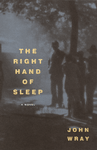
8) The memoirs of my maternal grandfather, an opera conductor and composer who enjoyed a modest amount of success in the Germany of his day, were of inestimable help in laying the raw foundations for The Right Hand of Sleep. My grandfather, as he imagined himself (often somewhat fancifully) in his memoirs, formed a template of sorts for two characters in the novel: Voxlauer's father, the unstable, haute-bourgois composer of operettas, and, to a lesser degree, Kurt Bauer, who finds himself drawn further and further in to the sinister workings of the Third Reich during the years of his asylum there. The following selection from my grandfather's memoirs may give a sense of the largely indirect and tangential way that I made use of this and other historical sources in writing the novel.
8.8.32
We spent that summer, as always, at the house in Friesach. A friend had given me Hitler's Mein Kampf as a curiosity and I actually read it beginning to end. I remember, the morning after I'd finished, saying to the family and friends gathered at the garden table under the old fir: "If this man makes it to the top we'll have a world war, one in which not only the Soviet Union will take part, but America, as well!" this was in 1932. My wife, as the only living witness, might yet be in a position to corroborate this.
*
10.14.33
Soon after coming home I was to make a truly astonishing discovery--the upper-middle class was largely indifferent to the past year's events. We'd returned to Germany in a very troubled mood, regarding the political upheavals in the Reich as far-reaching and significant. Thus I was dumbfounded, to say the least, on recognizing a certain cautious optimism among our more well-off acquaintances. One had simply begun to adjust oneself to the current circumstances. Needless to say, there were those who recognized what a great deal was in danger of being lost, even if no-one (insofar as I could determine from our circle of friends) was able to foresee the inescapable consequences. Here and there someone might express regret for the loss of democratic freedoms; the more popular view, however, seemed to be that Europe was travelling irresistibly down the path of political polarization, and that, given a choice between Russian Bolshevism and fascism after the Italian model, fascism was by far the preferable fate, and most likely an unavoidable one. And so, as I was, sad to say, not prominent enough an artist to be able to emigrate (say to Switzerland, perhaps, or England) I tried to find a place for myself in this new and utterly bewildering order. I can honestly say that I did not have an easy time of it.
*
3.7.34
That afternoon a call came for me at the opera house. My wife and I were requested to go to that evening's performance at the Rheydt City Theater, in black-tie and evening clothes: Reichs-minister Goebbels and his wife would be in attendance. Tickets had already been reserved. Very unwillingly we changed into formal clothes, went to the play and, by a great effort of will, managed to sit through all of it--"Lady Windermar's Files", if I remember rightly. In the second intermission Herr Ziegler asked me to invite certain members of the opera company to the Palace Hotel for dinner: the Reichs-minister himself wished to dine with us. When the play was over we went to the hotel, where a table had been reserved for the company. Goebbels and his wife sat at a nearby table chatting with old Rheydt acquaintances. The usual Sunday clientele filled the remainder of the huge dining-room; If there were any special security measures in place I saw no sign of them. Famished as I was, I ordered a full dinner; later that evening, when I asked for the bill, was informed that it had already been taken care of. This gives me a certain pleasure, even now, as it was the only time I ever to get a decent meal out of the blessed German Reich!
After finishing his own modest repast (bread and cold-cuts, if I remember rightly) the Reichsminister came over to our table and introductions were made in the finest bourgois style. Goebbels sat down just across the table from me and immediately began a ponderous lecture on the relations between our twin cities of Rheydt and Muenchen-Gladbach. Goebbels maintained that the Gladbachers were actively sabotaging all the Arts; the theater performances were poorly attended only because Gladbach was so "black" (Catholic-Conservative) a city. But he would show them, no need to worry! He'd move the city orchestra to Rheydt and leave the Gladbachers with nothing at all, not even a SA-marching band! He'd send the Berlin Philharmonic itself to Rheydt, under the great Furtwangler. Let the "blacks" come begging to him on their knees! And so it went, on and on, until the hairs on the back of my neck stood on end. Sitting mutely there at the table, staring at the Reichsminister over my empty dinner-plate, it finally began to dawn on me what a nightmarish wold I'd decided to enter. Had I, in fact, made any such decision, or had it simply appeared around me, as the sides of a jar must suddenly appear to a beetle that's been trapped under it by a curious schoolboy? It seemed to me I could still make out traces of the world I had known, but blearily, as if through mottled glass: this was to be a recurring vision to me over the next months, one which came to dominate my consciousness during daylight hours and, in time, to haunt my dreams. When the worst finally came, I had long since prepared for it.
Click to View: 1) Map
2) Village
3) House
4) Great-Uncle Karl
5) Dora Toula, Great-Grandmother
6) Cottage
7) Himmler
8) Memoirs of maternal grandfather, an opera conductor and composer