|
|
 |
|
|
|
Click to view larger |
|
 |
Repairing Frayed Cover Edges - Handling Dos and Don'ts
- Memoirs and Notable Quotations -
Do . . .
- Always treat your books as your dearest friends. They'll always be there for you. Rereading them is one of the greatest pleasures in life.
- Make sure your books are standing up straight on their shelves. Books that lean over will eventually stay that way, sometimes making the signatures come apart or loosening the spine. Leaning also allows the books to open a bit, letting dust get inside or even wrinkling the pages.
- Wrap up any books that have loose or broken joints. Use acid-free paper and the red cotton library tape from your Booklover's Repair Kit, which will keep further damage from occurring. You might also want to order a book box or archival envelopes (see order form).
- Protect books that have lost their covers by cutting a couple of pieces of acid-free mat board larger than the book to place over the pages. Then wrap and tie it up as described above. If you decide the book is important enough, you may want to take it to a book conservator so a new cover can be made.
- Make sure draperies are pulled or shades drawn during the day if any sunlight comes into the room where you keep your books. Even bounced sunlight can fade out leathers and book cloths.
- Make sure your bookplate is in your book before you loan it to a friend, to help ensure that it will be returned to you. Keep a log of books loaned.
- Use a pencil whenever writing is called for. Never, ever use ballpoint or felt-tip pens. Once on your books, ink cannot be removed.
Don't . . .
- Despair if you don't do every single procedure described in The Booklover's Repair Manual exactly right the first time. That's why we suggest trying everything out on practice books first. Okay, so the mending tape didn't get completely flat and there are a couple of wrinkles. Definitely don't try to remove it--it will pull off a layer of the paper. Instead, put the mat board under the page, lay down a piece of silicone release paper over the tape, and use your bone folder to burnish it firmly. If there are still a couple of wrinkles, rub the tape directly with your bone folder, but do it carefully so the tape doesn't start to abrade. It's okay if a few wrinkles remain. At least the tear is repaired, and your skills will get better every time you do the procedure.
- Try to tackle a procedure you feel uneasy about. Try it out first on a practice book. If you are still unsure, put the book aside with the problem written in pencil on a piece of typewriter paper sticking out the head of your book, or make an entry in your log journal. The book has been that way all this time, so waiting a little longer won't make any difference.
- Use books as bookends. Not only does this scuff the fore edges or spines of your bookend books, but it also marks up the books being held.
- Use bookmarks made of acid paper. If you don't know whether your bookmark is acid-free, then cut a strip of typewriter or computer paper and use that instead.
- Use thick items such as fancy sterling silver bookmarks, plastic bookmarks, or old bookmarks made of ivory. Thick things in books are definitely no-nos. They will eventually break the spine and might even warp the covers or leave marks and impressions on the pages. Silver is especially bad since it can tarnish and transfer oxidation onto the pages it touches.
- Reach for ordinary transparent tape to mend a page tear. Now you have archival mending tape in your Booklover's Repair Kit.
- Try to erase pen or crayon marks. They are permanent. Trying to erase them will only harm your book. Instead, think of these marks as adding to your book's history.
- Bring food or liquid into your work space. If you want to have a glass of soda or water nearby, put it a good distance from your work area. It's amazing how easily things get knocked over; there are mean little gremlins running around just waiting to overturn your container of water with the glue brush in it, or your glass of soda.
- Leave your book outside. Let's say you are reading on the balcony or porch or under the umbrella on the patio, and the phone rings. Don't lay your book down when you go inside, because you may forget about the book and it could get rained on or just forgotten. Sunlight, rain, insects, and dogs are enemies of books. Dogs love books, especially older books, because they were put together with hide glue, which is an animal product. They especially enjoy chewing on the spine, because that's where the glue is. It tastes just like a wonderful rawhide chewy to them.
- Ever, ever, ever use stickies to mark a page in a book that you want to come back to. The glue on stickies will transfer onto the page and leave a yellow mark (it's probably acidic). Use a piece of acid-free typewriter paper as a bookmark instead.
- Lay a book down on its pages with the book open. That's a good way to break the spine or loosen some of the signatures, and to get soiling on the pages or tear them. Put an acid-free bookmark in the book instead, and close it up, even if you intend to come right back to it.
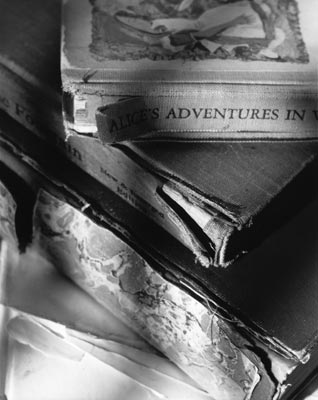
- Stack books in piles on their sides for any length of time. The bottom books shoulder a lot of weight, which tends to make them go out of square and can injure or twist the spines. If the books remain in this position for a period of time, the damage may become permanent. A book is designed to stand up straight.
- Use books as end tables. If you have more books than bookcases and you want the books you are reading close at hand, they tend to get piled up near chairs and used as end tables. This is not advisable since it puts too much pressure on the bottom books and weakens their spines. In addition, before long they become food trays and foot rests, getting kicked, bruised, bumped into, and soiled. Carpet dust and dirt is also damaging to books.
|
|
|
|
|
|