
| • About the Novel |
| • About the Author |
| • Read An Excerpt |
| • Reading Groups |
|
|
 |
||
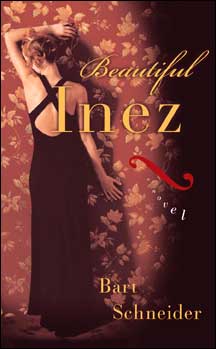  |
For Reading GroupsIf you are a member of a reading group and you’re considering Beautiful Inez for your next meeting, please drop us a line; we're happy to send you an advance reader’s copy of the book (while supplies last). And if your group has already chosen to read Beautiful Inez, let us know. We love hearing from you, and we’ll do our best to provide you with anything we can to help facilitate your discussion. The Story Behind the Book | Questions for Book Group Discussion The Story Behind the Book“In my recent novel Secret Love, San Francisco attorney and civil rights leader, Jake Roseman, mourns the death of his wife, Inez. Like Jake, I was haunted by the mystery behind Inez’s death and decided to write a stand-alone novel, from her point of view, set in 1962, two years earlier than the time of Secret Love. Why would a woman whose life appeared so charmed choose suicide? Although a physical beauty, a violinist of prodigious talent, the mother of two lovely children, and the wife of a simpatico man, Inez is possessed by a quiet engine that is driving her toward annihilation. More than two years into the writing of Beautiful Inez, I realized that Inez Roseman suffered in part from what may have plagued my own mother: a postpartum depression, that rather than being a temporary hormonal downswing, took up permanent residence within the skin. I recalled hearing stories about my mother, that for months after my birth she couldn’t bear to sleep on the same floor as me, that the sound of a baby crying drove her up the wall. Postpartum depression hadn’t been identified as such in the 1950s, when I was born and when Inez gave birth to her children. A half century later, the condition’s potential danger and wide-spread incidence is just beginning to be recognized. Beautiful Inez is actually a novel about two women. Sylvia Bran (waitress,
showroom pianist, part-time journalist, amateur linguist, petty thief,
voyeur, and budding bohemian), may be a strange bedfellow for Inez Roseman,
but she is able to open Inez up in a way that she hasn’t been opened
in years. A waltz between love and betrayal, Beautiful Inez involves
women ten years apart in chronological age, one having come of age in
the forties, while the other is becoming a woman of the sixties. —Bart Schneider Questions for Book Group Discussion1. On page 6, we’re told that “Sylvia Bran’s career as a voyant is about to begin.” What did you imagine that meant when you read it? What do you think it means now? Who turns out to be the more successful voyant, Sylvia or Inez? 2. What part do language and etymology play in the story? How does Sylvia use language as a barrier? Or a weapon? 3. Throughout the novel, questions of role and identity are raised: Sylvia pretends to be a reporter to meet Inez; Jake wears Bermuda shorts to court as a sort of costume; Christine dresses like a hooker for her final rendezvous with Jake. What role does Inez assume? Is she convincing? 4. On page 175, Inez admits to herself that “she doesn’t care who Sylvia is. Let her be whoever she wants.” Why is Inez willing to continue the affair after such a grave deception? How does their relationship change as a result? 5. How does the Cuban Missile Crisis impact the various characters? Do you think they might have behaved differently if it weren’t for the specter of imminent death? 6. Do you believe in Hy’s concept of a “mind lasso”? Which characters wield it best? Do they know they’re doing it? 7. On page 273, Inez thinks, “A woman like her isn’t brave enough to walk away from her family, her children, and go on living. She cannot make so sharp a left turn in her life, nor can she sit idle.” Why do you think Inez feels this way and continues to contemplate suicide, even while she seems so happy? How might things be different if the story took place in a different era? 8. Food has a different significance for each character, in for example Inez’s fluctuating appetite or Jake’s gourmet assignations with Christine. How does Sylvia’s simple, sensual attitude compare? What does Isaac’s disdain for “goyish” mashed potatoes reveal? 9. Was it wrong for Jake to bring Isaac home to live with them? Did he have any other options? 10. How does Bibi’s benediction alter the relationship between Inez and Sylvia? 11. How does the fact that Sylvia’s mother was a suicide influence her response to Inez’s initial confession? And later, when Inez announces her “irreversible decision”? 12. What role does religious belief play in the story? Is it a help, or a liability? 13. What do the chapter headings signify? Why do you think the author chose to name each chapter individually? 14. Did the ending surprise you? How might it have been different if the story took place in our era. |
|
 |
||
Purchase Online: Amazon • Barnes & Noble • Books-A-Million • Powell's • WalMart |