
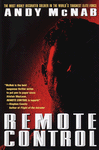
 Part of the effectiveness of Remote Control comes from its riveting and authentic procedural detail. How much of the book is based on your actual experiences?
All of the book's scenarios are based on my own experiences or on those of others I know. They were mostly picked up during my years with the Special Air Service (SAS). Each procedure in the novel has been used, and every technique works. For example, the method-of-entry techniques, how to defeat proximity alarms, lock-picking procedures--all these are standard issue for special forces operatives. I've often had to do the kind of covert close-target recces that Stone performs: going into a terrorist's house when he's not there, finding documents, trying to discover more about him, planting covert listening devices. You have to leave the house without any trace that you've been there--it's a hard and slow process. We are taught improvisation techniques, essential knowledge for any operator involved in industrial sabotage. On occasion, I've been projected into a country in order to disrupt the water and power supplies and, even more relevant these days, the information and telecommunications supplies. You can't go in with a big bag of explosives--to minimize the risk of raising suspicions you have to know how to make things out of materials you can buy commercially in everyday stores. Then you adapt these for your own particular use. Instead of having to watch your target twenty-four hours a day, much better to employ a video camera as an impromptu surveillance device, much as Stone does in the book. During an op, I've often had to cut wires or take the fuses out so that my vehicle's brake lights won't come on; these light cutouts are in place in Slack Pat's car when he picks up Stone and they check out the PIRA building. It means that if the car stops, drops men off, and moves again, from a distance the car still appears to be going forward. The scene when Stone discovers that Kev and his family are dead, and he has to perform an on-the-spot houseclearing--that's something I've done numerous times. It's particularly nerve-racking because you have no idea whether or not anyone's in the house, and whether they know what you're doing. All the emotions, what's going on inside Stone's head in that sequence, are completely real, I can tell you. All the characters are based on real people: Kev and Slack Pat are former colleagues, and Euan is based on a very close friend who is still in the SAS. The squash court incident did actually happen. Simmonds is based on an attorney I know--the way that he acts and speaks. Of course, I didn't want to be sued, so I had to ask his permission. He said I could use him on two conditions: he wanted to be instantly recognizable to his kids, and he insisted that he should turn out to be the villain . . .
Both the Ministry of Defense and the Intelligence Service wanted to review the book. They were aware that I'd be drawing on real-life operational techniques, and that I'd be using my knowledge of particular operations. They were worried that I could be exposing ongoing operations or the use of sensitive equipment. I was well aware that they'd insist on having a look at it, so I deliberately put three things in the novel that they could jump up and down about, that we could then agree to take out, and that would make them satisfied that they'd done their job. In fact, I was surprised that there are a number of passages still in there that they didn't make a fuss about.
I have a daughter who lives in the States, and the relationship is loosely based on ours. She's eleven now, going on thirty. Like every kid she assumes that all the stuff she watches on TV is universal, so we experience many of the cultural misunderstandings that Stone and Kelly come up against. I often seem completely out of the loop when I don't have a clue who Sabrina or Buffy are, so I keep an eye out for all the American kids' shows when they come to England. I'm absolutely certain, however, that if I had to talk my daughter through the bomb-making process she'd constantly be telling me what to do--I can hear her asking questions like "But don't we need a bit more sugar? Shouldn't the fertilizer go in later?"
Many of the operations I've been involved in over the years have been of a covert nature. My work with the SAS took me all over the world: some operations were purely military, in others I was performing an antiterrorist role. For instance, in the late eighties we took part in the battle against the South American drug cartels that were funneling major amounts of narcotics into the UK and Europe, as well as into the US. I helped train the Colombian antidrug police in jungle techniques--we taught them how to go into the forests and find the manufacturing plants so the supply could be cut off at its source. Once they were sufficiently trained we then led the patrols in. Because of the success of our operations, the cartels' bosses put a price on our heads. I also spent two years as an undercover operator in Londonderry, Northern Ireland, so I need to be careful not to present myself as a target. These people bear grudges--and although the peace accord is now in place, all groups still have their weapons. They now call the use of them "social terrorism." Some of the operations I took part in are still ongoing, and to reveal my face would compromise them and possibly put other operators at risk. Don't get the idea that I live in the dark. I just don't show my face in the media, and I don't do any public appearances. It's now known that I've been involved in operations where terrorists were eliminated, so it's important for me to continue to keep a low profile. A public appearance in a bookstore may cause a bomb threat. Not only would this put me in jeopardy, but everyone else in the store would be endangered, too.
I've been visiting the US since the early eighties. I first came over with the British army--after attending the air assault school at Fort Campbell, Kentucky, we joined the 101st Airborne for a time. During my SAS days I flew over frequently as there is a special relationship between our elite forces. These days, of course, I come over as a parent. The longest stint I've had in the States was the seven months I spent working as a technical adviser on the film Heat with Robert De Niro and Al Pacino. I trained the actors and checked the script so that the bank heist and armored car robbery would be as realistic as possible. I chose Washington, D.C., and Florida because I wanted locations that would be immediately recognizable to an international audience--everyone the world over knows where they are, and what they're like. I researched all the D.C. areas, drove down I-95 through the Carolinas and into Florida, and spent spring break in Daytona. I was determined to bring as much realism as possible to these locations, because many of the readers, be they German, Scottish, or American, are likely to have been there, so if I could get those details right, they'd trust me that the other stuff is totally authentic as well. The whole research/writing process took me a year; I then took another six months to top and tail, getting the feelings and emotions right.
There is a particularly close and strong relationship between the US and UK intelligence services. I've often been involved in joint operations. Because of legal considerations, there are certain things the Americans aren't allowed to do, so we Brits can carry them out for them. I've worked with Delta Force, the FBI's hostage rescue team, and the DEA, who obviously were involved in the First Strike operations in South America. A lot of good personal friendships have developed, too, and they have continued. Kev's background is based on a friend of mine in the ATF who has had many attempts on his life, resulting in his having to move from state to state and from job to job within the ATF. A couple of years back I was approached by a member of the FBI who invited me to become part of the agent enrichment program for agents in training at Quantico. This has been really interesting and a privilege to be involved with: spending time at Quantico, looking at their facilities, swapping ideas and experiences with their operators. It has its incidental perks, too--one evening I was out with some secret service people and I managed to sneak a look at the presidential bowling alley in the White House basement. For the first time, the threat of terrorism is now very real on the US mainland, and the Clinton administration has poured millions of dollars into the counterterrorist effort. Thanks largely to the situation in Northern Ireland, we Brits have had knowledge of how to handle this sort of activity for the better part of a generation, so we have the technical skill and the operational experience that the Americans are keen to hear about and learn from. I have therefore lectured to FBI operators on counterterrorism techniques. I've actually just been approached by another agency that is run out of the Pentagon to do a series of lectures in 1999 to American organizations. They want me to advise about conduct under capture: how to overcome the stress of capture, ways of recognizing what to do, how to deal emotionally. Interestingly, I'm now doing far more of this kind of thing with American agencies than I am with British ones.
The second Nick Stone thriller will take place after Remote Control. Because Ilove it so much, I'm setting the book in the States, which will enable me to spend more time here on research. Kelly is in the background now; this time there will be a rather older and wiser woman to hold Stone's interest, but she probably won't be as trustworthy. Crisis Four will be published by Ballantine in the summer of 2000. |
ABOUT REMOTE CONTROL | ABOUT THE AUTHOR | INTERVIEW | EXCERPT | LINKS | BUY IT
BALLANTINE PUBLISHING GROUP | BOOKS@RANDOM