About this guide
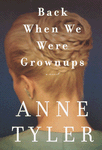
What if you were given the chance to go back in time and take your life
in a different direction? In her fifteenth novel, Back When We Were
Grownups, Anne Tyler brings to life Rebecca Davitch, who gets that
very chance to taste briefly what her life might have been like if she
had made different choices when she was younger. The questions,
discussion topics, and author biography that follow are intended to
enhance your group's reading of this charming and offbeat "what if?"
tale by an award-winning and best-selling author.
Tyler introduces us to our protagonist on the day Rebecca first wonders
whether she is really the woman she was supposed to be. Rebecca, we
learn quickly, is a veritable Everywoman: a professional hostess, a
widow, and a full-time mother, stepmother, grandmother, caregiver, and
sister-in-law. Her life is a string of parties--those she hosts for her
large and constantly growing family, and those she hosts for her
livelihood. But now Rebecca suddenly wonders: Is she--has she ever
been--enjoying herself at all these celebrations? And does she really
enjoy the unrelenting demands made on her by her family members, a
colorful cast of characters who are at times lovable and at times
infuriating? What type of woman would she have become if, instead of
marrying her late husband, she had married her college sweetheart or
even finished college? So Rebecca reconnects with her now-divorced
college sweetheart, and begins her research right where she left off. As
Rebecca makes an awkward and often comical attempt to go back in time to
take the other "fork in the road," Rebecca's hectic, crowded, joyous,
tedious, lonely, and occasionally mournful real life tumbles across the
pages, compelling Rebecca to finally come face-to-face with her real
self.
For discussion
1. It is upon Peter's second disappearance during the picnic that
Rebecca first thinks: "How on earth did I get like this? How? How did I
ever become this person who's not really me?" (p. 20, lines 33-34). Why
does Rebecca's "identity crisis" begin at this particular moment in her
life?
2. Did Rebecca "choose" her life, or is her life just an example of
Poppy's observation: "Your true life is the one you end up with,
whatever it may be. You just do the best you can with what you've got"?
(p. 252, lines 1-2). Do people choose their identities, or do they just
"end up" the way they are?
3. Rebecca asks her client: "Mrs. Border, have you ever stopped to
consider what a marvelous purpose a party serves?" (p. 38, lines 17-18).
How does Rebecca answer her own question? Would she answer it
differently at the end of the novel?
4. What is the significance of Rebecca's "Freudian slip"--if it can be
called that--when she tells Zeb that she is a "superficial" woman, when
she really means "superfluous"? Is Rebecca either "superfluous" or
"superficial"? Is superfluous a word one could use to describe any
character in the book?
5. "[Zeb] had a theory that Min Foo's many marriages were her way of
trying on other lives" (p. 29, lines 34-35). Is this the same as what
Rebecca is trying to do? Is this a universal fantasy that Rebecca is
living out? What might be Tyler's opinion of one trying to "go back to
take the other fork in the road" or "trying on different lives" ? What
other examples can you find in Back When We Were Grownups that
provide different ways to think about or define the concept of identity?
6. The opening words of the novel, "Once upon a time . . . ," recall the
motif used in fables or fairy tales. In what ways does Back When We Were
Grownups resemble a fairy tale or contain elements of the fairy tale or
fable? Does Back When We Were Grownups have a moral?
7. Rebecca realizes the irony of the fact that the more she does for her
family, the less she is appreciated. "It had occurred to her, often,
that the way to win your family's worshipful devotion was to abandon
them" (p. 87, lines 17-18). The reader learns a lot about how "Beck"
feels about her family--but how does her family feel about her? Does it
matter to Rebecca whether her family appreciates her or not? What does
the book suggest about how family members treat one another generally in
society?
8. How is marriage portrayed in Back When We Were Grownups? Are
there marriages of convenience, or are there examples of marriage where
both parties to the marriage are equally "useful" to each other, as
Rebecca advises NoNo on her marriage to Barry (p. 246, lines 31-32)? Is
Rebecca's advice to NoNo convincing to the reader? To Rebecca herself?
Why do marriages fail: Joe and Tina's, Will and Laura's, and Min Foo's
first two marriages?
9. How would you compare the different types of love explored in the
book? With respect to Poppy, Rebecca observes: "Apparently you grow to
love whom you're handed" (p. 157, lines 1-2). Is this applicable to the
love Rebecca has for any of the other people in her life? In the case of
her sons-in-law, Rebecca had promised that she would treat them
differently than her mother treated Joe, and "she had kept her promise
so faithfully that now she couldn't say for certain whether she truly
loved her sons-in-law or merely thought she did" (p. 144, lines 23-25).
Is there a practical difference for Rebecca? How do the other characters
love Rebecca?
10. What is the significance of Tyler's ending the tale with Poppy's
hundredth birthday party? What is really being celebrated?
11. Is the ending of Back When We Were Grownups anticlimactic or
satisfying? Is the reader mad at or frustrated with Rebecca, or proud of
her? At what point does the reader come to "recognize" the "real"
Rebecca?
12. Can Rebecca be described as a heroine? A martyr? Is she an ordinary
or extraordinary woman? When she realizes that she has brought the
Davitches her "joyousness . . . [which] she had struggled to acquire . .
. Timidly, she experimented with a sneaking sense of achievement. Pride,
even" (p. 246, lines 31-36, to p. 247, lines 1-4). Is this her greatest
achievement? What are Rebecca's failures?
13. Is there significance to Rebecca's dream about the boy on the train
(p. 21, lines 1-17)? Why does she realize that Peter was the boy on the
train at the moment that she does (p. 273, lines 32-33)? Is Peter her
chance at creating a new life or identity? Is Rebecca's dream a metaphor
for her "identity crisis," and, if so, what does it tell us about how
seriously to take her "identity crisis"?
14. What does "The Open Arms" symbolize? Is the name of Rebecca's house
intended to be ironic? How might the dynamic of the Davitch family be
different if their family business were something other than running a
party facility out of their home?
15. How does Tyler develop the characters in her novel? Compare how
certain characters, such as Poppy and Rebecca's mother, speak a lot, and
others, such as Peter, say very little. How much do we learn about some
of the lesser characters by the few words they say in the novel? How is
Rebecca's character developed differently than the other characters?
16. What is the meaning of the title (p. 188, lines 11-17)? What does it
mean to be "grownup," and can Rebecca or any of the other characters be
described as "grownups"?
17. Does the concept of "family" defy definition in Back When We Were
Grownups? Might the reader wonder how Rebecca came to be so
accepting of all of the assorted people she welcomes easily into her
family? Is she rebelling against her own mother's intolerance, or simply
filling the void of her lonely childhood?
18. For Rebecca, "the most memorable of the five senses . . . was the
sense of touch" (p. 34, lines 28-29). The sense of taste also figures
prominently in the book, invoked by the descriptions of the food served
to Rebecca (p. 64, lines 8-9; p. 131; and p. 205) and Biddy's gourmet
foods. What does Tyler achieve stylistically by invoking these senses,
or any of the other three senses?
19. How would you characterize the conversations Rebecca has with her
grandchildren? What do they reveal about Rebecca? For example: Rebecca
tells Merrie about her dream (p. 49, lines 13-14), and she discusses
Poppy's birthday party with Peter (p. 117, lines 20-35).
20. What is the significance of the descriptions of the lives and
families of the workmen who frequent The Open Arms? Are they merely
humorous interludes, or is their placement in the novel significant to
Rebecca's progress in her search for her identity?
21. Is Tyler's choice of the motives of Robert E. Lee as the topic of
Rebecca's college research project intended to be humorous? Ironic? Is
Rebecca's realization about Lee's motives analogous to her own
self-recognition, and, if it does invite such comparison, what does that
tell the reader about how to view Rebecca's identity crisis? (p. 232,
lines 6-23)
22. How do Tyler's descriptions of Baltimore, the scenery during the
drive from Baltimore to Macadam (pp. 127-28), and the town of Church
Valley, Virginia (pp. 57-61), affect the atmosphere and mood of the
novel? Do they reinforce any themes of the novel? Is Rebecca's life like
the once elegant street of Baltimore that "never reverses" (p. 47, line
1)?
23. What are Will's good qualities? Does the reader sympathize with
Will? Like him or dislike him? What happened at the family dinner that
made Rebecca "end it" with Will that night (p. 218, lines 6-8)? Is Will
in fact the one who was "superfluous"?
24. In several places, two characters' conversational paths converge.
(For example, p. 64, lines 30-31.) Where else does Tyler use this style
to convey how people talk to each other--but don't seem to really hear
each other? Are these realistic conversations? What does it tell us
about the way people communicate?
25. How does Tyler achieve a balance between the celebratory and the
mournful in Back When We Were Grownups? Does one tone dominate
the other?
26. Rebecca frequently feels that she is untrue to her own nature. (For
example, p. 183, lines 14-15; p. 69, line 24; and p. 162, lines 25-26.)
Is Rebecca really a "fraud" (p. 39, lines 28-29), or is this a common
character trait?
27. Rebecca explains that she refers to Min Foo as her daughter but
still refers to the other girls as stepdaughters because "acquiring"
stepdaughters was the most profound change in her life (p. 234, lines
15-27). Are any of the other characters shaped by such profound events
in their lives? Is Rebecca's a typical or understandable way people deal
with such profound life changes, or does it say something unusual or
significant about Rebecca and her own situation?
28. When Rebecca and Tina discuss Joe's poor driving, Rebecca recalls
Joe's bout with depression and the reader glimpses a little crack in the
veneer of Rebecca's perfect memories of Joe (p. 97). Dare we think that
Joe's death was a suicide like his father's, and, if the thought occurs
to us, doesn't it occur to Rebecca too? Might there have been more "bad"
memories that Rebecca has blocked out?
Suggestions for further reading
Anita Brookner, Hotel du Lac; Peter Taylor, Journey to Memphis; Michael
Cunningham, The Hours; Jane Smiley, A Thousand Acres; Alice Munro,
Friend of My Youth: Stories, The Moons of Jupiter, and The Love of a
Good Woman; Shelby Hearon, Ella in Bloom; John Updike, The Centaur;
Elizabeth Strout, Amy and Isabelle; Annie Proulx, The Shipping News;
Bailey White, When Mama Makes Up Her Mind; Richard Ford, Independence
Day; Alice McDermott, Charming Billy; John Irving, The Hotel New
Hampshire; Amy Tan, The Joy Luck Club