|
|
 |
|
|
|
 |
|
Chapter 1
Antipasti
(Appetizers)
Polpettine in Agrodolce di Gangivecchio (Gangivecchio's Sweet-and-Sour Meatballs)
Fuiulate di Lucia (Lucia's Fritters)
Frittata di Spaghetti con Capperi e Olive Nere (Spaghetti Omelette with Capers and Black Olives)
Bigne' Piccanti (Spicy Beignets)
La Bruschetta (Grilled Bread with a Topping)
Bruschetta con Pesce Spada e Menta (Bruschetta with Swordfish and Mint)
Bruschetta alla Casalinga (Home-Style Bruschetta)
La Bruschetta di Peppe (Peppe's Bruschetta)
Peperoni di Siracusa (Syracuse-Style Peppers)
Melanzane di Concetta (Concetta's Eggplant)
Melanzane di Campagna (Country-Style Eggplant)
La Cucina Allegra (The Happy Cook)
Panini Caldi di Melanzane (Hot Eggplant Sandwiches)
I Carciofi alla Maniera di Gangi (Gangi-Style Artichokes)
Caponata (Sweet-and-Sour Eggplant Stew)
Carciofi "Lasciatemi Sola"(Artichokes "Leave Me Alone")
Tortino di Carciofi con Sarde e Ricotta (Artichoke Tart with Sardines and Ricotta)
Fonduta di Verdure (Vegetable Fondue)
Fagioli Vellutina con la Menta (Beans with Mint)
Le Olive della Zia Elvira (Aunt Elvira's Olives)
Le Olive dell' Attore (The Actor's Olives)
Pecorino Fresco con Miele e Pistacchi (Fresh Pecorino with Honey and Pistachios)
Caciocavallo con Mandarini (Mandarins with Caciocavallo)
Torta di Gorgonzola e Pere (Gorgonzola and Pear Tart)
Torta con Lattuga (Lettuce Tart)
La Torta di San Giuseppe (Saint Joseph's Tart)
Torta di Ricotta e Nocciole (Hazelnut and Ricotta Tart)
Sformato di Peperoni e Cipolla (Pepper and Onion Souffle)
<
Melone con Aceto Balsamico e Menta (Melon with Balsamic Vinegar and Mint)
Mezze Lune di Ricotta (Half Moons with Ricotta)
Uno Strudel Mediterraneo (A Mediterranean Strudel)
Pizza Calabrese (Calabrian Pizza)
Panini di Modica di Nina (Nina's Little Sandwiches, Modica Style)
Il Pane del Re (The King's Bread)
Il Prologo
(The Prologue)
Come un innamoramento, un pasto comincia con un flirt, che chiamiamo antipasti.
(Like a love affair, a meal begins with a flirtation that we call antipasti.)
In Italian, antipasti literally means "before the meal." Appropriately enough, antipasti are small portions of foods that are served as a tantalizing overture to the fundamental courses in a menu. In Old Sicilian, they're called vucativi, from the Latin vocare, meaning to call--in this case, what we are calling is the appetite. In our Sicilian dialect, we also say isca i viviri, which is difficult to translate but roughly means something like bait to be drunk or like an almost--liquid bait so light it can be swallowed like water.
Antipasti are the most felicitous part of a menu--not too serious, yet extremely seductive. Mamma loves preparing classic antipasti dishes as well as inventing new ones, perhaps because in the past no such course existed in Sicilian homes, particularly in the countryside where we live. In Sicily, until the last several decades, antipasti were served only at special celebrations or large functions like weddings and official receptions. Many Sicilians were too poor and too busy to prepare antipasti.
Restaurants really invented antipasti, which were and are often still temptingly displayed on a long table containing as many as two dozen or more dishes. These dishes ranged from stuffed vegetables to marinated seafood, usually served at room temperature. I believe that this enormous offering was developed by clever restaurant owners as a sensible way of satisfying their hungry, demanding customers while the pasta and other dishes were being cooked to order in the kitchen. As much as my mother enjoys a delicious, big antipasti table, she also believes it defeats the purpose of a balanced menu. There is so much food that these temptations can become an entire meal, especially if diners return for second helpings, like my mother always does. (When I read Mamma what I'd just written, she protested and corrected me. She explained that she never has second helpings; she returns with her plate to the antipasti table for the sole purpose of tasting each dish presented . . . fare ricerca [to do research].)
At our restaurant at Gangivecchio, we typically serve three or four of an assortment of our antipasti rustici. A small amount of each antipasto is arranged on individual plates for every diner. In the summer there might be bruschetta (grilled bread) spread with either a simple puree of tuna or a spicy tomato sauce with tiny dice of swordfish, along with a few specially seasoned olives, salami or mortadella, and thin slices of melon with mint and balsamic vinegar. The season dictates the selection, of course. In fall or winter, we serve fried pecorino with pistachios, drizzled with honey, polpettine agrodolce (little sweet--and--sour meatballs) , crisp fritters, or a slice of Paolo's sumptuous gorgonzola and pear tart.
Sample recipes from Chapter One:
Polpettine in Agrodolce di Gangivecchio
(Gangivecchio's Sweet-and-Sour Meatballs)
1 pound ground veal
1 large egg
1 cup fresh bread crumbs
2 tablespoons freshly chopped Italian parsley
2 1/2 tablespoons freshly grated pecorino cheese
Salt and freshly ground pepper
4 tablespoons olive oil
2 medium onions, thinly sliced
3 tablespoons red wine vinegar
11/2 tablespoons sugar
2 tablespoons water
Serves 6
In a bowl combine the veal, egg, bread crumbs, parsley, and pecorino and season with salt and pepper. Shape lightly into 1--inch balls (about 36).
Heat 2 tablespoons of the oil in a frying pan. Cook the veal balls over medium heat until brown all over and just cooked through, about 12 minutes. Transfer to a plate lined with paper towels to drain.
Add the remaining 2 tablespoons of oil to the pan and stir in the onions. Season with salt and cook over medium--low heat until the onions are limp, about 15 minutes, stirring often. Don't let the onions brown.
Stir in the vinegar, sugar, and water.
Return the meatballs to the pan and gently turn to coat them lightly in the sauce. Cover and cook over medium--low heat for 5 minutes, shaking the pan frequently. Transfer to a serving dish and cool. Serve at room temperature.
Frittata di Spaghetti con Capperi e Olive Nere
(Spaghetti Omelette with Capers and Black Olives)
I pound cooked spaghetti, coarsely chopped
4 large eggs
1/2 cup pitted and chopped black olives
1 small onion, chopped
1 tablespoon capers, rinsed and patted dry
1 tablespoon freshly chopped Italian parsley
1/2 cup freshly grated Parmesan cheese
6 tablespoons olive oil
Serves 6
Put the chopped spaghetti into a large bowl. In another bowl beat the eggs with the olives, onion, capers, parsley, and cheese. Pour mixture over the spaghetti and combine well.
Heat 3 tablespoons of the oil in a 10--inch nonstick frying pan with curved sides. Pour the spaghetti mixture into the pan and flatten top evenly. Cook over medium heat until the bottom is golden brown.
Carefully invert the frittata onto a flat lid or plate. Slide back into the pan, browned side up. Add remaining 3 tablespoons of oil to the side of the pan. Cook until other side is golden brown.
Cut into wedges and serve immediately.
La Bruschetta
(Grilled Bread with a Topping)
The word bruschetta comes from the verb abbruscare, which in Italian means "to burn without flames." In the fall in the Sicilian countryside, it is common to see clouds of smoke slowly drifting off at an angle, rising from large patches of land: the contadini burning the land to sterilize it. We say that they "abbruscano la terra."
Bruschetta is a slice of good Italian bread put on a grill over a fire and toasted until it is crispy and light brown on both sides. If you don't have a grill, the bread can be toasted under a broiler.
The classic bruschetta is a slice of bread rubbed with a pungent slice of garlic and grilled. The topping is simply a brush stroke of extra virgin olive oil and a sprinkle of salt and freshly ground pepper. If Mamma is napping and I'm alone in the late afternoon, and hungry, I prepare myself a merenda [snack] of two or three of these classic bruschetta. I might have a glass of chilled white wine. And I also might listen to Bach--he is nourishment, too.
Beyond the classic bruschetta, there are countless other toppings. One of the most admired is a fragrant mixture of chopped tomatoes, fresh basil, olive oil, vinegar or lemon juice, and salt and pepper. Sometimes people add a little diced mozzarella to this combination. We give a few examples of our favorite toppings here, but the choice is really up to the cook's own fantasy.
Bruschetta con Pesce Spada e Menta
(Bruschetta with Swordfish and Mint)
Olive oil
1 pound swordfish, diced
8 mint leaves, finely chopped
2 garlic cloves
1/2 cup diced tomatoes
Salt and freshly ground pepper
1 slice of white sandwich bread, crusts removed, and torn apart into small pieces
2 tablespoons milk
Twelve I-inch-thick slices Italian bread, toasted
Serves 6
In a large frying pan, put enough olive oil to just cover the bottom of the pan. Add the swordfish and cook over high heat, stirring, until white and just cooked. Add the mint, garlic, and tomatoes. Season to taste with salt and pepper. Cook over medium heat for 10 minutes, stirring occasionally.
Meanwhile, soak the pieces of bread in the milk.
Remove the garlic from the pan and discard. Add the soaked bread. Season mixture with salt and pepper and crush lightly with a fork.
Put the mixture into a serving bowl. Place the bowl on a platter and surround with the toasted bread. Serve immediately.
Melanzane di Concetta
(Concetta's Eggplant)
1/2 cup plus 3 tablespoons olive oil
8 small eggplants
1 large onion, thinly sliced
1 1/2 cups fresh tomato sauce
2 tablespoons raisins
Red wine vinegar
10 fresh mint leaves, chopped
6 slices (about 8 ounces) caciocavallo or soft pecorino cheese
Concetta, a former maid of friends of ours, was famous for this dish. During a memorable lunch about twenty years ago, she gave Mamma the recipe. Mamma remembers that lunch well because so many dishes were served. She always refers to it as "The Mortal Invitation."
Serves 6
Heat 1 cup of the olive oil in a large skillet. Cut eggplants into thin slices. Fry half of the slices until golden on each side. Drain them on paper towels. Add another 1/2 cup of oil to the pan. Fry the remaining eggplant slices. Drain on paper towels.
In a clean large frying pan, heat 3 tablespoons of oil and saute the onion until soft, about 15 minutes.
Preheat the oven to 350 degrees.
Arrange the eggplant slices on the bottom of a shallow 9--by--13--inch baking pan. Spoon the Salsa di Pomodoro evenly over the eggplant.
Combine the onion and raisins. Spoon them over the top of the eggplant mixture. Sprinkle lightly with vinegar and mint. Bake for 10 minutes. Remove from the oven, and cover with the cheese slices. Return the pan to the oven and bake until the cheese has melted, about 15 minutes. Remove from the oven and cool. Serve at room temperature.
Excerpted from Sicilian Home Cooking by
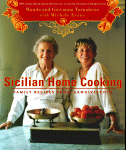
Wanda and Giovanna Tornabene with Michele Evans
Copyright 2001 by Wanda and Giovanna Tornabene with Michele Evans. Excerpted by
permission of Knopf,
a division of Random House LLC. All rights reserved. No part of this excerpt
may be reproduced or reprinted without permission in writing from the publisher.
|
|
|
|
|
|
|
|
|