Cucina Siciliana della Casa
(Appetites in the Third Millennium
and Sicilian Home Cooking)
When our editor, Peter Gethers, proposed that we write another cookbook, Giovanna and I were, of course, thrilled. Our first book, La Cucina Siciliana di Gangivecchio, remains, in my mind, a glorious fantasy, even though I see and touch it, as my talisman, every day. The fantasy continued when we traveled across America, promoting our book, appearing on television for cooking demonstrations, giving radio and newspaper interviews, and, eventually, even winning a big culinary award. Giovanna will tell you in her introduction how dramatically the publication of that book affected our lives.
Although we included more than two hundred of our treasured classic Sicilian recipes in our first book, we had to leave out many other recipes due to lack of space. La Cucina contained personal stories of our past experiences and information about specific foods indigenous to Sicily, as well as a detailed history of the abbey and the Tornabene family. You can examine Gangivecchio's historical chronology, dating from 1299, on pages xiÐxiii. (A full account of our history, along with more delicious recipes, is included in La Cucina Siciliana di Gangivecchio.)
In this new book, there are more personal and gastronomical stories as well as revelations about some of Sicily's great foods, like cardoons, nuts, and blood oranges. But once again the real focus is on our recipes, the food we know and love best: our own robust Sicilian home cooking. The dishes we eat at home are primarily hearty soups, the freshest vegetables, and simple, tasty egg dishes. And pasta, topped with a variety of fragrant sauces, has always reigned as queen in our home. But we also include delicious antipasti, risottos, main courses of meat and fish and seafood, and more recipes in my favorite food category, Sicilian desserts.
Giovanna insisted that we devote a chapter to cuscus (couscous), the unique, aromatic Arabian dish she so admires. Cuscus is served throughout the western part of Sicily, in the Trapani region--from there, the Tunisian coast is only ninety miles away. A Tunisian friend, Angela De Santis, who has lived in Sicily most of her adult life, spent a day at Gangivecchio teaching us the authentic method for making cuscus. When she was done, twelve of us devoured the delicious result of her lesson.
Giovanna is also responsible for the chapter on pizza and focacce--wonderful Sicilian versions of these savory flatbreads. After cooking a multicourse luncheon feast for a hundred people in the abbey's restaurant on a Sunday, nothing is more satisfying to me than eating a simple, scrumptious pizza that Giovanna prepares for me that night at home. She knows my favorite toppings: tomatoes, mozzarella cheese, and chopped anchovies with an explosion of fresh basil.
To better appreciate our lives and our cooking (often, the two cannot be separated), some background of our culinary heritage might be helpful.
Our home, Gangivecchio, is an old Benedectine abbey, built in 1363. After three centuries it became privately owned property. It was occupied first by the Bongiornos, then, in 1856, by the Tornabene family. Giovanna, my daughter, Paolo, my son, and I are the last Tornabenes (at least, so far--I still hold out hope, but my children tell me that I would be the oldest granny in the world).
In 1978, during a financial crisis, I opened a restaurant in the west wing of the abbey, trying to scrape up enough income to save Gangivecchio and the rest of our 140-acre property. The success of the restaurant made that possible. In 1992, Paolo built and opened a small nine-room inn, which we call Tenuta Gangivecchio, with his own restaurant. He too has become a formidable presence in front of the stove. We were blessed that his albergo and restaurant were prosperous too.
To be honest, when I first came here, more than fifty years ago, the culinary art was not bubbling in my veins. Born and raised in Palermo, I knew little of the remote Sicilian countryside, and apart from a healthy appetite, absolutely nothing about cooking. My secret aspiration was to become an actress. I am what people call a cook by fate--a very happy fate, I must add. You see, I happened to fall in love with a man--the only child of a wonderful cook--who lived in an immense, ancient place, surrounded by all the genuine foods of the earth. It was only natural for me to awaken from my childish dream and surrender to such a wondrous fate.
I was also most fortunate to be welcomed into Gangivecchio's kitchen and taught how to cook by my generous, patient mother-in-law, Giovanna (my daughter's namesake), who was a highly skilled cook. She gave confidence to a willing student, convincing me that I showed promise.
Giovanna and Enzo, my husband, are no longer with us, but they remain with me always. Looking at their faces in picture frames, I hear their voices, their suggestions, and receive their endless amore ogni giorno (love each day).
Since the opening of the restaurant, Giovanna has been at my side. She is my guardian angel, my assistant and pupil (and she cooks very well, nowadays). She is the amazing English translator and chief administrator of our restaurant at Gangivecchio. Without her there would be no cookbooks.
Many changes are happening in Sicily and Gangivecchio. For some time I have witnessed the world I know vanishing around me. Anna Mazzola, our superb cheese maker, retired. Many dear old friends have died. Hundreds of people have left the countryside and moved to cities for better opportunities. Few youth of today are interested in dedicating their lives to the cultivation of the earth. Instead, if they stay, they open a big business, like a gelato factory, such as the one near us in Gangi. Our best staff member, Peppe, though he is nearing seventy, is still busy with me in the kitchen. He recently decided to revive our home garden, with his beloved peppers and tomatoes, and is now fighting with Mario, another worker, about who is more skilled in this area. We once had an enormous, flourishing home garden, but with Peppe in the kitchen we didn't have anyone to do the garden work. For too many years, the only garden at Gangivecchio was the small one behind Paolo's inn. It still supplies him with fresh vegetables and herbs--tomatoes, eggplants, peppers, green beans, zucchini and their bright orange blossoms, arugula, lettuces, basil, sage, oregano, thyme, and mint. Paolo is quite proud of his garden, but he is happy Peppe has replanted a sizable garden for me. I suspect Paolo pays visits to my garden when his own vegetables are finished.
Of course, it is very reassuring that we will always have great bushes of rosemary, and meters and meters of bay laurel hedges that are covered with thousands of fragrant leaves. (Giovanna makes an incredibly good bay laurel leaf liqueur; see page 224.) Our fruit trees continue to provide us with luscious cherries, figs, and pears, and our nut trees give us all the pine nuts, hazelnuts, and almonds that we could ever possibly use. We even have pure water from a natural spring. We are quite blessed to have this wealth of natural resources.
But in the midst of our bountiful, idyllic country home environment, other astonishing changes are sneaking into our lives.
At Gangivecchio, on an early-December day in 1999, a young man arrived from the telephone company, lugging the tools of his trade. He was there to install an additional phone line in the walls of our fourteenth-century home, this one providing an additional Internet connection. As he drilled and hammered, I sat in a nearby room at my old walnut table, my old pen held in my seventy-two-year-old hand, a plain pad of paper in front of me. I wasn't composing a food shopping and errand list for the day, as is my morning habit, but was beginning my introduction for this book. The top page of the pad remained blank, because at that particular moment I could concentrate on nothing but an enveloping and threatening feeling of becoming obsolete. Fortunately, this thought stayed in my mind only briefly. I then decided it was not a question of becoming obsolete, but of my two crazy children's desire to be so up-to-date.
I am unable to share my children's enthusiasm for technology. I view this sorcery as some unauthorized, invisible surgeon snipping away at my orderly, sensible, and perfectly contented life. Yes, yes, I know e-mails and faxes are invaluable for people wanting to make reservations for dinner at our abbey and for rooms at my son's albergo, and these diabolical machines have enabled Giovanna and Michele, our coauthor, to communicate almost instantly for work on our books. But as the phone man continued to work, I didn't care about any of that. I reminisced about the hand-written recipes in the old black exercise book that had been lovingly assembled and patiently written by my mother-in-law, Giovanna, and her mother-in-law, Giulia. My own recipes fill that book's last pages. These frail sheets of paper seemed to me a mystical communication. Unlike the words typed on a computer, these precious pages showed the importance of faithfully preserving our past, at least in terms of our cuisine.
Startling me from my thoughts, the telephone man announced that he would soon complete his work. Then he commented, "That delicious aroma smells just like my grandmother's tomato sauce." A big pot of fresh salsa di pomodoro was indeed simmering on the stove in the kitchen and this starving man gobbled up two big plates of spaghetti before he left. He said the sauce was even better than his granny's--but he wouldn't tell her that. Then he rushed off to install more Internet lines.
It wasn't long before the phone rang. It was Paolo, who announced, "Mamma, sixteen unexpected guests are coming for lunch. Can you give me two liters of your tomato sauce?"
"Ah, so I am not obsolete," I told him. "Are you not fortunate that I am still alive?"
"Mamma, what are you talking about? Are you ill? Allora, Mamma, at least don't die until after the New Year's celebration. You must make your wonderful desserts for that dinner. Forty people are coming! Mamma? Do you have the salsa di pomodoro?"
I repeat this short conversation because it lightened my dark mood, and also because it proved two things to me: first, the uninvited technical world is here to stay, but second, the telephone man, my son, his many guests, and everyone else in the world will still be hungry in the third millennium.
With a new peace of mind, I returned to fulfilling our goal: to write a book dedicated to the flavors and perfumes of authentic Sicilian home cooking. These are the dishes that have evolved throughout our history, an extraordinary combination of the foods introduced by our conquerors, from the Greeks, Romans, and Arabs to the French and Spanish. We Sicilians add our preferences and touches, naturally. A few recipes in this book are from the harvest of the gardens of my modern son's and daughter's minds.
My attitude has changed entirely from the time we began our first book, when I was so reluctant to part with any of our secret family recipes. As I come to the end of this introduction, I can now say what perhaps should have been the opening sentence: "Questa volta ho iniziato un nuovo libro con il proposito di dividere il suo contenuto con altri e mi sorprende di farlo con immenso piacere. [I begin this new book with the purpose of sharing its contents with others, and I'm surprised I'm doing this with so much pleasure.]"
I have been a very lucky woman, because somehow I have been able to transfer my genuine love of cooking and my passionate love and dedication to Gangivecchio on to my children. After all, they have shared in all Gangivecchio's hardships and glories, and it has been their home since birth. Someday it will be theirs to protect.
My children are my greatest gifts, my future. They are my critics, but also my strength and enthusiasm. I believe that human beings, like plants and trees, can only thrive with good roots, loving care, and nourishment. And like most strong plants and trees, they can survive the storms.
To know and be close to your family, nothing is more important than dining together at home, as often as possible, on delicious home cooking.
It gives me great pleasure to imagine people sitting at tables in their American homes with their families and friends, conversing and laughing, while dining on the Sicilian dishes from within these pages. Salute!
--Wanda Tornabene
Incontri Incantevoli
e Vita con Mia Madre
(Enchanting Encounters and
Life with My Mother)
Historians have said that we Sicilians sopravviviamo brillantemente (are brilliant at surviving), that when faced with adversity, we thrive. We say, "Non abbiamo altra scelta che arrangiarci. [We have no choice but to be resourceful.]" At least, that has always been my mother's philosophy.
Mamma saved us from losing Gangivecchio by opening the restaurant back in 1978. Almost twenty years later, when our first cookbook, La Cucina Siciliana di Gangivecchio, was published, in December of 1996, we were once again in economic trouble--both personally and nationally. There have been more leaders of government in Italy than pasta shapes. We wonder if someone will ever take over who finally can get the country's finances right. Anyway, taxes were then and are still exorbitant, like the cost of telephones, electricity, and petrol for cars. In 1996, people were still coming to our restaurant, but our bookkeeping figures revealed a marked decline in guests. Paying more attention to their lire, Sicilians were going out less and eating at home much, much more.
So it was with this worry on our minds, and mixed feelings of agrodolce (sweet and sour, like some of our favorite Sicilian dishes), that Mamma and I left for New York to begin an exciting new adventure--something called a "national book tour." We'd been warned that it would be very tiring, but to Mamma and me, it turned out to be a fascinating holiday.
When we arrived in New York, as always, we had to pass through the dreaded customs inspection--dreaded because hidden deep inside our suitcases, we always bring fresh foods with us for cooking demonstrations--fresh cheeses, Gangivecchio's fresh rosemary and bay leaves, pasta frolla (prepared cake dough), lard, and many other prohibited foods. A stern-faced examiner called us forward and asked Mamma (with me as interpreter), "Why are you visiting America? Business or pleasure? You marked both on your form."
"Because it is both business and pleasure," Mamma replied, smiling at the man. "We are here to promote the Sicilian cookbook we have written." Mamma proceeded to produce a copy of our book from the briefcase she had bought for the sole purpose of holding our printed treasure. (She carries the book everywhere she goes, even to the butcher.)
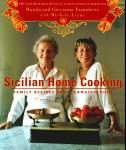
Mamma told me to show the man that it was us pictured on the book's cover. After congratulating us, he told us that his mother was half Italian, as her father was from Naples. He made a big check on our form, and we were free to go. Mamma's diversional tactic had worked. Relieved that the danger was over, we were thrilled to be in America again.
We traveled like a sirocco across America, flying in and out of each city in two or three days. In New York, Los Angeles, San Francisco, Chicago, and Boston, we talked to radio hosts about the recipes in our book and about our lives. Newspaper columnists interviewed us and took our pictures. We cooked our dishes on television after makeup artists and hairdressers made us look like movie stars. We met enchanting, welcoming people everywhere. Alice Waters, in her restaurant, Chez Panisse, in Berkeley, California, and Nancy Silverton and Mark Peel at their restaurant Campanile, in Los Angeles, held special dinners for their clients featuring menus from our cookbook. Mamma and I were amazed and touched by their generosity.
We returned to New York at the end of the terrific journey to celebrate with Michele, Peter, and Amy Scheibe, our Knopf publishing family, and other old and new friends. Then the party came to an end, and it was back to reality again: two Sicilian women trying to be sopravviviamo brillantemente.
But our new reality turned out to be a surprise. Not only did Americans buy our book, they began coming to Sicily, traveling the long distance to the Madonie Mountains to stay at Tenuta Gangivecchio and to meet and dine with us. Some stayed for a day, some up to a week.
On May 5th, 1997, we returned to New York to attend the James Beard Foundation awards dinner in the huge ballroom at the Marriott Marquis on Broadway in Manhattan. Incredibly, our book had been nominated for the best Italian book of the year award. Of course, Michele joined us from St. Thomas. Honestly, none of us expected to win. But we very much wanted to experience this important ceremony. More than a thousand distinguished food writers, chefs, restaurateurs, publishers, and editors were to attend.
When it was time for our category, we held hands. The presenter began slowly announcing the winner syllable by syllable:
"La Cucina Siciliana di . . ."
Before he could finish the title, we jumped up, screaming with glee. On the stage, long purple ribbons with large medallions were placed over our heads. Mamma threw kisses to the audience, repeating over and over again "Grazie! Grazie! Grazie!" I was in such shock I don't even remember what Michele or I said.
What happened in the coming months was nothing less than a miracle, like winning the award had been. There was an American invasion. More and more Americans were faxing for reservations. When Mamma opened the restaurant, in 1978, she saved our home the first time; nearly twenty years later, our cookbook and the award were saving Gangivecchio again.
Paolo's nine-room inn soon was booked for months in advance. Mamma decided to refurbish a stone cottage on the property so we would have more space for guests. Tour groups from America and Europe began booking the entire albergo and the cottage for several weeks at a time in both the spring and the fall. And they booked on a yearly basis! It was fantastic to be balancing the books again.
But success can also be a battle. It took quite some time, plus extra help, and hard work, to settle in to this hectic new schedule. Not only were we running our restaurant in the abbey, we were helping Paolo cook two meals a day in his albergo. For the pleasure of the large groups, we organized old-fashioned schittichiate (picnics) on a nearby mountaintop. And we also gave cooking classes!
I worried that writing another book in the midst of all this extra work would be difficult, but Mamma insisted: "Certo [of course] we can do this. I have enough space in my briefcase for another book."
Life with my mother reminds me of how Sicilians respond to a red traffic light: it's merely a suggestion. "Run through the red lights of life" is her philosophy: "Vai! Vai! [Go ahead! go ahead!]" is what she likes to instruct me to do while I'm driving. When we appeared on TV, the directors in America told Mamma, "When the red light on the camera goes on, that's the signal. It means Now! Then you're on!" My mother liked the sound of that. Today when we approach a red stoplight in Palermo, she yells, "Now! Now!"
Living and working with someone with such a strong personality, being at her beck and call twenty-four hours a day--especially if that someone is your mother--can be exasperating. Fortunately, our common goal and mutual commitment have been the glue of our relationship. It helps that we are also each other's best friend. And it helps even more that we somehow manage to find humor in the worst possible crises. And time has taught me, my brother Paolo, and Peppe and our other workers how to survive and still admire and love the perilous boss of our lives: that incredible person named Wanda.
At least the kitchen is no longer our personal battleground. My sauces are almost perfect, my eggs and puddings turn out well. From my mother's cooking instructions over the years I have also learned many useful lessons of life: never surrender to a difficult mayonnaise or the tax collector.
Now that the success of our albergo and restaurants makes it possible for beloved Gangivecchio to remain securely in our future (we hope and pray, at least, since one can never predict life), we can mentally and physically adjust to our new work rhythm. We can also take even more pride and pleasure in this ancient place that was my father's splendid gift to us.
This book, like our first, is an invitation to all those wanting to enter Gangivecchio's Sicilian kitchen and dining rooms. Be sure to bring along your appetites, because we invite you to taste the genuine flavors of our island's traditional dishes. You can listen to our stories and breathe in some of the scents of the Sicilian countryside. The protagonists of this book are the recipes, and there are more than 175 of them. We hope you will enjoy our dishes at your own table, remembering that they come from two Sicilian women with a passion for home.
--Giovanna Tornabene