|
|
 |
|
|
|
 |
 |
 |
|
AAK: What is your earliest memory?
OS:
My earliest memory is of my father reading. I
would see him in his study, intent on his book, with
a little smile sometimes hovering on his face. This
gave me a sense of the wonder of books and incited
me to read very early myself.
AAK: What role
did your family, particularly your parents and your
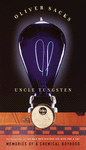
uncle Tungsten, play in the development of your
scientific curiosity?
OS: I was
always asking questions. Why is the sky blue? What
is lightning? What makes the sun shine? And though I
tried their patience, my parents always struggled to
give me real answers, or to refer me to my
"science" uncle, Uncle Tungsten. Uncle
Tungsten had a laboratory in his light-bulb factory,
and he introduced me to chemical experiments and
showed me that these were a way of asking questions
directly of Nature.
AAK: You were sent to
boarding school when you were six years old. What
were the conditions precipitating this decision, and
what effects did the boarding school years have on
you?
OS: I was one of nearly four
million children in England who were sent away from
their homes at the beginning of the Second World
War. This evacuation from London and other major
cities was ordered by the government, with the
thought that Britain's children, at least, might be
protected from the expected bombings. This worked
out well for some children, but being sent to
boarding school at the age of six was traumatic for
me (like many others), because of the long
separation from my parents and the somewhat abusive
atmosphere in the school.
AAK: You write of
the passions, even the obsessions, of your young
mind. Is there one particular passion that stands
out in its intensity or
strangeness?
OS: I was crazy about
numbers, especially prime numbers. I spent thousands
of hours exploring, multiplying and dividing, and
factoring numbers, looking for patterns and special
relationships, suspecting these might have some
mysterious significance, might be somehow a key to
the universe. "God thinks in numbers," a
favorite aunt used to say.
AAK: Some of the
chemicals in your experiments were highly volatile.
Did you have any spectacular
accidents?
OS: Things were always
blowing up or boiling over. The most frightening was
when some lithium caught fire and burned down a
corner of my laboratory before I had it under
control. Once I filled the house with vile-smelling
and very poisonous hydrogen selenide, and once there
was an explosion of hydrogen that blew off my
brother's eyebrows. But, luckily, neither I nor
anyone else was really hurt.
AAK: Who were
your boyhood heroes? Are they still your
heroes?
OS: My boyhood heroes were
almost all chemists or physicists. Humphry Davy, the
famous nineteenth-century chemist, was very special
to me because he seemed so boyish himself. I
repeated a lot of his experiments: getting metallic
sodium and potassium by electrolysis, trying to make
fluorine, burning a small diamond of my mother's
with a magnifying glass (she was not pleased),
electroplating objects around the house, trying to
imagine, to feel, his excitement when he first did
these things.
Marie Curie was another
hero, partly because my mother had met her, partly
because I read Eve Curie's biography of her mother
when I was 10 or 11—this was the first
biography of a scientist I ever read.
Another hero was Glenn Seaborg, and it was a
great delight actually meeting him in 1997 (as it
was to meet Eve Curie the following year). These are
still heroes for me, the more so as I am now much
more conscious of their being human, having their
fill of human impulses and failings and problems and
yet achieving so much.
AAK: It seems that
your knowledge could have led you to practice in
almost any scientific field. Why did you decide to
pursue neurology?
OS: I came to
medicine and neurology slowly and almost
reluctantly, for I had thought of being a chemist, a
marine biologist, a physiologist (and a few other
things) on the way. But finally the business of
being a physician, as both my parents were, and
curiosity about the most mysterious and yet intimate
things in the world—thinking, feeling, memory,
consciousness—drew me, perhaps ineluctably, to
the study of the human brain.
|
|
|
|
|
|
|
|
|