|
|
 |
|
|
|
 |
|
 |
|
Sri-Lanka native Michael Ondaatje's work is a stunning
fusion of jazz rhythms, film montage technique, and profoundly beautiful
language. Although he is best known as a novelist, Ondaatje's work also
encompasses memoir, poetry, and film, and reveals a passion for defying
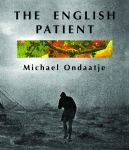
conventional form. In his landmark novel, The English Patient --
later made into the Academy Award-winning film -- he explores the history
of people history does not explore, intersecting four diverse lives at the
end of World War II. Ondaatje is himself an interesting intersection of
cultures. Born in the former Ceylon of Dutch/Indian ancestry, he was raised
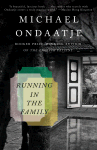
in London, and is now a Canadian citizen. From the memoir of his childhood,
Running in the Family, to his Governor-General's award-winning book
of poetry, There's a Trick With a Knife I'm Learning To Do, to his
classic novel, The English Patient, Michael Ondaatje casts a spell
over his readers. And having won the British Commonwealth's highest honor
- the Booker Prize - Ondaatje has taken his rightful place as a contemporary
literary master.
"Writing poetry and fiction, momentarily clutching his Asian heritage
then spinning it off like a jitterbug partner, Ondaatje and his imagination
can leap continents in a single paragraph."
-- Voice Literary Supplement
"Mr. Ondaatje is one of North America's finest novelists . . ."
-- The Wall Street Journal
Michael Ondaatje was awarded the Booker Prize in 1992. He taught for
many years at York University in Toronto, Canada. He is the author of
ten collections of poetry including Handwriting (1999) and four books
of fiction: The English Patient, In the Skin of the Lion,
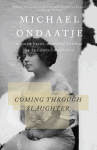
Coming Through Slaughter and Anil's Ghost.
He and his wife, Linda Spalding, live in Toronto and edit the literary
journal, Brick.
|
|
|
|
|

|
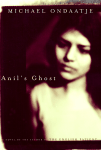
With his first novel since the internationally acclaimed The English Patient, Booker Prize—winning author Michael Ondaatje gives us a work displaying all the richness of imagery and language and the piercing emotional truth that we have come to know as the hallmarks of his writing.
Anil’s Ghost transports us to Sri Lanka, a country steeped in centuries of tradition, now forced into the late twentieth century by the ravages of civil war. Into this maelstrom steps Anil Tissera, a young woman born in Sri Lanka, educated in England and America, who returns to her homeland as a forensic anthropologist sent by an international human rights group to discover the source of the organized campaigns of murder engulfing the island. What follows is a story about love, about family, about identity, about the unknown enemy, about the quest to unlock the hidden past–a story propelled by a riveting mystery. Unfolding against the deeply evocative background of Sri Lanka’s landscape and ancient civilization, Anil’s Ghost is a literary spellbinder–Michael Ondaatje’s most powerful novel yet.
“It is Ondaatje's extraordinary achievement to use magic in order to make the blood of his own country real.”–The New York Times Book Review
|
|
|

|
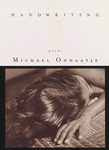
Handwriting is Michael Ondaatje's first new book of poetry since The Cinnamon Peeler. It is a collection of exquisitely crafted poems of delicacy and power--poems about love, landscape, and the sweep of history set in the poet's first home, Sri Lanka. The falling away of culture is juxtaposed with an individual's sense of loss, grief, and remembrance, as Ondaatje weaves a rich tapestry of images--the unburial of stone Buddhas, a family of stilt-walkers crossing a field, the pattern of teeth marks on skin drawn by a monk from memory.
And, like the poets who "wrote their stories on rock and leaf / to celebrate the work of the day, / the shadow pleasures of the night," in these poems Ondaatje writes of desire and longing, the curve of a bridge against a woman's foot, the figure of a man walking through a rainstorm to a tryst. Handwriting is a poetic achievement by a writer at the height of his creative powers. In it, we are reminded once again of Michael Ondaatje's unique artistry with language and of his stature as one of the finest poets writing today.
"Tumultuous, vibrant, tragic and over too soon." --Newsday
"Richly sensual images.... [Ondaatje] contracts the narrative to a few concrete images, giving his verse a mysterious reticence." --The New York Times Book Review
"Poems that are virtual hybrids of the contemporary and the ancient." --Boston Book Review
"Smooth poetic lines.... Another finely polished Ondaatje gem." -- Time Out-New York
"Extremely beautiful." --Robert Hass, The Washington Post
|
|
|
|
|
|