|
|
 |
|
|
|
 |
 |
 |
|
AAK: Why is the difficulty of maintaining a good
marriage a recurring theme in your
work?
SM: Chekhov said it: for a
good story, all you need is he and she -- a man and
a woman. I think that's true; and I think marriage
is inherently fascinating and mysterious. Why do
some, often the seeming unlikeliest, work, while
others which perhaps look dreamy from the outside,
not work? Clearly too, marriage is a changing
institution in our culture, one which we continue to
struggle to have, but which has become more
difficult for more people, as statistics tell us.
All this makes the problem a rich one, fictionally,
and an important one culturally.
AAK:
Appearance versus reality in relationships is
another major theme in your fiction. How well do you
think we can ever know the people we
love?
SM: I think the more apt
question might be how well we can even know
ourselves. We live in a self-conscious age, but one
which, perversely, makes self-knowledge more
tenuous. We understand all too well the mixed
motive, even our own, the denied feeling, the
only-much-later-realized emotional reality of some
situations.
AAK: Where did you get the idea
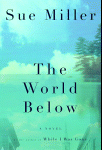
for The World Below? What inspired you to
weave together the lives of two women from different
generations?
SM: I'm never sure
exactly where my fictional ideas come from, but
somewhere at the heart of this one was the notion of
EXILE -- the sense we have (I think we may all have)
that there was another world somewhere, another
place, another time, inaccessible to us now, in
which things were clearer, simpler, better, safer.
I wanted to explore that feeling, and these two
women's lives seemed a good way to do
that.
AAK: Do you think that this belief in
a safer, better past is the reason it seems
especially shocking to learn that grandparents (e.g.
Georgia, in The World Below) are capable of
having secrets and hurting each
other?
SM: I think Cath’s
learning about her grandparents’ lives helps
her face living her own; helps her understand
something about what is the same, always, about the
human condition -- its fundamental solitariness, its
constant yearning for what is lost.
AAK: In
an interview you once said, "You don't change
anything by changing your life dramatically.
There's the sense that you haul it all along with
you. You're accountable finally for your life....
In my work, people pay for things." What do you
mean by this? How does this apply to The World
Below?
SM: I think by this I
mean something about the persistence of CHARACTER.
This is something you can explain in many different
ways -- genetics, the psychological scars we bear
simply from growing up. In any case, something
permanent about our way of being in the world that
we can perhaps tinker with a bit, but not radically
alter after a certain age without losing a great
deal. This is a notion which would have been
familiar to Georgia; but which Cath is less certain
of, at least initially.
AAK: Both Chicago,
where you were raised, and Boston, where you now
live, figure in this novel. Are other parts of your
life woven into the book?
SM: All
the places in my life are in this book -- Maine,
Vermont, San Francisco, Boston. But everything is
changed. The Vermont house, for example, is closely
modeled on a house I lived in and loved in Westport
Massachusetts. The San Francisco house, which I've
never been in, belonged to a strange
"outsider" architectural artist named
Achilles Rizzoli, whose work I love. Similarly,
there are characters I've used, but in parallel
ways, made my own.
AAK: Why did you decide
to set a key part of the novel in a sanatorium for
people with TB? What did that location offer you as
a writer?
SM: Basically it seemed
to me it would feel like the experience of being
exiled to the grandmother -- to Georgia. And of
course, the culture of the sanatorium itself is
fascinating. But in addition, it offered a world so
isolated from the normal universe of its inhabitants
that extraordinary things could happen there -- and
did. Another fictional opportunity.
AAK:
Did you do any research about TB for the book? Why
did you choose to focus on that illness versus
others?
SM: I did a lot of
research about TB, from reading patient newsletters
I found on the internet, to reading books about the
disease itself, and then also about the social
implications and understanding of the disease. I
read too a number of first-person narratives about
living in sans, most of them fascinating.
I
focused on TB in particular because it had such a
range of implications at just that time in history
-- because it was newly being understood as
infectious, and therefore as "dirty";
perhaps a little the way AIDS is now, but with the
special emphasis then being on it as an immigrant
disease, caused by filthy living; and because having
it put you (or could put you) in a quite unique
subculture, where the rules were different, and the
feeling of isolation was intense. This all seemed
rich material psychologically, especially for such a
sunny, competent type as Georgia.
AAK:
According to the latest census, less than 25 percent
of the U.S. population lives in what is known as a
“nuclear family,” many fewer people than
did two generations ago. As a chronicler of the
American family, how has your fiction reflected this
change?
SM: I think this change has
been at the center of all my fiction, from my first
published short story, which concerned a single
parent, having sex with someone she doesn't know
well down the hall from her sleeping child; to
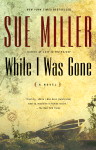
While I Was Gone, my last novel, in which the
main character has a whole previous life in which an
early, young marriage plays a part.
My first
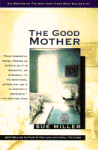
novel, The Good Mother, looked directly at
the changes happening in the American family. Anna,
the protagonist, had grown up in an extended family
controlled by its connections, by the sense all the
members had of their visibility to each other. By
their lights, she has failed, failed dramatically,
with the loss of her marriage. And she feels
she’s failed, while she also feels set free a
bit, set free to discover who she truly is without
that encircling set of relations. Family
Pictures and For Love also have
characters who are part of this sea change in the
way we live our lives; and I look carefully, I
think, at both what’s lost and what’s
gained when these things change.
The World
Below is expressly concerned with this; with the
difference between Cath's life -- twice-divorced,
living on the other side of the continent from where
she grew up, her children scattered all over -- and
Georgia’s life. Georgia, whose biggest move
geographically was from Maine to Vermont, who loved
the same man all her married life. What I'm trying
to look at is what is truly different, and then too,
what is not. What, humanly, feels the same though so
much has changed in how we live, in how we structure
our lives.
AAK: What was it like to have
your novel While I Was Gone selected for
Oprah's Book Club? Did your life change as a
result?
SM: My life hasn't been
changed by the experience, in part because my
writing career started with such a big bang. The
big change happened then. But I was delighted to
reach the entirely new group of readers being chosen
by Oprah's Book Club made accessible to me -- and
amazed by the size of that group.
AAK: In
the past, you've written short stories as well as
novels. Would you go back to writing
stories?
SM: I've got one story
sitting around which needs some major surgery -- the
equivalent, I think, of a heart-lung transplant. But
the size and expansiveness of the novel is very
seductive. Almost every time I have what I think is
a short story idea, when I start to make notes, it
complicates itself, it grows, it gets thicker and
richer, and I find I'm launched once again into a
novel. So I would go back, but it almost seems I
can't.
AAK: Do you have any novels
currently in movie production? What is it like to
watch your own novel made into a film, as happened
with The Good Mother?
SM: I
have one novel which may become a television
miniseries, if the gods of such things do not get
pissed off at me. It seems to me the job of the
writer when a book is taken to be translated into
film -- whatever form of film -- is to take the
money and use it to write another book. And hope
that the film inspires a few new people to try the
book from which it was made.
AAK: What are
you working on now?
SM: I'm
finishing -- I hope -- a memoir, long in the works,
about my father's death from Alzheimer's
disease.
|
|
|
|
|
|
|
|
|