|
|
 |
|
|
|
 |
 |
 |
|
AAK: Why did you write this
book?
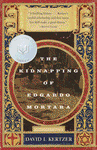
DK: In 1997 I published a
book, The Kidnapping of Edgardo Mortara, the story
of a small Jewish boy who, in 1858, was forcibly
taken from his parents on orders of the Inquisitor
of Bologna and sent to a Catholic institution in
Rome. The Church still had police powers in parts of
Italy and the Inquisitor had been told that the
family's Catholic maid had secretly baptized the
boy. So my interest in how the Church treated the
Jews goes back a way. But it was two events in
early 1998 that led me to want to write this new
book. A Vatican Commission, charged by the Pope
with determining whether the Church bore any
responsibility for the rise of modern anti-Semitism
and for the Holocaust, reported that the Catholic
Church had played no role whatsoever. At the same
time, the Vatican announced that scholars would, for
the first time, be allowed into the archives of the
central office of the Inquisition. From what I knew
about the history of Vatican relations with the
Jews, I was skeptical about the Commission's report,
and found the prospect of working in the long-sealed
Inquisition archives too exciting a possibility to
pass up.
AAK: What is its main premise?
DK: While anti-Semitism has an
ancient history, the development of modern
anti-Semitism, of the sort that would make the
Holocaust possible, arose only in the late
nineteenth century. The Vatican maintains that
modern anti-Semitism did not grow out of the long
history of Christian anti-Judaism, but from new
nationalist movements that arose in Europe in the
nineteenth century. What I show in the book, based
largely on documents found in the Vatican archives,
is that the Vatican was very much involved in the
development of modern anti-Semitism. I also show
that the distinction made by the Vatican today
between religious anti-Judaism, which the Church
acknowledges to have marked its past, and
social-economic-political anti-Semitism, which it
claims not to have embraced, is not tenable. The
Vatican championed a view of the Jews as sinister
enemies of the state and of the people, and, well
into the twentieth century, called for keeping them
quarantined from healthy Christian
society.
AAK: Are you arguing that the
Catholic Church is responsible for the
Holocaust?
DK: I argue that the
Catholic Church shares responsibility for making the
Holocaust possible. This of course is not to argue
that the Holocaust was the outcome of Catholic
Church action alone, an assertion that would be
ridiculous. First of all, the Christian roots of
anti-Semitism go back centuries, and affected
Protestantism as well as Catholicism. Germany in
fact had a Protestant majority, though a very large
Catholic minority. Moreover, Nazism, as a secular
religion, was no friend of Catholicism. But if we
look at what happened in Germany, Austria, Poland,
France, Italy, and other countries during the
Holocaust, I think we can only make sense of it by
understanding how the Catholic Church, along with
other Christian churches, encouraged people to view
the Jews.
AAK: So what is the Catholic
Church guilty of?
DK: The
Catholic Church promulgated the view, into the
twentieth century, that the good people of Europe
were endangered by the presence of the Jews. Into
the twentieth century, the Vatican spread the belief
that Jews were required by their religion to torture
and murder Christian children to use their blood for
their Passover matzah. The Vatican was involved,
secretly, in building Europe's most important
anti-Semitic political party -- the Austrian Social
Christian party -- at the turn of the twentieth
century. When Mussolini announced the racial laws
in 1938, throwing Jewish children out of public
schools, throwing their parents out of their state
jobs, stripping Jews of membership in professional
societies, the Pope voiced no objection to any of
these measures. Indeed, the Vatican indicated that
they were in harmony with Church policy. The list
could go on....
AAK: Is the Catholic Church
today still perpetuating Jewish stereotypes, even if
in subtle ways?
DK: Unfortunately,
it took the Holocaust to lead the Church to
radically rethink its attitude toward the Jews.
With John XXIII and the Second Vatican Council, the
centuries-old vilification of the Jews was at last
rejected, the liturgy was altered to remove
offending elements, and catechism was changed to
remove references to Jews as killers of Christ. The
current pontiff, Pope John Paul II, has done a great
deal to improve Church relations with Jews, as
evidenced by his visit to the Rome synagogue and,
more recently, his visit to Israel. Yet the
Church's legacy does keep popping up, as is
inevitable. For example, I just returned from
Bologna, where I visited a newly restored church
right off the main piazza. Its beautiful oratorio
is dominated by a set of statuary depicting an
episode from the New Testament. A plaque helpfully
explains the scene. While mourners surround the
body of the Virgin Mary, who has just died, an evil
Jew has come to desecrate her corpse. Fortunately,
an angel appears and strikes down the Jew. Images
of this sort are still around in the churches of
Europe.
AAK: Leading up to the Holocaust,
were there any heroes in the Catholic Church, people
who defended the rights of
Jews?
DK: I show in my book that
there were always people in high positions of the
Church who sought more humane treatment of the Jews.
For example, when the Pope was restored to power
over the Papal States in 1814, following Napoleon's
defeat, the Vatican faced the question of whether to
make the Jews go back into the ghettoes. Napoleon
had, of course, freed them years earlier. Cardinal
Consalvi, the Vatican Secretary of State,
passionately pleaded with Pope Pius VII not to
reestablish the ghettoes. Yet, he argued in vain.
Or, to give another example, at the turn of the
twentieth century, the Archbishop in charge of the
British Catholic Church pleaded with Pope Leo XIII
to end the Vatican campaign that branded the Jews as
sadistic murderers of Christian children. The Pope
referred the matter to the cardinals of the
Inquisition, who rejected the Archbishop's plea,
writing in a private note that the archbishop who
made the complaint had clearly become a
"dupe" of the Jews. Of course, as the
Holocaust itself got underway, there were bishops in
Germany and elsewhere who pleaded with Pope Pius XII
to take a firm public stand against the Nazi
slaughter of the Jews, and some of them paid with
their life. As we know, the Pope did not heed their
call. Of course, if we look at priests, nuns, and
Catholic laity, there were many thousands who risked
their lives to hide Jews.
AAK: Why did you
decide to focus on the Popes, rather than the
various levels of the Catholic hierarchy?
DK: Throughout the book I try to
get as close to the Popes as I can. There are a
number of reasons for this. Of course, given the
Pope's authority in the Church, knowing what the
popes wanted done and what they thought is
absolutely central to my task. But I was also
concerned to deal with a common defense found in the
Church. It goes something like this: yes, as in
any large organization you can find extremists in
the Church, people filled with hatred. But the
popes were always protectors of the Jews, and indeed
the Jews often turned to the popes just because of
their well-known generosity in dealing with them.
Fortunately, newly available Vatican archives
allowed me to find out just what the popes
themselves were doing as far as the Jews went. That
said, the book also looks at others in the Vatican
hierarchy, and shows their role in the rise of
modern anti-Semitism.
AAK: How did you
find such incriminating information about the Church
and its historic treatment of Jews?
DK: The Church deserves a great
deal of credit for making its archives open to
scholars. I have mentioned the central archives of
the Inquisition, which were opened only in 1998, but
the Vatican Secret Archives have been opened to
researchers much longer. The papal records dealing
with the formative period of modern anti-Semitism,
in the late nineteenth century, were opened for the
first time in 1979. At the moment, with minor
exceptions, no Vatican records after 1922 can be
consulted, so I had to turn to other sources in
dealing with the most recent period. Other
information is more publicly available. For
example, the two publications most closely tied to
the Vatican historically-- the Vatican's own daily
newspaper, L'Osservatore romano, and the Jesuit
bi-weekly, Civiltà Cattolica-- were both filled
with the most grotesque kinds of
anti-Semitism.
AAK: It's surprising you were
given access to the archives, given your history of
writing sometimes unflattering things about the
Church. How did you obtain
permission?
DK: Well, there are
actually several different Vatican archives, and
each one is a separate story. Perhaps of greatest
interest from this point of view is the archive of
the Inquisition. When Cardinal Ratzinger announced
that archive's opening, the New York Times asked me
to write an op ed about it, which I did. In order
to get permission to work there, I had to send in a
request directly to Cardinal Ratzinger, along with a
letter of recommendation. I asked my friend,
historian Carlo Ginzburg, to write for me, as in
announcing the opening of the archive to scholars,
the Cardinal had cited Ginzburg's request of 19
years earlier (the Church moves slowly!). There was
tremendous interest in the scholarly community in
what would be found in the Inquisition archives, yet
only twelve places for scholars had been provided
for. Just why my request was approved I can only
guess, but again I think it is a tribute to the
Church that it was granted.
AAK: Even though
you've studied interfaith relations extensively, did
any of the information you discovered in the
Archives shock you?
DK: I found
much that I had not known about the role played
behind the scenes by the Vatican in the growth of
modern anti-Semitism. I also found out things about
the earlier period I found shocking. For example, I
learned that in the first half of the nineteenth
century, when the Pope controlled Rome, Jewish women
and children were regularly seized by papal police
from their homes in the ghetto and locked in the
Church institution set up to convert the Jews.
While the women were free to go after forty days
confinement if they still refused to accept baptism,
their small children were baptized immediately. The
women were told they would never see their children
again if they refused to accept baptism themselves.
For the later period, I must say that what most
shocked me was the persistence of the Vatican
commitment to the charge of Jewish ritual murder
into the twentieth century. I still find this hard
to fathom.
AAK: Will the Catholic Church be
taken by surprise by what you found or is this
information already known at the Church's highest
levels?
DK: There is much in the
book that will be new even to high officials of the
Church today. But in answering your question we
should keep in mind that the Catholic Church is a
large and complex institution. While the Vatican's
official position is that the Church played no role
in the rise of modern anti-Semitism, there are many
good Catholics who know very well that this is
untrue. My book provides a great deal of previously
unknown evidence to show just how extensive the
Vatican's role in the development of modern
anti-Semitism was. In some circles of the Church it
will not be welcome reading.
AAK: How do
you think the current Pope will respond to this
book?
DK: I would like to flatter
myself by thinking that the Pope would read the
book, but of course that is unlikely. However, I
see myself as having embraced and responded to the
Pope's own call for a clear-eyed look into past
Church treatment of the Jews. The Pope has argued
that only by properly understanding this past can we
look forward to a brighter future, and I would like
to think that my book will play a significant role
in this process.
AAK: What can the Church do
to take full responsibility or to make restitution?
Is restitution even possible?
DK: I
am not a theologian, nor a moral philosopher, and I
am not especially interested in apologies, much less
restitution. What does bother me is the
misrepresentation of history and an unwillingness to
confront the past truthfully. Let me give a small
example. A couple of days before the beatification
of Pope Pius IX in September 2000, I did a live
national Italian radio debate with a monsignor from
the Vatican congregation for the promotion of
saints. In that debate, in response to the claim
that Pius IX was kindly disposed to the Jews, I
cited his remarks at an audience in 1871 in which he
referred to Rome's Jews as "dogs" who were
running barking through the streets, molesting the
good people of the city. The next day, at a Vatican
press conference, in response to a journalist's
question about my remarks, the Vatican official said
that no responsible historian would put any credence
in what I had said. When the journalist
subsequently contacted me about the quote, I
referred him to a volume titled "The Speeches
of Pio IX" published by the Vatican in 1872,
edited by a priest. In addition to giving him the
page number where the quote about the dogs was to be
found, I pointed out the page of the preface which
reported that the Pope himself had read and approved
the proofs of the book before publication. If there
were any apology I am interested in from the Vatican
at the moment, I guess it would be for what was said
about me at that press conference. But I'm not
holding my breath.
AAK: Why are you
interested in this subject? Is there personal
significance for you?
DK: As I
mention in the introduction to my book, when I was a
child my father was director of inter-religious
relations for the American Jewish Committee. It was
right after World War II, and he spent a great deal
of his time working with Catholic clergymen to
improve Church-Jewish relations. He had great
respect and affection for these Catholic colleagues,
and he was never so proud as when he received a
special medal from Rome honoring him for his efforts
to bring about Catholic-Jewish reconciliation. I
would like to think that, through a very different
path, I am in this book doing something to build on
my father's work.
AAK: Are you hopeful for
the future of Jewish-Catholic
relations?
DK: Yes, I am. If we
put things in a larger historical perspective, the
amount of progress made in recent years has been
tremendous. I do think, though, that until we can
all confront the truth about the past, a dark cloud
will remain.
|
|
|
|
|
|
|
|
|