|
|
 |
|
|
|
 |
 |
 |
|
AAK: What is your book about and what made you
decide to write it?
SK: My book is about a
peculiar malady of the vagina and how having it
affected my life. So it's about sex and how sex fits
into life. It's also about disease generally, and
what it's like to be ill. I didn't decide to write
it; I found myself writing it. I was involved in
such a confusing medical maze that I started taking
notes to try to keep things straight. One doctor
said one thing, one doctor said another, and I felt
I needed to document all of it--partly because I
couldn’t remember it. As I was doing that, I
realized it was funny, and wacky. So I kept writing
it.
AAK: So it was therapeutic to
write?
SK: Not exactly. I don't like that
notion that writing is therapeutic. Therapy is
therapeutic. Writing is writing. It was practical
to write it. I needed a chronology in order to give
each new doctor a proper history. And then it
became a sort of mystery novel. I admit, I got some
satisfaction from noting all the contradictory
theories and advice.
AAK: It’s so
direct and personal. Did you have any hesitation
about publishing it?
SK: I did , and I
still do! I know, for instance, that the book
raises questions about my current sex life--have I
got one, mainly--and I'm not eager to answer those
questions. But the general feeling these days seems
to be that I must. People assume that if you're
willing to say something about personal matters, you
must say everything. You're a bad sport if you
don't participate in total self-revelation. Girl,
Interrupted provoked this reaction too at times.
Why didn't I tell everything about my family? Since
this book is about even more intimate things, I
imagine the desire to know will be correspondingly
more intense--and as we all know, there really isn't
anything more interesting than somebody's sex
life.
AAK: So how is your sex
life?
SK: Next question. Well, that won't
do, I suppose. I've decided that sexual inactivity
is something that is worse to admit to than lack of
money. It's the new taboo. I don't have sex: Who's
willing to say that? Just about nobody. And yet, is
it that bad not to have sex? Did anyone die from not
having sex? It's not as bad as having no heat or no
food or no health insurance. But there's something
truly humiliating about it, isn't
there?
AAK: One of the doctors suggests that
your problem is simply part of menopause. Is he
right?
SK: The research I did indicates
No. Plenty of women in or approaching menopause
don't have this problem. And plenty of quite young
women do. It does not appear to be triggered by the
hormonal changes of menopause.
AAK: But many
women at the age of menopause do have problems with
lack of desire and with enjoying sex.
SK:
That may be, but their problems are not this
particular array of symptoms. Usually their
problems can be resolved or improved with hormonal
regimes, or even with yam powder or whatever that
stuff is. It's a different problem. But what do I
know? I'm not a doctor.
AAK: I want to
return, for a moment, to a previous question. Why
did you withhold information about your family in
Girl, Interrupted and why are you now
unwilling to answer the natural follow-up questions
about your current sexual functioning?
SK:
In my previous book, I felt the details of my own
family's behavior were beside the point. The book
wasn't a case history. It was more a travelogue
about the country of mental illness. In a sense,
this is a similar book, though it is, I admit, more
of a case history--my own case. But both books
describe how a certain sort of invisible awkward
functioning catapults you into another world, and
changes your relation to the everyday
world.
Sometimes I think people have
forgotten that memoirs are books. This isn't a CAT
scan of my emotional life, it's an artifact,
structured and arranged by me to provoke
certain emotions in you. I'm describing events in
the way I would like you to imagine them. I'm
manipulating you. That's called writing. You may or
may not enjoy the way I manipulate you. But I think
you shouldn't forget that I am doing so. Well,
perhaps if you get so caught up in the book--That's
the ultimate compliment, to forget the writer's
machinations.
AAK: What happens to women in
our society as they age and their sexuality slows or
becomes muted, if it does?
SK: Women in
American culture are simply sex objects. We don't
have a firm reason for existence if we're not
sexually attractive. This sounds overstated, but it
really isn't. You have only to look at the usual
suspects--advertising, movies, TV, etc.--to see that
it's true. The obsession with body-part improvement.
It's insane. Breast lift. Tummy rearrangement.
Someday people will look back and marvel at our
idiocies.
I'm not saying that a woman's
reason for existence is to be a sex object. It
isn't. It's men's reason for our existence. Doris
Lessing has a marvelous scene in a novel where a
woman in middle age is passing a construction site
where the guys are eating lunch and enjoying foot
traffic. She's preceded by a young, pretty woman, at
whom they whistle and call out admiring (or
insulting, depending on your political stance)
things. They haven't got anything to say to her, of
course. She goes around the corner and she
rearranges herself, she turns herself into a
"woman." She improves her posture and
fluffs up her hair and walks past them again with
the desire to be attractive. And they pay her the
compliment of whistling and admiring. Then she goes
past again, only this time she's back in her own,
middle-aged woman thoughts. And they ignore her
again. I remember reading this years ago and
knowing, absolutely, even though I was in my early
twenties at the time, that this was true. So women
have to deal with that. Whether our existence
really is our own or only relational--only activated
by male interest.
AAK: There's been much
openness about male sexuality lately, erectile
dysfunction and so forth, yet female sexuality has
remained somewhat taboo. Do you think your book will
change that?
SK: This is complicated. I
think one reason there's more discussion of male
sexuality lately is that there is now something to
DO about impotence. There's, plainly speaking,
money to be made from impotence, because there's a
pill for it. When there's a pill for a female
orgasm, we'll hear a lot more about female
sexuality. And I don't think there ever will be,
because female orgasm seems to be much more
complicated than male orgasm.
Plus, I think
the erect penis has a power over the human
imagination that nothing can compete with. It always
has, and it always will. It's an engineering and
physiological miracle.
But I don’t
really care about all that. I don't think it's a bad
thing that women's sexuality remains obscure,
veiled, medically opaque and conversationally taboo.
One of the only powers women have over men, now that
we seem to have lost the power to say No to sex, is
that men do not actually know if women are enjoying
themselves in bed. This is our secret. Our erotic
workings are hidden, and men have to rely on our
reports to a large extent. And our reports might be
false. This drives some men crazy, this idea that we
might be faking. And it's true. We might be. Women
have an unfortunate physiological capacity to engage
in sexual relations that are of little or no
interest to us. Men don't. They probably envy us.
I'm all for the secret quality of women's
erotic lives. Then I go writing this book,
undercutting my own argument. But actually, I don't
think my book tells all that much. So I don't think
my book will change the discussion.
AAK:
Continuing in that vein, descriptions of the erotic
lives of women who are no longer "young"
are rare as well. Is this taboo addressed in your
book?
SK: To some extent. There is a
discussion of why it's "icky" when older
women are interested in younger men but it's
perfectly natural--even rakishly appealing--when
older men are interested in younger women. I didn't
explore this very far. I hope someone else will
write a whole treatise on the older woman as
repulsive/fascinating sexual predator, which is how
I think the erotic drive is perceived in older
women. Predatory--even if they aren't focused on
motorcycle riders in their twenties, as I am in my
book.
Remember, though, this is a
particularly American problem. Colette wrote two of
her greatest books, Cheri and The Last of
Cheri, about a much older woman and a much
younger man and love--not only sex, but love,
between them. This wouldn't fly in our country! As
I say in the book, though, for Americans, sex is
about reproduction (our Puritan roots, perhaps).
With no capacity for reproduction, the older woman
is an anomalous, category-breaking and therefore
creepy specimen.
AAK: Your medical condition
was never fully or definitively diagnosed. Is it
possible it was simply the symptom of an unhappy
relationship?
SK: That question IS the
book! Is it in the head or in the crotch? And, is
there any difference between the head and the
crotch? In the end of the book I say that there
isn't any difference, that the distinction between
the mind and the body just doesn't work. I don't
know if I truly believe in this. But I nearly
believe it. Anyhow, I don't provide an answer in the
book, and I can't provide one now. It's the great
question.
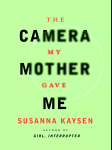
AAK: Where does the title come
from?
SK: It's a line from a Buñuel
movie, Viridiana. The movie's about a bunch
of hobos and peasant who take over a country mansion
that belongs to a rich woman who's been trying to
help them. There's a scene in which all these
drunk, dirty characters are sitting at a banquet
table and someone says, "Let's take a
picture!" A woman gets up and faces the group,
so her back is to us, the audience. Where's the
camera, someone calls out, and she says, "I'll
take it with the camera my mother gave me," and
she pulls up her huge peasant skirts, exposing her
bottom to us and her you-know-what to them.
I
have to confess that she actually says, "I'll
take it with the camera my father gave me," and
I remembered it wrong.
In Latin and
Italian--maybe in Spanish too--camera means room.
Camera obscura means dark room. That's where
we get the word for the thing that takes
photographs. And the vagina is a dark, private room.
For some women, it's the closest they're going to
get to having a room of one's own. And I feel that
the vagina is a gift from the mother, the passing
down of gender. Though my father pointed out to me
that since it's the sperm that determines the sex of
an embryo, it really should be the camera my father
gave me. Bu–uel was right. So I guess I've
taken poetic license all over the
place.
AAK: Do men and women have different
approaches to medical problems?
SK: I
imagine. Men stereotypically are thought to want to
act rather than to discuss, to want to just Fix It.
There's probably a lot of truth in that. Women are
more likely to want to know Why, and Why did I get
it? Also, because women's bodies are more
"medicalized," we are more comfortable
with doctors--although, that could be an argument
for being less comfortable. We're more used to
them, I think. Almost every life stage for women
involves a medical profession: adolescence
necessitates birth control, pregnancy involves the
entire medical network, now menopause has become a
medical problem, mammograms--all that stuff. Some
guys probably don't go to a doctor until they're
quite ill, if they're lucky, not till late in
life.
This is bound to create different
approaches to the profession.
AAK: In this
book and your previous memoir, the doctors you meet
don't, or can't, give clear diagnoses of the
problems you confront. Should there be a clear-cut
medical response to our difficulties?
SK:
I don't see how there can be a clear-cut response
when neither we nor the medical profession truly
understands half of what's going on in our bodies.
Some things aren't so mysterious--appendicitis, many
aspects of heart disease, broken leg. But then
there's a whole world of mystery: inflammatory
things, autoimmune things, sexual things, cancer
things. Just because something is treatable, as
many cancers now are, doesn't mean they're
understood fully. And then there's the opposite
problem: understanding but no cure. Though usually,
a fuller understanding would lead to a better
treatment.
But things that are tempered by or
created by psychological states--if you can make the
distinction between psychological states and
physiological ones, which I'm not so sure of--are
more difficult to understand and to
treat.
Part of my point here is that not
everything can be fixed. Not everything can even be
improved. My two best doctors were the ones who
admitted they didn't understand, really, what was
going on or how to help me with it. That was
healing for me. They acknowledged my suffering,
they didn't tell me it wasn't there, but they didn't
pretend that they could fix it.
Healing is
complicated. Sympathy and listing are a big part of
a doctor's job, and few have time for it these days.
That's hard. I think it's as hard for the doctors
as it is for their patients, because the doctors
KNOW this is part of their job.
AAK: Is it
the ambiguities of the situation that drew you to
write about it?
SK: Certainly. Ambiguity
is fruitful to think about. And ambivalence. I was
ambivalent about getting cured of my disease. It
was useful to me, as I showed a number of times in
the book. And disease can be useful. This goes
back to the previous question. A good doctor might
intuit why a certain patient needs a certain
ailment, and try to address that with the patient .
I'm talking about a doctor who had NOTHING to do
except take care of thirty patients a week--a doctor
who's been made extinct by the state of modern
medicine. They just don't have that kind of luxury
anymore.
The ambiguity of physical existence
fascinates me, maybe because I live so much in the
head. I spend most of my time alone at home thinking
or reading, now and then writing. So when my body
acts up, squawking about something, it really gets
my attention, since half the time, I'd guess, I act
like I haven't got a body at all.
AAK: What
can men learn about women from reading your
book?
SK: A few secrets of the trade of
being women? Maybe that we're not that
different? It's so hard to say. I'm not a man,
after all, so I can't assess it. And since I wrote
the book, I can't objectively consider how it might
instruct or inform anyone, man or woman.
I
think of another marvelous scene in a novel, though
I don't remember whose novel. It feels that it must
be by Philip Roth. At any rate, there's a young man,
a teenager, I guess, being amazed that girls have
breasts. They just walk around with them all the
time, he tells himself, they could touch them
anytime they wanted to! Just touch them! As women
know, this is quite a different approach to breasts
from the one taken by the possessor of them, who
spends her time assessing them in a dissatisfied
way, usually: They're too small, they're too big,
they sag, whatever. Have you ever encountered a
woman who was pleased with her breasts? Certainly,
we don't find them sexually compelling. They're just
our breasts.
So I hope that men reading this
book, men for whom the vagina is an amazing fact
hiding between our legs, men who think WOW, they
have those things, right there, they could touch
them, they got 'em, right between their legs, this
book can say: Yup, we've got 'em, and they can be a
pack of trouble.
|
|
|
|
|
|
|
|
|