|
|
 |
|
|
|
|
|
|
|
|

|
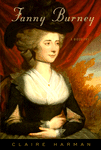
Claire Harman's full-scale biography of Fanny Burney, the first literary woman novelist and a true child of eighteenth-century England and the Enlightenment, is rich with insights and pleasures as it brings us into the extraordinary life (1752-1840) of the woman Virginia Woolf called ìthe mother of English fiction.
We are present at Mrs. Thrale's dinner party when the twenty-six-year-old Fanny has the incomparable thrill of hearing Dr. Johnson himself admiringly acknowledge her authorship of Evelina, her first novel, anonymously published for fear of upsetting her adored father, and now the talk of the town. We see her growing up, daughter of the charming and gifted musician and teacher Dr. Charles Burney, who was the very embodiment of a new class: talented, energized, self-educated, self-made, self-conscious, socially ambitious and easily endearing himself to aristocratic patrons.
We see Fanny partly enjoying, partly rejecting the celebrity engendered by Evelina, and four years later by Cecilia ("If you will be an author and a wit," says Mrs. Thrale, "you must take the consequences"). And we see her mingling with the most famous men and women of the time, not only Dr. Johnson but Joshua Reynolds, Sheridan, David Garrick, Mrs. Siddons, Horace Walpole and, later, Chateaubriand and Madame de StaÎl.
For five years, during the time of George III's madness, Fanny Burney held a position in the Royal Household as Second Keeper of the Robes to Queen Charlotte. For her father, Fanny's going to court was like going to heaven, but for Fanny it was more an incarceration. Her journals, published posthumously in 1842, gave her some solace. She saw herself as an eavesdropper. Dr. Johnson wryly called her "a spy." Her marriage at forty-one to a penniless Catholic exile, Alexandre d'Arblay, resulted in trans-Channel crossings that left her stranded for almost a decade in Napoleon's France, and then, after a dramatic flight from Paris, trapped in Brussels on the eve of Waterloo.
Claire Harman's biography of Fanny Burney is as lively as it is meticulously researched and authoritative. It gives us the woman, her world and the early-blooming artist whose acute grasp of social nuance, gift for satire, drama and skillful play among large casts of characters won her comparison with the best of Smollett, Richardson and Fielding, the admiration of Jane Austen and
Lord Byron and a secure place in the pantheon of the English novel.
"Harman's excellent biography of Fanny Burney is unlikely to be bettered for many years to come." --Kathryn Hughes, New Statesman
"We are priviledged to have this new and meticulous account of an extraordinary life. Harman's account is full of special delights. She excels in the vivid presentation of scenese, the selection of detail. A marvellous and beautifully written book." --Elspeth Barker, The Independent on Sunday
"An elegantly written biography . . . Harman recognizes Burney as a person of her times and not the feminist heroine that academic industry has often made of her."--Alex McLaughlin, Evening Standard
"Sensitive and immaculately researched."--Simon Sebag Montefiore, Mail on Sunday
"Harman's biography scrupulously resists gossip in favour of a sober engagement with important questions of truth, identity, and the nature of biographic enquiry. She invites us to rethink our perspective on Fanny Burney, and suggests new approaches to reading a woman's life and work."--Pamela Norris, Literary Review
|
|
|
|
|
|