|
|
 |
|
|
|
 |
|
 |
Theodore
On February 16, 1884, at a little
before ten in the morning, horses walked side by
side down Fifth Avenue pulling two hearses. They
carried matching rosewood coffins covered with
wreaths of white roses and lilies. Theodore's
mother, Martha, had succumbed to typhoid fever on
February 14; eleven hours later his young wife died
after having given birth to their
daughter.
Nothing had prepared the young
state assemblyman for what had been given and taken
away in the same furious instant. Theodore's face
was expressionless at the funeral. His older sister,
Anna, whom everyone called Bye, led him about like a
small, unfocused child. Later, in the family house
at 6 West 57th Street, as she listened to the
rhythmic tread of his boots on the floor above, Bye
worried that her brother was losing his mind. The
next day Theodore held his infant daughter in his
arms, a locket of her mother's yellow hair around
her neck, and christened her Alice, after his dead
wife.
Alice Hathaway Lee had grown up with
four sisters and a brother in Chestnut Hill,
Massachusetts, next door to five first cousins, the
children of the Leverett Saltonstall family. Eleven
boys and girls had spent their childhood running
back and forth across the lawn that joined the two
clapboard houses, sure of being home wherever they
went. Later, when one of the Saltonstall cousins,
Richard, invited his Harvard friends home to
Chestnut Hill, bespectacled and energetic Theodore
was struck by Alice Lee. Her blue eyes were pale,
and at the same time bright, as if an artist had
sharpened them with a touch of white
paint.
Theodore had had a secret
understanding with his childhood love, Edith Carow,
but they had quarreled, and he began courting Alice
Lee in his junior year at Harvard. When his
extravagant nature and impetuous pursuit frightened
her away, he was shaken by her withdrawal and walked
all night in the woods around Cambridge. Friends,
alarmed, sent a telegram to his family in New York,
and a Roosevelt cousin, a medical student, was
dispatched to find Theodore and calm him down. It
was rumored that when Alice rebuffed him again, in
Bar Harbor, Maine, he attempted suicide. At another
low point, Theodore ordered a set of French dueling
pistols. "I did not think I could win her and I
went nearly crazy at the mere thought," he
confessed.
But in the end Theodore prevailed,
and they were married in October 1880. "They
are both so well and bright that they are like
sunbeams, everyone loving them," Theodore's
aunt Annie Gracie said of the young couple six
months before Alice Lee died.
After the
funerals, Theodore returned to Albany and threw
himself back into his state-assembly work. He kept
up a feverish pace and barely slept, but when the
session ended, he chose not to seek reelection. His
political career, he told Bye, now mattered little
to him. The year before, he had become a partner in
a cattle business, and he decided to move out West
to his ranch in the Dakotas, leaving young Alice
with Bye.
The inhospitable terrain of the
Badlands-like "Hell with the fires out,"
one observer wrote-suited Theodore. Two thousand
miles from his baby, with his wife and his mother
dead, he courted every challenge and grew
gaunt-"thin-flanked," one newspaper
reported. A friend said, "You could have
spanned his waist with your two thumbs and
fingers." Theodore bankrupted his body and
didn't care. He was finishing work he had begun as a
child.
Asthma had plagued Theodore when he
was a boy, and he had been clumsy and not athletic;
he had lived, he later wrote, "much at
home." But he had undergone a transformation
when, as a fourteen-year-old, he took up
bodybuilding and learned to box. He took to the
sport slowly; "sheer industry" had seen
him through. The boy had also struggled to be brave,
inspired by the story of the British sea captain
Frederick Marryat, who became courageous, as
Theodore put it, "by sheer dint of practicing
fearlessness." Sometimes Theodore called it
willpower; at other times he called it deliberate
determination. But at an early age he developed an
existential belief in the need to create himself.
"By acting as if I was not afraid," he
later wrote, "I gradually ceased to be
afraid." It was a lesson his niece Eleanor
would also learn at a young age.
Out West,
Theodore rarely spoke of the depression that haunted
him, but his business partner William Sewall
remembered his saying once that he "didn't have
anything to live for. He was as blue a man as you
ever see. I went right for him bow-legged. I told
him he had no right to talk that way. He had his
child to bring up. He said Alice would never
know."
"Her aunt can take care of
her a good deal better than I can," Theodore
told his business partner. "She would be just
as well off without me." The young widower
seemed "used up" in the spring of 1885,
"all teeth and eyes," as one observer put
it, and the Roosevelts were so worried that they
asked Sewall to look after him. "They had no
business to write to you, they should have written
to me," Theodore said.
"I guess
they knew you wouldn't write about how you were
getting on," his partner replied. "You'd
just say you were all right."
One cold
day in April, the Little Missouri River was a
fast-running tide of mountain water and ice floes.
John Fisher was cutting and hauling ice on the
riverbank when Theodore rode up on his horse Manitou
and asked where the dam was. Fisher was surprised.
"You surely won't try to cross on the dam when
you can go and cross on the trestle the way the
others do?" The water was coursing so high that
the dam couldn't be seen. "It's more than
likely that there's not much of the dam left,"
Fisher warned.
"It doesn't matter,"
Theodore said. "Manitou's a good swimmer and
we're going across."
But the dam had
crumbled partway across the flooding river. Manitou
lost his footing, and Fisher knew that if the horse
drifted even a little downstream, he and his rider
would never get ashore. But Theodore kept shoving
chunks of ice away from his horse's head, and
Manitou held his own against the current for the
quarter of a mile across the Little Missouri. They
were safe. The reckless ride showed John Fisher that
Theodore could survive almost anything. In 1912,
when Fisher heard that his friend had been shot, he
didn't worry about "the man who could swim the
Little Missouri on horseback when it was running
bank full and blocks of ice as big as a
house."
Soaking wet, Theodore rode up to
the general store on the far bank. In the years to
come, the shopkeeper, Joe Ferris, would also tell
the story of the time Theodore and Manitou had
crossed the river, and he'd always end by saying he
"wouldn't have taken that swim for all of
Dakota." That afternoon in Ferris's store,
Theodore bought a pair of dry socks and put them on.
The Little Missouri had decided that he should
live.
Within weeks of his river crossing,
Theodore headed East. Before he went, he turned his
saddle horses out on the range and left word that no
one was ever to ride them or sell them. From time to
time the cowboys caught sight of some of the horses,
but never Manitou. One by one over the years the
horses died on the range, and in the summers when
the snows melted, the cowboys would come upon their
bodies. But no one ever found a trace of
Manitou.
Alice and Eleanor
Theodore
was expected home from the West early in the summer
of 1885. Shortly before his arrival, Edith Carow
came to spend a week with one of his aunts in Oyster
Bay, a semi-wilderness of water and chestnut woods
on the north shore of Long Island, thirty miles east
of New York City. Theodore and his brother and
sisters had grown up in New York with Edith. Their
nurses had pushed them across Union Square in their
carriages. As they got older, the friendship between
Edith and Theodore became especially close, and when
the Roosevelt family sailed to Europe for a year,
she kept the letters she received from him, together
with a curl of his hair, locked up in a little
box.
Everyone was surprised when they did not
marry. Theodore told his sister Bye that in 1878,
when Edith was seventeen and he was twenty, they had
"very intimate relations," but that there
"came a break." Edith maintained that
Theodore had not been nice, though a story she wrote
when she was fifteen suggests her own youthful
conflicts. The heroine found the hero,
"Rex," the epitome of all human
excellence, and he in turn had "lost his whole
loving heart" to her. But the girl dreaded
Rex's great love and was afraid to let him come too
close. Once when they were out walking together, a
burr pricked her finger and Rex-"poor foolish
Rex"-took her wounded hand in his larger,
warmer one and kissed it.
"How dare
you," the girl cried, and, in her "dusky
brown dress with a bit of red at the throat,"
ran from him like a "hunted
deer."
Theodore had taken care not to
see Edith on his visits East after Alice Lee's
death-not even a glimpse in the drawing rooms of
relatives and friends. Victorian propriety dictated
that a gentleman should not marry a second time. To
do so would put a lie to his first love. Theodore's
tor-ment was that he agreed with his fellow
Victorians, but he was also young, with a tumultuous
and ardent nature. Now more than a year had passed
since his wife had died, and only a bit of woods
would lie between him and Edith. But she, learning
of Theodore's impending arrival, quickly decamped to
New Jersey, and it wasn't until a few months later
that they accidentally encountered each other in
Bye's house.
Theodore had changed
considerably since Edith had seen him last. No
longer the boy she had known, he had gained an
astonishing thirty pounds since his river crossing,
and there were subtler changes, too. Theodore had
always had a sense of the fragility of life and a
familiarity with suffering, but now they had risen
to the surface and were shadowing his face. Edith
would not turn from that.
They married in
December 1886 and moved to his new house in Oyster
Bay the following summer, bringing Alice, who was
nearly three and a half. Theodore had designed
Sagamore Hill from the inside out, paying more
attention to the use and flow of the rooms than to
the aesthetics of the structure itself. He made sure
that the huge fireplaces took the logs he liked to
chop and that his study companionably flanked
Edith's parlor, but the outside had an ungainly air.
Four boys and a girl (in order, Ted, Kermit, Ethel,
Archibald, and Quentin) were born between 1887 and
1897, and Sagamore Hill became the family's favorite
place.
Theodore wrote Bye that he found Alice
"too good and happy for anything." He told
his younger sister, Corinne Robinson, that he missed
his daughter when she did not come and sit in her
chair in her long white nightgown to watch him
shave. But the little girl was also a constant
reminder and rebuke. Theodore had loved his first
wife passionately; he had driven her memory before
him in wild rides across the West. Young Alice
personified his grief, so vividly did she resemble
the beautiful girl who had been his wife. And
because Theodore believed he had betrayed Alice Lee
by remarrying, his daughter bore the brunt of what
she would describe as his "guilt
fetish."
Even as a young girl, Alice was
an arresting figure with a commanding presence, but
at times she clung pathetically to her nurse, Jane.
Her aunts worried that she did not seem "to
relish either meat or vegetables," and Edith
noticed that she could look pale and sickly, like a
"quiet and mousy person." Theodore did not
recognize this vulnerability in his daughter. He
teasingly called her "stony hearted." He
tried in vain once, when she was going to visit her
grandparents in Boston, to elicit some sign that she
did not want to leave him. Dressed in her best,
looking just like a "white penguin," his
daughter had not cried; he had left her too many
times for that. But Alice was not without feeling.
"Saying good-bye to Father was a choky, though
tearless business," she confessed years later.
"I always felt a little gulpy when I said
good-bye to him; for any length of time-not only
when I was a child."
Eleanor was born
eight months after her cousin Alice. Theodore's
younger brother, twenty-four-year-old Elliott, had
married Anna Hall, a beautiful girl from the Hudson
River Valley; she gave birth to their daughter on
October 11, 1884.
Like Theodore, Elliott had
been gravely shaken when their mother died, and the
family hoped his young wife would be a comfort to
him. But Anna's haunting beauty hid a troubled
nature. Her childhood had been dominated by an
eccentric and religious father who placed great
importance on self-discipline. Valentine Hall made
his daughter take walks several times a day with a
stick laid across her back, the ends held firmly in
the crook of her elbows. Anna was slender and pale
because she was often unwell, but her distinctive
carriage was eloquent testimony to her father's
control. She grew up the child most like him, as
serious and high-minded.
But when he died,
Anna tried to cast off his legacies: the tyranny of
self-denial and the constant, austere dialogue with
God. At nineteen she welcomed marriage to Elliott
Roosevelt, and it seemed a good match at first. Anna
had a flawless social presence-she was said to be
tuned to a ballroom pitch-and he was a handsome,
pleasure-seeking young man with a taste for
fashionable society. But soon Anna began to return
to her childhood home, sometimes for six months at a
time. And she took her daughter, Eleanor, with her,
up the driveway through small steel gates, past the
stone gatehouse and stables and the lawn shaded by
towering oaks, to the large stuccoed
house.
Oak Terrace, in the village of Tivoli,
was one of many estates fortressed by the headlands
that rose above the Hudson River. Residents called
the freedom that came from the steep terrain living
in "the shadow of the mountains." The
enclave was linked by a private road that had been
cleared through the woods along the river. For most
people, the freedom to do as they wished unfolded
gently eccentric lives.
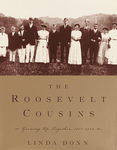
Excerpted from The Roosevelt Cousins by
Linda Donn
Copyright 2001 by Linda Donn. Excerpted by
permission of Knopf,
a division of Random House LLC. All rights reserved. No part of this excerpt
may be reproduced or reprinted without permission in writing from the publisher.
|
|
|
|
|
|
|
|
|