|
|
 |
|
|
|
 |
|
 |
|
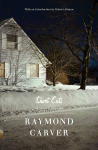
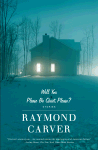
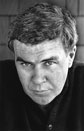
Raymond Carver was born in Clatskanie, Oregon, in 1938. His first collection of stories, Will You Please Be Quiet, Please (a National Book Award nominee in 1977), was followed by What We Talk About When We Talk About Love, Cathedral (nominated for the Pulitzer Prize in 1984), and Where I'm Calling From in 1988, when he was inducted into the American Academy of Arts and Letters. He died in August of that year, shortly after completing the poems of A New Path to the Waterfall.
|
|
|
|
|

|
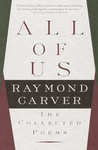
"I began as a poet, my first publication was a poem. So I suppose on my tombstone I'd be very pleased
if they put 'Poet and short-story writer--and occasional essayist' in that order."
Now, in what
would have been his sixtieth year, and ten years after his death, Raymond Carver's poems--more than
three hundred in all--are collected in this volume, allowing readers to experience their full range
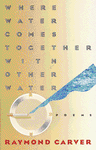
and overwhelming cumulative power. This complete edition brings together, in their order of
publication, the early poems of Fires, the mature work of Where Water Comes Together with
Other Water and Ultramarine, and the last, intensely moving collection, A New Path to
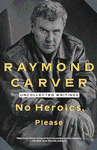
the Waterfall. Poems uncollected during his lifetime, but published posthumously in No Heroics,
Please, are included in an appendix.
The text has been edited by Professor William L. Stull
of the University of Hartford, whose notes address details of first publication and significant
variant readings. The introduction by Tess Gallagher, Mr. Carver's widow, provides valuable insights
into his methods of composition.
Hailed as our own Chekhov, and certainly the preeminent
storyteller of his time, Raymond Carver is revealed in All of Us as the "heir to that most
appealing American poetic voice, the lyricism of Theodore Roethke and James Wright" (New York Times).
And whether in fiction or verse, his heart, craft, and vision ensure his essential position in modern
literature.
|
|
|
|
|
|