|
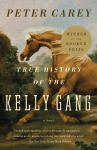
True History of the Kelly Gang
Now available in paperback from
Vintage Books
|

|
Jack Maggs
|
Oscar and Lucinda
|
The Fat Man in History
|
Bliss
|
The Unusual Life of Tristan Smith
|
|
 |
- The Australian publisher's Ned Kelly site.
Watch videos, see a flash presentation, listen to Peter Carey reading an excerpt from True History of the Kelly Gang,
performed at the Brisbane Irish Club on 18
October 2000.
- The New York Times feature site on Peter Carey and the Kelly Gang.
"Carey's latest book is bolder and more challenging
than anything he has attempted before. ''True
History of the Kelly Gang'' isn't merely a historical
novel; it's a fully imagined act of historical
impersonation..."
- The Independent (UK) review of TRUE HISTORY.
"The injustices heaped upon Kelly and those of his class--poor labourers of Irish stock--force the reader into a
continuous reappraisal of the ambivalent nature of probity.
Can a thief be honest? Is a murderer necessarily evil? The
truth of the history is Ned Kelly's truth, and Carey's skill in
presenting the outlaw's voice gives moral complexity to the
raw stuff of legend..."
- The Scotsman interview with Peter Carey:
"'There will be at least one siren, I promise,' he warns. I
am sitting with Peter Carey on the rooftop of the
Manhattan apartment he shares with his American wife,
theatre director Alison Summers, and their two children..."
- The Telegraph UK's interview with Peter Carey:
"Ned's not just a Jesse James character who robbed banks and upset the establishment," Carey
says with a gleam of passion in his eyes. "He's a symbol of national pride and freedom. He's our
Thomas Jefferson..."
- The Age, from Melbourne, Australia:
"NED KELLY has been part of Peter Carey's life for almost longer than he cares to remember. Perhaps it
comes from one of his grandfathers who knew Thomas Curnow, the crippled schoolteacher who betrayed
the Kelly Gang to the authorities at Glenrowan..."
Ned Kelly Links
- Ned Kelly: Australian Iron Outlaw
A fully comprehensive and finely produced Ned Kelly site. Much information and archival material.
- The World of Ned Kelly
Hear the folksong "Edward Kelly" by Lazy Harry and more.
- The Law Report A transcript of a recent broadcast.
This re-enactment of the trial of Ned Kelly was performed early in 2000. It was a montage of court transcript, Kelly's
own words from his Jerilderie letter which the jury never heard, and the reflections of an
elderly and ghostly Mr Bindon, who as a grossly inexperienced young barrister, defended
Ned.
- WHEN THE KELLYS WERE OUT:
This is a film study guide produced for teachers. It focuses on the silent film WHEN THE KELLYS WERE OUT released in 1922.
(A shortened version was released in England in 1924 as
The True Story of the Kelly Gang)
- Consider this--The 1970 Movie "Ned Kelly" starring Mick Jagger and its interesting sound track: (from artistdirect.com) "The soundtrack album for Ned Kelly features performances from Mick Jagger, Waylon
Jennings and Glen Tomasetti...Featuring words and music by acclaimed author and poet Shel Silverstein, and vocals by Waylon
Jennings, Kris Kristofferson and Tom Ghent, the soundtrack is very western sounding with twangy bawdy ballads and
hoe-down music."
Opinions from Australia
- From the Australian: An article by Fred Devine...
"NED Kelly has always been an embarrassment to me. He is the kind of Irish-Catholic hero the (19th-century) Masons might have made up to humiliate us...Portraying Kelly as the heart and soul of the nation? God forbid.
Now a chap with a name like Carey has taken Nedophilia a step further with a regrettably scintillating novel, True History of the Kelly Gang...It was a relief to read commentary on Carey's novel by Cath Keneally (a fine family name) in which she referred to the Kelly gang as "cavorting monsters on horseback..."
- On whether Ned Kelly received a fair trial:
"About the trial itself, a few things are clear: Kelly was inadequately represented; the only eye-witness was not adequately challenged; a viable case of self-defence was not
properly developed. Kelly did not get a fair trial. About the underlying facts there is more room for dispute. On one view, a fair trial would still have resulted in a conviction. On another view, the defence of self-defence
might have been available (although it was not without its difficulties) if it could be shown that the police who went to arrest Kelly were in truth intent on killing him..."
Sidney Nolan
|
|
|
 |
|
|
|
|
|
 |
ABOUT THIS GUIDE
The introduction, discussion questions, author biography, and suggested reading list that follow are designed to enhance your group's reading of Peter Carey's True History of the Kelly Gang. We hope they will provide you with new ways of thinking and talking about a novel that vividly re-creates the life of Australia's most famous and most fascinating outlaw.
ABOUT THIS BOOK
Winner of the 2001 Booker Prize
Out of nineteenth-century Australia rides a hero of his people and a man for all nations, in this masterpiece by the Booker Prize-winning author of Oscar and Lucinda and Jack Maggs. Exhilarating, hilarious, panoramic, and immediately engrossing, it is also—at a distance of many thousand miles and more than a century—a Great American Novel.
This is Ned Kelly's true confession, in his own words and written on the run for an infant daughter he has never seen. To the authorities, this son of dirt-poor Irish immigrants was a born thief and, ultimately, a cold-blooded murderer; to most other Australians, he was a scapegoat and patriot persecuted by "English" landlords and their agents.
With his brothers and two friends, Kelly eluded a massive police manhunt for twenty months, living by his wits and strong heart, supplementing his bushwhacking skills with ingenious bank robberies while enjoying the support of most everyone not in uniform. He declined to flee overseas when he could, bound to win his jailed mother's freedom by any means possible, including his own surrender. In the end, however, she served out her sentence in the same Melbourne prison where, in 1880, her son was hanged.
Still his country's most powerful legend, Ned Kelly is here chiefly a man in full: devoted son, loving husband, fretful father, and loyal friend, now speaking as if from the grave. With this mythic outlaw and the story of his mighty travails and exploits, and with all the force of a classic Western, Peter Carey has breathed life into a historical figure who transcends all borders and embodies tragedy, perseverance, and freedom.
FOR DISCUSSION
1. In Australia, Ned Kelly is so revered as a national icon that his image was placed on center stage during the opening ceremonies of the Summer 2000 Olympic Games. Though his legacy is still controversial and some regard him as a criminal and murderer, he is widely seen as a champion of the oppressed and a forerunner of Australian nationalism. What aspects of Kelly's character and actions might be responsible for his heroic status? What heroic feats does he accomplish in the novel? In what ways does the novel present a realistic rather than mythic or romanticized portrait of the man? 2. True History of the Kelly Gang is fiction, yet most of the characters in the novel existed as real people and many of the events are based on historical fact. What complications arise from using fiction to tell the truth? Can a factually based imaginative reconstruction present a truer or more accurate account of people than straightforward nonfiction can? What distinctive pleasures does the historical novel afford? 3. Ned Kelly begins by writing that his history "will contain no single lie may I burn in Hell if I speak false" [p. 7], and much in his narration is concerned with setting the record straight. Is Kelly a reliable narrator? Why should his history be more "true" than other versions of these events? What aspects of Kelly's voice and character convey a feeling of authenticity? 4. Why does Ned Kelly address his history to his daughter? What effect does he hope it will have on her? What are his motives for writing? 5. Throughout the novel, Ned Kelly represents himself as a person who was pushed into the life of an outlaw by forces beyond his control. "What choice did I have?" he asks, when he kills Strahan at Stringybark Creek. "This were the ripe fruit of Constable Alexander Fitzpatrick" [p. 250]. What are the forces, individual and political, that influence his fate? In what ways is Fitzpatrick responsible for this killing? 6. What effect does Harry Power have on the young Ned Kelly? What does Ned learn from him? In what ways does Ned define himself against Harry Power? 7. Looking back on the moment that Harry Power told him that he had killed Bill Frost, Ned thinks: "Now it is many years later I feel great pity for the boy who so readily believed this barefaced lie I stand above him and gaze down like the dead look down from Heaven" [p. 123]. At what other points in the novel is Ned betrayed by the dishonesty of others? What does his willingness to trust suggest about his character? Why would he liken this recollection to the dead looking down from Heaven? 8. How are the Irish in general, and the Kelly family in particular, regarded by the English in Australia? What methods do the police use to intimidate and control them? In what ways can the novel be read as an indictment of English colonialism? 9. When Tom Lloyd is arrested for the shooting of Bill Frost, Ned returns because, as he tells his mother, "I can't let Tom do my time" [p.140]. By what ethical code does Ned live? Where else does he refuse to violate this personal code of honor? How do his own ethics contrast with those of the police, squatters, and judges who are arrayed against him? What are the consequences of Kelly's strict adherence to his code? 10. What do Ned's relationships with Joe Byrne, his mother, his brother Dan, his wife Mary, and their child reveal about the kind of man he is? Why is it impossible for him to flee with Mary to America? How has his relationship with his father--and his father's history--shaped him? 11. Ned Kelly claims that his gang had "showed the world what convict blood could do. We proved there were no taint we was of true bone blood and beauty born" [p. 337]. To what extent is Ned Kelly aware of himself as an actor on the historical stage? To what extent should he be regarded as a revolutionary? What events lead to his growing political consciousness? 12. Though possessing little formal education, Ned Kelly was in fact a remarkable writer, as evidenced by the 1879 Jerilderie letter, which Kelly dictated to Joe Byrne and which survives today. What aspects of Kelly's writing, as Carey represents it, seem most distinctive? How is his writing regarded by others in the novel? What does he hope his writing--in the letter to Mr. Cameron and in the pamphlet he tries to publish--will accomplish? In what ways does Peter Carey's novel fulfill this hope? 13. True History of the Kelly Gang is preceded by an epigraph from William Faulkner: "The past is not dead. It is not even past." How does this quote illuminate what happens in the novel? In what sense do both English colonial history and Ned Kelly's personal past affect the events in the novel? What does this epigraph, and the novel itself, imply about similar contemporary conflicts in Ireland and elsewhere? 14. After his capture in 1880, Ned Kelly said, "If my lips teach the public that men are made mad by bad treatment, and if the police are taught that they may exasperate to madness men they persecute and ill treat, my life will not be entirely thrown away." In what ways does Kelly's life, as it is presented in True History of the Kelly Gang, serve as a warning about the consequences of injustice and persecution?
AUTHOR BIOGRAPHY
Born in Australia in 1943, Peter Carey lives in New York City with his wife, Alison Summers, and their two sons. The author of six previous novels and a collection of stories, he won the Booker Prize for Oscar and Lucinda; his other honors include the Commonwealth Prize and the Miles Franklin Award.
Peter Carey's Jack Maggs, Oscar and Lucinda, The Unusual Life of Tristan Smith, Bliss, Illywhacker, The Fat Man in History, and The Tax Inspector are available in Vintage paperback.
|
|
|
|
|
|