|
|
 |
|
|
|
 |
|
 |
|
AAK: What made you want to write a novel about
Hiroshima and its aftermath?
DB:
As a reader I've always been drawn to the “Big
Question” book. Philosophical, difficult, set
in their particular time—the kind of book that
isn't afraid to ask tough questions. In the same way
I'm put off by books that pretend to answer the
questions they raise. There can't be
answers—not sincere or meaningful
answers—to the questions raised in a great
book.
For me a novel doesn't try to solve
riddles, but instead simply lay them out, expose, or
state those riddles in new, arresting, and entirely
crucial ways. In raising those questions—by
positioning your characters, building your setting
and your drama—you approach the heart of what
it is to be human. Cliche, I know, but what other
reason could there be? Specifically, at this point
in my life, I can't think of any one question more
important, more interesting and terrifying than
Hiroshima and its aftermath. Everything in that
history fascinates me. And there will never be any
complete and satisfying decision regarding the
bomb's use. We will be asking questions about it for
the next five hundred years.
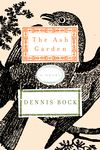
AAK: What kind
of research did you conduct while writing The Ash
Garden? Did you meet with people involved in
the construction of the bomb? With those like Emiko
who barely survived it? Did you travel to Japan,
New Mexico?
DB: I didn't meet
anyone. Interviews like that, for me, are too close
to reportage. The characters in The Ash
Garden are fictional. Someone recently said that
this novel wears its history lightly. I like that.
That is extremely high praise because this is not an
historical novel. It has its historical setting,
its real events, but no one in the
book—besides the peripheral historical figures
like Oppenheimer—is
real. Only the bomb is real here.
That being
said, I sifted though dozens of books to help build
the historical tone of the novel—not the facts
so much as the colour. Research helps carry the
plotting. You can't deliver a character to Los
Alamos without reading a bit about the place and
time, and it's the detail you're not looking for
that stays with you and ends up in the
book—stuff that comes out of nowhere, that
surprises you, like the billboards they had set up
to inspire the workers. Or the fact that the core
group of scientists, the people who witnessed the
first explosion at Alamogordo, wore suntan lotion
thinking this was going to help protect them from
radiation. You find a detail like that and you know
it's going in the book. And not just as an aside; it
finds its way into the book. It becomes a crucial
metaphor for the innocence of those times, of just
how new this science was—even for the
brilliant minds behind its creation.
AAK:
Reverend Tanimoto, one of the real-life survivors of
the bombing, who John Hersey profiled in his
acclaimed Hiroshima, appears in this novel. Was
that book influential for you?
DB:
The book wasn't influential. In fact, I stayed away
from it because I thought it might pull me in a
certain direction. In the research I tended to
favour the studies, the bland historical texts, and
the photo essays. I didn't want the event or the
emotions told to me through a narrative. I needed to
find my own words.
AAK: All three of your
protagonists flee their countries of origin during,
or soon after, the war. Was this an important trait
for them to share?
DB: It was. But
that just happened. As a writer I tend to let things
land on the page. Parallels like that appear before
my eyes. It's there; then I recognize the
significance and run with it. I develop it later on.
A lot of what I do surprises me. I've often
considered first and second drafts as ways of
leaving hints for myself on the page which I later
pick up and accept or reject, depending on impact,
metaphor, or plot. Sometimes magic happens without
me noticing. Sometimes it's just crap. I can't
control it. But when it's there it's a wonderful
sensation—like your secret writing brain is
way ahead of your conscious self and just waiting
for you to catch up and make something of it
all.
AAK: This book switches from a
first-person narrative (Emiko's story) to a
third-person one (Anton and Sophie's story). Was it
difficult to go back and forth, and why did you
choose to tell Emiko's story in her own
voice?
DB: Most of those sections
were written with quite a bit of time between them.
I wrote the lion's share of the first-person in one
fell swoop, and ditto for the third. There wasn't a
lot of movement in and out of the voices. As for
Emiko's voice, it just seemed natural, and very
important, that her voice stand apart from Anton's
narrative. In this way, she, in the end, gets the
last word, both literally and in terms of
authority.
AAK: You describe Anton as
"A man with a particular and unforgiving point
to be made, which was that the nightmare, terrible
as it had been, would always be overshadowed by the
majesty of the dream." This is surely a
sentiment shared by many scientists who have been
instrumental in creating weapons of mass
destruction. Do you feel that such scientists are
blameless for the consequences of their
work?
DB: The other side of blame
is achievement. Lots of these guys—I'm
guessing here—would still hold that view. I
mean, the achievement was immense. Anton, my
character, sits right there in the middle. These
people were geniuses. Most of them knew what they
were doing. I'm talking about context. How can you
hold the capacity for genius and the need to destroy
a city in the same hand? This is the question I
cannot answer. Some walked away. Others were haunted
by it the rest of their lives. What makes Anton
interesting to me is that he struggles with ideas of
guilt, yet will never admit that the bomb was a
mistake.
AAK: A certain interest seems
to have sprung up around WWII—the Broadway
play Copenhagen won the Tony for best new play last
year, the star-studded movie Pearl Harbor opens this
month, and a reverence for what has come to be
called the Greatest Generation has arisen. What do
you feel accounts for this?
DB:
There's the easy patriotism, the kind you find in
the movies, which is meant to offer hope in less
glorious times—the sort of,
remember-back-when-we-were-a-great-and-idealistic-nation
kind of attitude. That's simple, convenient, and
rather staged. The real look backwards—it's
still within living memory. I guess that's it. Many
of our parents and grandparents were touched by the
war. Maybe there is an unconscious, collective
effort to refocus ourselves one last time before
this history assumes its permanent place in the
dusty books.
AAK: You've published short
stories, poetry, and now a novel. What is your
writing process and how does it differ when working
in various forms?
DB: I mentioned
leaving hints for myself in early drafts, which
means I edit a lot. In terms of efficiency, I'm
probably the most wasteful writer there is. I
generate hundreds of thousands of words, then go
back for the cull. It takes a lot of time to find
the story in all that mess. Maybe in time I'll learn
to zero in on the book earlier. I see the assembling
of the big mess of words in the earlier stages of
the novel as the search for the right block of
marble in a quarry. Only after you get your hands on
the right block can you start chipping away inch by
inch. Hopefully, with a couple tons of crumbling,
excess marble at your feet, you get your little,
perfect six-pound statue to show, gleaming and
smooth, as if it existed in that block of stone all
along and you were the only one able to see it. Only
you know how much tonnage you had to remove to get
there.
|
|
|
|
|
|
|
|
|