|
|
 |
|
|
|
 |
|
 |
Emily Bernard was born in Nashville, Tennessee, in 1967. She received her Ph.D. in American studies from Yale University. She has been the recipient of a Ford Foundation Fellowship, a National Endowment for the Humanities Fellowship, and a W. E. B. Du Bois Resident Fellowship at Harvard University. She is an assistant professor of African American studies at Smith College. This is her first book.
|
|
|
|
|

|
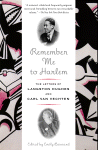
These engaging and wonderfully alive letters paint an intimate portrait of two of the most important and influential figures of the Harlem Renaissance. Carl Van Vechten--older, established, and white--was at first a mentor to the younger, gifted, and black Langston Hughes. But the relationship quickly grew into a great friendship--and for nearly four decades the two men wrote to each other expressively and constantly.
They discussed literature and publishing. They exchanged favorite blues lyrics ("So now I know what Bessie Smith really meant by 'Thirty days in jail / With ma back turned to de wall,'" Hughes wrote Van Vechten after a stay in a Cleveland jail on trumped-up charges). They traded stories about the hottest parties and the wildest speakeasies. They argued politics. They gossiped about the people they knew in common--James Baldwin, W. E. B. Du Bois, Ralph Ellison, Zora Neale Hurston, H. L. Mencken. They wrote from near (of racism in Scottsboro) and far (of dancing in Cuba and trekking across the Soviet Union), and always with playfulness and mutual affection.
Today Van Vechten is a controversial figure; some consider him exploitative, at best peripheral to the Harlem Renaissance--or, indeed, as the author of the novel Nigger Heaven, a blemish upon it, and upon Hughes by association. The letters tell a different, more subtle and complex story: Van Vechten did, in fact, help Hughes (and many other young black writers) to get published; Hughes in turn appreciated what Van Vechten was trying to do in Nigger Heaven and defended him, fiercely. For all their differences, Hughes and Van Vechten remained staunchly loyal to each other throughout their lives.
A correspondence of great cultural significance, judiciously gathered together here for the first time and annotated by the insightful young scholar Emily Bernard, Remember Me to Harlem shows us an unlikely friendship, one that is essential to our understanding of literature and race relations in twentieth-century America.
"When the two first met in November 1924, Carl Van Vechten was a socially adept, married, homosexual, 44-year-old white man. Langston Hughes was a poor, single, sexually ambiguous, talented but barely published 22-year-old black man. Their shifting relationship over the next four decades is embodied in this correspondence. The adroit selection of photographs-many by Van Vechten-and Emily Bernard's lucid, scrupulous annotation bring this rich period to life."
-Steven Watson, author of The Harlem Renaissance and Prepare for Saints
"The friendship between Hughes and Van Vechten is surely one of the more inspiring in recent American history. Meeting in the 1920s as an aspiring young black poet and a celebrated white man of letters, they crossed almost every hurdle that an often disapproving society set before them. Sharp differences about art and politics, about money and the complexities of culture-these were never allowed to come decisively between them. They had in common an irrepressible love of life and art, an enduring sense of the value of friendship, and a delight in African American culture from top to bottom. These letters, superbly chosen, attest to the depth of their relationship, its sparkling optimism, its priceless sense of honor, and its determination to survive despite the expectations of a needlessly divided nation."
-Arnold Rampersad, author of The Life of Langston Hughes and co-editor of The Collected Poems of Langston Hughes
"Remember Me to Harlem is not only a major contribution to our understanding of the Harlem Renaissance, it is a delightful collection of gossipy correspondence between two of its leading-and most intriguing-characters."
-Henry Louis Gates, Jr., author of Wonders of the African World
|
|
|
|
|
|