
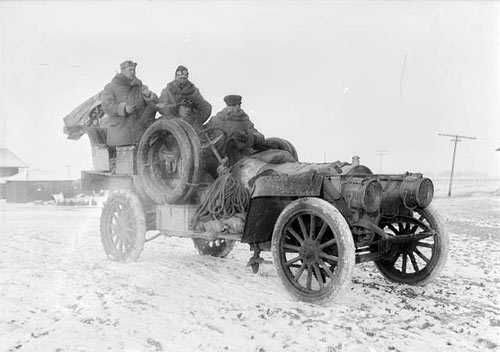
The Thomas Flyer, shown in Cheyenne, Wyoming. Courtesy Western History/Genealogy Department, Denver Public Library.
The Route
Excerpted from Race of the Century:
"The route started by crossing the United States, which had been traversed only nine times before by automobile, each time an arduous adventure. It then led north through Canada and made a left turn at Alaska, fifteen hundred miles wide, which the cars were to cross before arriving at the Bering Strait, a narrow body of water that separates the American wilderness from the Russian one—sometimes. Occasionally, the choppy waters of the strait freeze over, and when that happened, the racers were to drive across to Russia. “The most difficult stretch of the journey,” predicted Roald Amundsen of the dash across the Bering Strait, in a letter to the New York Times. “The loss of a machine at that point should be considered by the contestants.” Amundsen may have sounded rather callous, calmly weighing the odds of a car and its occupants falling through the ice, but that same imperturbability would help put him first at the South Pole four years later, in 1911.
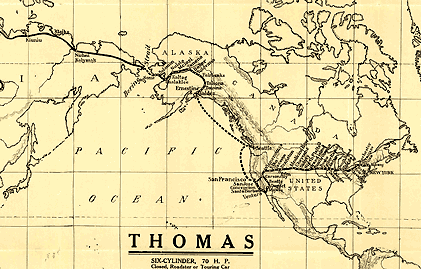
This map image is from a promotional brochure produced by the Thomas Car company to promote the race. It is used courtesy of the Buffalo and Erie County Public Library. View the full collection.
The course was not much easier on the other side of the strait. The peninsula that stretches into northeastern Russia was only a little more fully explored than the moon in 1907. Practically every outsider who had ever made the trip got a book out of it: in fact, there had been just three. The consensus was that the only thing meaner than the sudden blizzards that racked the area were the inhabitants. And the only thing scarier than they were was their food—bits of meat or meal that generally ran the gamut from rancid to rotted—should they be in a truly rare frame of mind and offer to share any.
The course of the New York-to-Paris Race led next through Siberia, four million square miles in total, and five thousand miles across. No one had ever traveled across it by car; the only road through much of it was the track of the Trans-Siberian Railway, slicing through forests with no room to spare on either side of the ties. It may as well have been a subway, the woods were so thick.
The twenty-two-thousand-mile trek would include Moscow, perhaps even make a detour to St. Petersburg, and definitely run through Berlin, before ending finally in Paris.
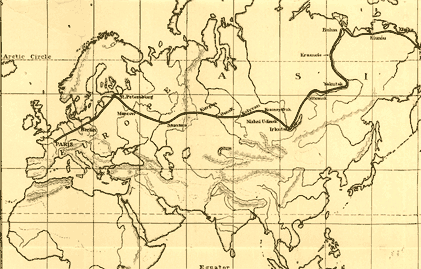
Map image courtesy of the Buffalo and Erie County Public Library. View the full collection.
Just describing the New York-to-Paris Race took longer than it did to run some races, start to finish, in 1907. Even in a modern car on today’s highways the trip would be daunting. In a world without highways, it was regarded as suicidal. “The cars,” explained Carlton Mabley, a New York automobile importer who passed for a voice of authority under the circumstances, “will have to climb mountains several times to an altitude of over 10,000 feet and drop down the sides of mountain ranges on passes and roads that are well-nigh impassable even to the sure-footed beast of burden. The drivers will have to go through rivers which in many cases will completely cover the wheels and flooring of the car, and the motor will have to do its work at a temperature of 100 degrees as well as at 50 below zero.” The prospect of such an endeavor certainly started people talking—and rifling through atlases.
The New York Times could stand only three days of the buzzing excitement before bursting forth, on November 28, with the announcement that it would join Le Matin as cosponsor. In an era that glided along without any overarching news story, such as a war or some pestilence to dwell on, the New York Times realized that the world’s longest race would not only be news, but a turning point in the young twentieth century. Besides, it would fill up a column on page one every day, and a lot of page two for at least six months running.
The Book | The Race | The
Author | An Excerpt
Buy
the Book | Crown Publishing | Privacy Policy