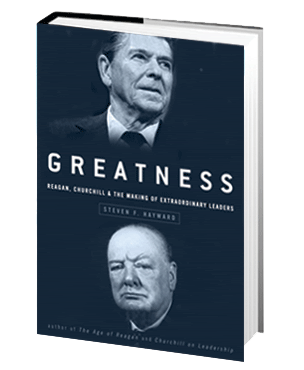
Greatness
Reagan, Churchill, and the Making of Extraordinary Leaders
by Steven F. Hayward
"Brilliant. If you admired Churchill and liked Reagan, you will love this book." —Martin Anderson, editor of Reagan, In His Own Hand "Churchill and Reagan were historic leaders. Anyone interested in the lessons of leadership will find this a compelling and important book." —Newt Gingrich From Chapter 1: What Is Greatness? A democracy, not less than any other form of government, needs great men to lead and inspire the people.—James Bryce, The American Commonwealth Ronald Reagan, like many American politicians of both parties, liked to quote Winston Churchill. Reagan paraphrased him by name in his first presidential utterance, his inaugural address in 1981. "To paraphrase Winston Churchill," Reagan said, "I did not take the oath I've just taken with the intention of presiding over the dissolution of the world's strongest economy." Reagan quoted or mentioned the example of Churchill more than 150 times during his presidency—more than three times as much as any other president. Beyond the direct references, one finds that Reagan discussed many political issues in the same terms, and with the same vocabulary, as Churchill. Many fine books have been written about Churchill and Franklin Roosevelt, the contemporary world leaders and indispensable partners of the Western alliance during World War II. And the most apt Anglo-American comparison might seem to be Churchill and the other Roosevelt—Theodore Roosevelt. Both were war heroes. Both were serious and accomplished writers and historians. Churchill certainly understood the meaning of TR's "bully pulpit" and his famous injunction to be "in the arena," getting your nose bloodied. In 1940 an American newspaper saw enough of the similarities to call Churchill "the Rough Rider of Downing Street." It turns out that TR, who met the young Churchill in 1900, didn't care for the brash young Englishman. His daughter, Alice Roosevelt Longworth, later told historian Arthur Schlesinger Jr. that her father disliked Churchill because "they were so much alike." Win a Copy! Send and email to crownmarketing@randomhouse.com with "GREATNESS" in the subject line. (official rules) Send to a Friend Have a friend interested in Reagan, Churchill, or the history of this Great Nation? Copy and paste this URL into an email and send this newsletter to a friend. |
Revealed: The Parallel Lives of Two of History's Greatest Leaders Ronald Reagan and Winston Churchill were true giants of the twentieth century, but somehow historians have failed to notice the many similarities between these extraordinary leaders. Until now. In Greatness, Steven F. Hayward—who has written acclaimed studies of both Reagan and Churchill—goes beneath the superficial differences to uncover the remarkable (and remarkably important) parallels between the two statesmen. In exploring these connections, Hayward shines a light on the nature of political genius and the timeless aspects of statesmanship—critical lessons in this or any age. A swift-moving and original book, Greatness reveals: • The striking similarities between Reagan’s and Churchill’s political philosophies: the two were of the same mind on national defense, the economy, and many other critical issues • What made both Reagan and Churchill so effective in the public arena—including their shared gift for clearly communicating their messages to the people • The connecting thread of the Cold War, which was bookended by Churchill’s “Iron Curtain” address of 1946 and Reagan’s “Tear Down This Wall” speech of 1987 • The odd coincidences that mark everything from their childhoods to their shifts from Left to Right to their shared sense of personal and national destiny Ultimately, Hayward shows, the examples of Churchill and Reagan teach us what is most decisive about political leadership at the highest level—namely, character, insight, imagination, and will. Greatness also serves as a sharp rebuke to contemporary historians who dismiss notions of greatness and the power of individuals to shape history. Hayward demonstrates that the British historian Geoffrey Elton had it right when he wrote, “When I meet a historian who cannot think that there have been great men, great men moreover in politics, I feel myself in the presence of a bad historian.”
Praise for Steven F.Hayward
Praise for GREATNESS: “Brilliant. If you admired Churchill and liked Reagan, you will love this book. You will smile and nod yes to yourself again and again as the comparability of these two men is unveiled.” —Martin Anderson, editor of Reagan, In His Own Hand “In times of crisis, countries need leaders of courage, conviction, and clarity with an ability to rally the nation to overcome its challenges. Churchill and Reagan were two such historic leaders. Anyone interested in the lessons of leadership will find this a compelling and important book.” —Newt Gingrich Praise for THE AGE OF REAGAN “Grand and fascinating history . . . The Age of Reagan goes far toward making the definitive historical case for Reagan’s greatness.” —National Review “Reads at times like a grand historical drama, a kind of War and Peace of the American century, complete with romance and adventure and tragic characters, a thrilling survey of what we might have thought to be familiar history but which appears here quite transformed.” —Times Literary Supplement “A big, bold, ambitious book by one of the rising stars of the conservative intellectual movement, Steven F. Hayward . . . The best historical biography yet written about our fortieth president.” —World and I “A massive achievement . . . It is hard to imagine anyone doing better. . . . Mr. Hayward leaves us awed by his achievement and looking forward hungrily to volume II.” —Washington Times About the Author Steven F. Hayward is a recognized authority on both Ronald Reagan and Winston Churchill, having written The Age of Reagan: The Fall of the Old Liberal Order, 1964–1980, and Churchill on Leadership. He has written for the New York Times, the Wall Street Journal, the Chicago Tribune, the Baltimore Sun, the San Francisco Chronicle, National Review, Reason, and Policy Review, among other publications. A Ph.D. in American studies, he is F. K. Weyerhaeuser Fellow at the American Enterprise Institute and Senior Fellow at the Pacific Research Institute. Hayward is currently at work on The Age of Reagan: Lion at the Gate, 1980–1989, to be published by Crown Forum in 2007. He divides his time between Washington, D.C., and California. Buy the Book Click HERE to see the entire list of available booksellers, both local and online.
|

This email and all its contents belong to Crown Forum, a division of Random House LLC. All rights reserved. No part of this excerpt may be reproduced or reprinted without permission in writing from the publisher.
You received this message because you signed up for the Crown Forum
e-newsletter. If you no longer wish to receive these emails, send a blank email to
unsub_crown-forum@info.randomhouse.com. If you received this e-newsletter
as a forward and wish to subscribe, send a blank email to
sub_crown-forum@info.randomhouse.com