A rep at Knopf named Paul told me back in March that my novel wore its
history very lightly. I don't know if Paul's observation was meant as a
compliment, but I was glad he said it. It's hard to know whether the
various facts you include in a book amount to much more than a mountain of
lifeless statistics. But that's what you walk out of the library with at
the end of the day-just an armload of books and scribbles on paper of what
you hope are interesting and meaningful clues that will push along your
narrative, establish context and provide texture. It's the writer's job to
pick and choose what will be discarded, and how the remaining jumble of
research will be assembled.
Let's begin with the obvious detail, the day to day texturing, that must be
located and placed to good effect in your novel. If your book is set in
post-war Japan you should probably know what sort of food was eaten by your
characters, what their clothes looked like, and the type of material it was
made of. This is the sort of detail that a novelist should know about his
or her characters; they also help the reader get a better sense of the
world those characters live in. Of the three sorts of research and detail a
writer goes hunting for, this is probably the easiest to track down and
present, and it is what I leave to the end of the writing process.
The second type of research is a little more accidental. It is the
discovery of the historical fact that suggests more to us today than it
did, say, to the people who experienced that reality fifty years ago. Let
me explain by providing an example from my novel: when the first bomb was
detonated in Nevada, the observers thought it prudent to wear suntan
oil as an extra layer of protection against the unknown effects of
radiation. (It happened to be coconut flavoured.) Now this of course sounds
ludicrous to us, with what we have learned about the power of atomic energy
since then. Yet at the dawn of the nuclear age even the scientists at the
forefront of this technology were surprisingly innocent. This type of
research, when used delicately, can function on two levels: it provides the
necessary and interesting background detail, along the same lines as the
type of food your characters eat, as well as a telling glimpse into your
characters' day and age, the thinking back then and so forth. In other
words, it provides context.
Far more difficult and even more accidental is the type of research that
propels the narrative in directions neither the novelist nor the reader can
predict. When I started writing The Ash Garden I had very little idea of
what was going to happen between the three principal characters. In order
to discover the "what" I turned to the histories surrounding the bomb. From
stories of the earliest nuclear science to the protest rallies in New York
City long after the end of the war.... this is where I looked for hints or
clues regarding plot. When I discovered during my travels through miles of
library bookshelves the television program called This is Your Life, on
which two adolescent Japanese bomb survivors appeared in 1955, I knew
immediately this would provide some answers to the question of what happens
in the novel. It turns out that this television program, after a degree of
reinvention, is central to the structure and purpose of the novel. This is
what I mean when I say my research is a crucial ingredient in moving a
narrative forward. Without that research and the subsequent discovery of
that television program a significant piece of the puzzle would have
remained unsolved.
When I stop and read what I have just written about my research habits I
see it sounds a tad formal and technical, maybe even a little calculated.
I'd like to emphasize the accidental nature of this process. You stumble
into it. At least I did because I had no one out there pointing me in this
or that direction. I spent two years thumbing though history books,
government and scientific reports, first-hand accounts, film and video and
photo essays. What you've read above is merely an attempt to approximate
and describe what happened when I wrote this novel. In fact, the writing
process is all too intuitive and hit and miss. Only nearing the end of a
very long haul to the coast do you begin to glimpse signs of the sea.
I believe no amount of research can tell a writer how someone feels when
they are dying of cancer. Or how someone felt lying in bed three weeks
after the bomb destroyed their city and their family. This I can only
explain as the writer's ability to move inside his or her characters. This
is where a writer's human intuition comes into play. Those historical
details, such as what might be seen hanging on the hospital wall, are
important. Like I said, these details help provide texture and context; but
at this moment in your story narrative slows and the reader is interested
in only that little girl lying in her bed, what she feels. She is alone but
for the invisible hand of the writer, and the compassionate eye of the
reader. Here you wait for her true experience to rise to the surface. The
better the writer, the greater the truth will be.
--Dennis Bock, August 2001
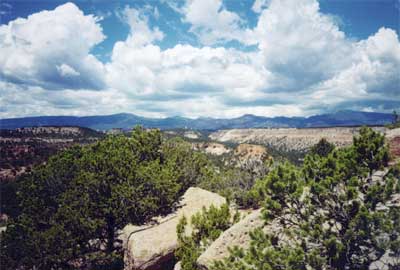
These photos were taken around Los Alamos in summer 2000. The laboratories where the atom bomb was developed are surrounded by mesas, canyons, scrub desert, and the ruins of the Anasazi civilization, which disappeared from the area around 1275. All photos (c) Daniel Spirn.
Click on a thumbnail image to view larger.


an essay about researching and writing "The Ash Garden" | photos from Los Alamos