


 |
 |
 |
 |
 |
 |
 |

 |
|
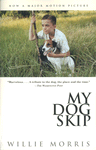
My Dog Skip
"A rich experience all around. . . . Skip turns out to be a dog worth writing about. . . . I'd take him home in a shot."--Bruce McCall, The New York Times Book Review
|
Excerpt
A Faded Photograph
I came across a photograph of him not long ago, his black face with the long snout sniffing at something in the air, his tail straight and pointing, his eyes flashing in some momentary excitement. Looking at a faded photograph taken more than forty years before, even as a grown man, I would admit I still missed him.
It was 1943. I was nine years old and in the third grade when I saw him for the very first time. I had known we were getting him. My father had ordered him from a dog breeder he had heard about in Springfield, Missouri. Daddy had picked him up at the Illinois Central train depot, and when I came home that day from school he had just put the wire portable kennel on our back porch. I opened the door to the box and looked inside. I saw a little puppy drinking water from a container attached to the bottom. He glanced up at me.
"Come here, boy." I said.
He walked on unsteady legs toward me. I was sitting on the floor of the porch when he came out. He jumped into my lap and began nuzzling my hand with his nose. When I leaned toward him, he gave me a moist lick on my chin. Then he hugged me.
I led him into the house and gave him some puppy food in a dish. Then I followed him as he gingerly explored every room I the house. That night he jumped into my bed and stared at me, as if her were looking me over. Then, perhaps because he missed his mother in Missouri, he went to sleep in my arms. I was an only child, and he now was an only dog.
This was the first of our many days and years together. We named him Skipper for the lively way he walked, but he was always just Skip to me.
None of those other dogs ever came up to this one. You could talk to him as well as you could to many human beings, and much better than you could to some. He would sit down and look you straight in the eye, a long, mesmerizing gaze, and when he understood what you were saying he would turn his head sideways, back and forth, oscillating his whole body like the pendulum on a clock. Before going to sleep at night, with him sitting next to my face on the bed as he always did in such hours, I would say, "First thing tomorrow I want you to get your leash and then come get me up, because we're gonna get in the car and go out to the woods and get some squirrels," and the next morning sure enough he would get his leash, wake up both my father and me, walk nervously around the house with the leash in his mouth while we ate breakfast, and then lead us out to the car. Or I could say, "How about a little swim?" and his face would light up and he would push open the back door with his paws and escort me the quarter of a mile down the back alleyway to the swimming hole under the cypress near the bayou. Or, "Bubba's comin' over here today, and we're gonna play some football," and he would listen closely to this, and go out and wait around in front of the house and pick up Bubba's scent a block down the street and come tell me he was on his way. Or, "Skip, how about some catch?" and he would get up and walk into the front room, open a door in the antique cabinet with his improbable nose, and bring me his tennis ball.
I watched him grow up from the puppy who came to us from Missouri to the sleek, dexterous, affectionate creature who could do all these things, and more. He knew my father by the name of Big Boss. My mother was Bossie, and I was Little Boss or, interchangeably, Willie. (I called him, depending on the mood, Skip, Old Skip, and Boy. I have learned that when you love somebody, you will address him or her by different names.) Sometimes my father would hide in a closet and I would ask, "Skip, where's Big Boss?" and he would search the whole house, looking on every bed and under every chair and table until he arrived at the right closet, and began scratching it with his paws.
All this was before the big supermarkets and shopping centers and affluent subdivisions with no sidewalks and the monster highways and the innocence lost. It was even before there was television, and people would not close their doors and shut their curtains to watch the quiz games or the comedy hours or the talk shows where everybody talks at once. We would sit out on our front porches in the hot, serene nights and say hello to everyone who walked by. If the fire truck came past, we all got in our cars to follow it, and Skip was always the first to want to go. The houses were set out in a line under the soft green trees, their leaves rustling gently with the breeze. From the river sometimes came the melancholy echo of a boat's horn.
I knew the place then better than I did my own heart--every bend in every road, every house and every field, the exact spot where the robin went for her first crocus. It was not in my soul then, only in my pores, as familiar to me as rain or grass or sunlight. The town was poor one year and rich the next; everything in it pertained to cotton, and hence to usury and mortgage, debenture and labor. We lived and died by nature and followed the whims of the timeless clouds. Our people played seven-card stud against God.
It was a sly and silent town then, and Skip and my friends and I absorbed its every rhythm and heartbeat and the slightest sounds from far away. I lived those funny silences. The whole town was also abundant with alleys behind the paved thoroughfares inherited from an earlier day, little vagrant pathways running with scant design or reason behind the houses and stores and barns and chicken yards and gardens. You could get away with anything in those alleys. How Skip adored the freedom of them!
It was a lazy town, all stretched out on its hills and its flat streets, and over the years Skip also grew to know almost every house, tree, street, and alley. Occasionally he wandered around the town by himself, and everybody of any consequence knew who he was. Unbelievable as this may seem, Skip had the most curious and spooky way of sensing-don't ask me how-where I might be at any given moment, what a later day called ESP.
Our neighborhood was on one of the broad thoroughfares. In our side yard was a row of immense pecan trees shaped at the top like witches' caps, and in the back a huge field, vined and bosky. On the front lawn was a full, towering oak, one of Skip's favorite trees in the entire town.
Every time I shouted "Squirrel!" Skip would charge on the oak tree and try to climb it, sometimes getting as high as five or six feet with his spectacular leaps. This would stop traffic on the street in front of the house. People in cars would see him trying to shinny up the tree and would pull up to the curb and watch. They would signal to other passersby and point toward Skip, and these people would pull over too. They would gaze up into the tree to see what he was looking for, and, after a respectable pause, ask me, "What's he got up there?" and I would say, "Somethin' small and mean." They seldom recognized that Skip was just practicing.
This exercise was nothing to compare with football games, however. I cut the lace on a football and taught Old Skip how to carry it in his mouth, and how to hold it so he could avoid fumbles when he was tackled. I instructed him how to move on a quarterback's signals, to take a snap from center on the first bounce, and to follow me down the field. Ten or twelve of my comrades and I would organize a game of tackle in my front yard. Our side would go into a huddle, Skip included, and we would put our arms around one another's shoulders the way they did in real huddles at Ole Miss or Tennessee, and the dog would stand up on his hind legs and, with me kneeling, drape a leg around my shoulder. Then I would say, "Skip, pattern thirty-nine, off on three"; we would brake out of the huddle with Skip dropping into the tailback position as I had taught him. Muttonhead or Peewee or Henjie or Bubba or Big Boy or Ralph would be the center, and I would station myself at quarterback and say, "ready, set, oneÉtwoÉthree"; then the center would snap the ball on a hop to Skip, who would get it by the lace and follow me downfield, dodging would-be tacklers with no effort at all, weaving behind his blockers, spinning loose when he was cornered, sometimes balancing just inside the sidelines until he made it into the end zone. We would slap him on the back and say, nonchalantly, "Good run, boy," or when we had an audience: "Did you see my block back there?" Occasionally he would get tackled, but he seldom lost his grip on the ball, and he would always get up from the bottom of the pile and head straight for the huddle. He was an ideal safety man when the other side punted, and would get a grip on the second or third hop and gallop the length of the field for a touchdown. After considerable practice, I succeeded in teaching him the "Statue of Liberty" play, always shouting "Stature of Liberty" to him and our teammates before the play unfolded. I would take the snap from center and fade back in a low crouch, less a crouch than a forty-five-degree list, holding the ball behind my shoulder as if I were about to pass, all the while making sure the loosened lace was at a convenient angle. Skip, stationed at the left-end position, would circle around behind me, taking the lace of the pigskin between his teeth, then moving with deft assurance toward the right side of the line of scrimmage, where I was leading interference, whereupon he would follow his usual phalanx of blockers to the enemy's end zone for another spectacular score. "Look at that dog playin' football!" someone passing by would shout, and before the game was over we would have an incredulous crowd watching from cars or sitting on the sidelines, just as they did when he was after squirrels. The older men especially enjoyed this stunning spectacle. Walking down the sidewalk in front of the house, they would stop and let go with great whoops of astonishment: "man, that's some dog. Can he catch a pass?"
For simple gratification, however, I believe Skip enjoyed our most imaginative intrigue above any other, and there are people still living in the town who will testify to it.
Later we would ride out into the countryside, past the cotton fields and pecan groves and winding little creeks on the dark flat land toward some somnolent hamlet consisting of three or four unpainted stores, a minuscule wooden post office with its porch stacked with firewood in the wintertime, and a little graveyard nearby. Here the old men in overalls would be sitting on the gallery of the general store with patent-medicine posters on its sides, whittling wood or dipping snuff or swatting flies. When we slowly came past with Skip behind the steering wheel I heard one of them yell, "A dog! A dog drivin'!" and when I glanced slightly above the dashboard I sighted him falling out of his chair over the side of the porch into a privet hedge. One afternoon not long after that Henjie and Skip and I were out and about in the same country vicinity when far up the gravel road we saw a substantial congregation of humanity emerging from a backwoods church after a revival meeting. A number of the people, in fact, were still shouting and wailing as they approached their dusty parked cars and pickup trucks. I stopped the car and placed Skip at his familiar spot behind the steering wheel; then we slowly continued up the road. As we passed the church, in the midst of the avid cacophony a woman exclaimed: "Is that a dog drivin' that car ?" The ensuing silence as we progressed on by was most horrendously swift and pervasive, and that sudden bucolic hush and quell remained unforgettable for me, as if the very spectacle of Old Skip driving that green DeSoto were inscrutable, celestial, and preordained.
We had had a whole string of dogs before. When I was a very little boy we had big bird dogs, and then two purebred English smooth-haired fox terriers like this one, and I got to know all about dogs, a most precocious expert-their funny or crazy moods, how they looked when they were hungry or sick, when they were ready to bite and when their growling meant nothing, what they might be trying to say when they moaned and made strange human noises deep in their throats.
The town where Old Skip and I grew up together was an unhurried and isolated place then. About ten thousand people lived there, of all races and origins, and it sat there crazily, half on steep hills and half on the flat Delta. Some of the streets were not paved, and the main street, stretching its several blocks from the Dixie Theater down to the bend in the river, was narrow and plain, but down along the quiet, shady streets, with their magnolia and pecan and elm and locust trees, were the stately old houses that had been built long before the Civil War, slightly dark and decaying until the descendants became prosperous enough to have them "restored," which usually meant one coat of white enamel.
In that place and time, we began driving our parents' cars when we were thirteen years old; this was common practice then, and the town was so small that the policemen knew who you were, and your family, although they of course expected you to be careful. When I started driving our old four-door green DeSoto, I always took Skip on my trips around town. He rode with his snout extended far out the window, and if he caught the scent of one of the boys we knew, he would bark and point toward him, and we would stop and give that person a free ride. Skip would shake hands with our mutual friend, and lick him on the face and sit on the front seat between us. Cruising through the fringes of town, I would get Skip to prop himself against the steering wheel, his black head peering out of the windshield, while I crouched out of sight under the dashboard. Slowing the car to ten or fifteen, I would guide the steering wheel with my right had while Skip, with his paws, kept it steady. As we drove by the Blue Front CafŽ, I could hear one of the men shout: "Look at that ol' dog drivin' a car!"
(Excerpted from My Dog Skip by Willie Morris. Copyright © 1995 by Willie Morris. Excerpted by permission of Vintage Books, a division of Random House LLC. All rights reserved. No part of this excerpt may be reproduced or reprinted without permission in writing from the publisher.)