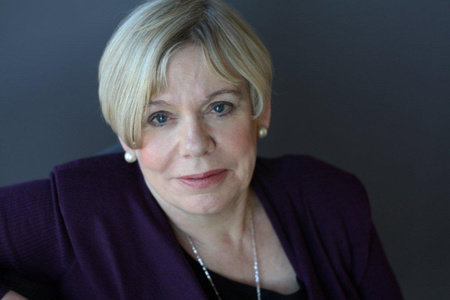
A small woman in her mid-50s with short blond hair and an
eager expression Armstrong signed copies of her books while
the 100 or so guests grazed a buffet table.
"Across the country," she began her brief talk, "night after
night in bookstores, I saw in people's faces that they are
interested in Islam. You might feel in despair as you are
now a minority, living in the West, but people are very interested
in learning more about you."
Earlier, she explained in an interview: "It is challenging
for Muslims in the U.S. who for the first time are not living
in a Muslim-governed state. A basic message of the Koran is
to create a united community and share the wealth." When Western
capitalism was introduced in the East in the last few decades,
Iran and other Muslim countries rebelled. "The challenge for
Muslims in the U.S. is to come to terms with the success of
the secular West."
Part of the problem in integrating, she suggested, is that
Muslims don't want to alienate anyone. "Muslims need to reach
out to other faiths. They aren't as practiced as the Jews
at it, who've lived in sometimes hostile countries for 2,000
years."
Other religious cultures have met similar challenges as immigrants
in the U.S. "The Catholics did, late in the last century.
They came from Ireland, Poland and Europe in huge numbers,
and they were hated. Their arrival encouraged the rise of
Protestant fundamentalism in the U.S. Now it is the Muslims
who want to be good Americans."
Reviews of her new book, and of earlier works, tend to challenge
Armstrong's sophistication. In the case of her new work, one
reviewer argued she gave too little attention to the development
of Islamic law, a central feature of a faith that blends religion
and politics while Western democracies struggle to keep the
two apart. Another reviewer said she overlooked Islam's contribution
to science, art and economics.
"I never read reviews," Armstrong replied, defending herself
in a cadence that an observer once timed at 130 words per
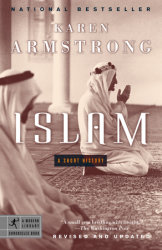
minute. "Islam" presented the added challenge of telling it
all in 222 pocket-book-size pages. "This impossibly brief
history of Islam," was the publisher's idea, she said. "People
too daunted by thick books will get a sense of things in this
one."
Armstrong teaches Christianity at London's Leo Baeck
College for the Study of Judaism. It was her first trip to
Jerusalem in 1983 that piqued her interest in commonality
among faiths. "I got back a sense of what faith is all about."
At the time she was an atheist who was "wearied" by religion
and "worn out by years of struggle." Born a Roman Catholic
in the countryside near Birmingham, England, in 1945, she
gave up on religion after her time in the convent. "I was
suicidal," she said of life in her late 20s. "I didn't know
how to live apart from that regimented way of life."
With an undergraduate degree in literature from Oxford University,
she began teaching 19th and 20th century literature at the
University of London and worked on a PhD. Three years later,
her dissertation was rejected. Without it, she did not qualify
to teach at the university level and took a job as head of
the English department at a girls' school in London. Not long
afterward, she was diagnosed with epilepsy. "After six years
at the school I was asked to leave, but nicely," she said.
"My early life is a complete catastrophe. It all worked out
for the best."
She left the school in 1982 and began working on television
documentaries. The story that took her to Jerusalem set her
on a new career path and changed her earlier impressions about
God. She went from atheist to "freelance monotheist" but has
never returned to the Catholic Church or joined any other.
Since her writing career took off, Armstrong's communion
with God occurs in the library, where she spends up to three
years researching her books, which are as densely packed with
detail as her conversations. "I get my spirituality in study,"
she said. "The Jews say it happens, sometimes, studying
the Torah."
It seems no one sacred scripture could satisfy her now. "It's
inevitable that people turn to more than one religious tradition
for inspiration," she said. "It's part of globalization."
She recently read from the Buddhist canon of teachings for
her next book. "Religion is like a raft," she said, explaining
the Buddha's view of it. "Once you get across the river, moor
the raft and go on. Don't lug it with you if you don't need
it anymore." She knows that mode of travel: Leave one raft
behind to pick up the next just ahead.
Copyright ©MARY ROURKE, Los Angeles Times, October
9, 2000