| |
 |
"Fish is the only food that is considered spoiled once it smells like what it is."
—P.J. O'Rourke
|
 |
| |
 |
 |
|
 |
THE SUSHI EXPERIENCE |
 |
|
 |
|
| |
| |
|
|
| |
| |
3 cups (lightly packed) prepared sushi rice (see recipe below)
28 pieces prepared prawns (see recipe below)
Wasabi paste
Makes 28 Nigiri-zushi balls or 3 to 4 servings
1. 
2. 
3. 
4. 
5. 
6. 
7. 
8. 
9. 
10. 
|
|
Master Recipe for Prawn Nigiri-zushi
In this master recipe, I am using only prawns, but try to include one or two
more seafood varieties, such as tuna or salmon, to make your nigiri-zushi meal more colorful and flavorful. Although it might be fun to emulate the graceful ballet that the sushi chef performs to make each nigiri-zushi, it is undoubtedly simpler for the home cook, who is not yet practiced in this art, simply to prepare, up to 1 hour before serving, as many rice balls as will be needed.
Set up the working counter with sushi rice, prawns (and fish), wasabi, and a
bowl of vinegar water.
Dip the tips of the fingers of your right hand in the vinegar water and rub
both your hands together to distribute the water over your palms. Remember that too much water makes the sushi rice watery and too little makes it stick
to your hands.
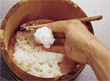
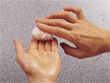
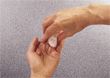
Following the illustrations, 1. reach into the sushi rice container with your right hand and pick up a small Ping-Pong-ball-size portion of rice (1/2 to 3/4 ounce). If you are a beginner, I recommend that you weigh the rice on a scale until you can eyeball the right amount to pick up. Without squeezing, quickly roll the rice over several times in the tips of your fingers, palm facing down. Transfer the rice to your left hand, placing it along the base of your four
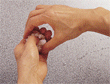
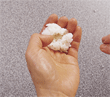
fingers. 2. Hold the rice in place with the thumb and index finger of your right hand as you make a depression on the top of the rice with your left thumb. 3. When you lift your thumb, the small depression remains in the center; it will
not be visible when the sushi is completed, but it keeps the rice ball light and airy.
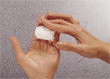
Place the index and middle finger of your right hand on top of the sushi rice
ball and 4. roll the rice toward the tips of your fingers (the depression is
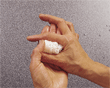
down). 5. Slide it back to the original space at the base of the fingers of your left hand. Now you will make two motions simultaneously: 6. Grab the rice
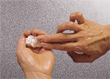
ball between the thumb and index finger of your right hand and move your
left thumb back and forth across the top of the rice ball, exerting gentle pressure to smooth and flatten it. Do not squeeze the rice or press it down. 7. Continue to shape with the index and middle fingers of your right hand.
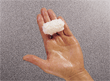
8. Pick up the sushi rice ball, rotate it 180 degrees clockwise, and return it to the base of the four fingers of your left hand. Repeat the process of grabbing the sides of the rice ball between the thumb and index finger while smoothing the top with the thumb as in step 6. Continue to shape as in step 7. 9. Now you have made a perfect rice ball. Repeat until you have used up all the rice. You should have about 28 rice balls.
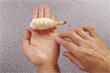
Now smear a dab of wasabi on top of each rice ball, if called for, and 10. then place the prawn on top pressing it into the rice just enough so that it
will adhere. There is nothing difficult about the technique. It just takes a little practice to do it as swiftly and efficiently as your sushi chef does.
NOTE: Making Rice Balls Ahead of Time
Line the rice balls up in a clean plastic container, then cover them with a clean damp towel plus a lid to keep them from drying out. Float the container in a bowl of warm water, changing the water as it cools down. Also, up to half an hour before serving, slice the raw, cooked, or cured seafood you will be using as toppings into the right size. At the last moment, all you have to do is smear a small dab of wasabi, if called for, on top of the rice ball and then put the topping on, pressing down slightly to hold it in place. That's it.
|
|
| |
| |
Step One
2 1/4 cups rice + 2 1/4 cups water = 6 cups cooked rice
3 cups rice + 3 cups water = 8 cups cooked rice
Step Two
6 cups cooked rice = 5 tablespoons rice vinegar + 1 1/2 teaspoons sea salt + 2 tablespoon sugar
8 cups cooked rice = 6 tablespoons rice vinegar + 2 teaspoons sea salt + 3 tablespoons sugar
1. 
2. 
3. 
4. 
5. 
|
|
Master Recipe for Sushi Rice
Step One
The proper rinsing of the rice is important for its final flavor and appearance. Pour the rice into a fine-mesh strainer, large enough so you can freely toss and turn the grains. Have at hand a larger bowl into which the strainer can easily fit and fill it with cold tap water. Pour the rice into the strainer, then lower the strainer into the large bowl so that the water covers the rice. With both hands, gently rub, turn, and toss the rice. Do not press the grains too hard against the strainer or against one another, or the fragile grains may break, especially if you are using a lower grade of rice. The water will instantly turn milky white, so remove the strainer from the large bowl, discard the water, and refill the bowl with fresh cold water. Return the rice-filled strainer to the bowl and repeat. On the second rinsing, the water
will look only slightly milky. Repeat once or twice more. When you have finished, the water will be almost clear, but do not expect 100 percent clarity.
Drain the rice and let it sit in the strainer for 10 minutes.
Transfer the rice to a heavy-bottomed pot that is deeper than it is wide and has a heavy, tightly fitting lid (during cooking, rice swells to as much as two and a half times its original volume, so your pot should be at least three times deeper than the level of the rice and water), add the water, and let it
sit for 20 minutes.
Set the rice over medium heat and cook, uncovered, until the water is nearly absorbed by the rice—about 10 minutes. Quickly reduce the heat to very low, cover the pot with the lid, and cook until the rice is plump and cooked through—another 10 minutes. The exact cooking time depends on the heaviness of the pot, the level of the heat, and the quantity and condition of your rice. After a total of 20 minutes' cooking, take a quick look: the rice should be completely transparent. If you see any dry, very white-looking grains, sprinkle a little warm water over the dry spots and cook another couple of minutes or so over very low heat. During the cooking, never stir the rice.
After confirming that all the rice grains are transparent, immediately put the lid back on before the built-up steam can escape. Turn off the heat and let the rice stand for 5 minutes.
Step Two
While the rice is cooking, put the rice vinegar, salt, and sugar in a bowl and stir with a whisk until the sugar and salt are almost dissolved.
If you are using a Japanese sushi-oke (wooden sushi tub) and shamoji (flat wooden paddle), soak them in a bath of cold water for half an hour while the rice is cooking (dry wood will absorb a good portion of the sushi vinegar dressing, and the rice will stick to the wood). Drain the water and wipe the tub and paddle with a dry kitchen towel. If you are using a large unfinished wooden salad bowl, moisten it just before using (soaking for a long time might cause it to crack). Other bowls made of metal, glass, or porcelain can be substituted, but they tend to make the sushi rice watery, mushy, and lumpy.
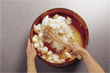
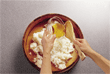
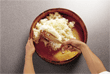
Transfer the steaming hot cooked rice all at once to the sushi tub or salad bowl. Following the illustrations, 1. quickly and gently break up the rice, crisscrossing it with the side of your paddle. 2. Pour the prepared vinegar dressing evenly over it and, with the paddle, break up the lumpy clumps and turn the rice over, working one area at a time. Repeat once or twice until you can tell by looking that the vinegar dressing is roughly distributed throughout the rice. 3. Push the rice toward one side of the tub.
Now hold the paddle horizontally and 4. insert the paddle into the rice in one area, then rapidly move it back and forth with many small strokes. By cutting into the rice this way, you are breaking up the clumps and pushing a portion of rice toward the opposite side of the tub. Now work on the remaining areas of the rice one at a time in the same way, until you have moved all of the rice to the other side of the tub. Rotate the tub or bowl 180 degrees and repeat the process. You can see at the end of the second "cutting" that each grain looks evenly plump, when all the vinegar dressing has been evenly absorbed. The whole procedure should take about 2 minutes. With a hand fan or with a magazine or folded newspaper, 5. fan the rice for about 30 seconds. This quick fanning gelatinizes the surface of the rice to give it a glossy appearance and also cools it, helping the vinegar dressing to settle inside each grain.
Sushi rice, if it is prepared in a large quantity, tends to remain rather hot, even after being fanned. If so, let it cool to a temperature of 104° F, covered with a moist kitchen cloth to prevent it from drying out.
|
|
| |
| |
Sweet Vinegar Marinade
1/2 cup kokumotsu-zu (grain vinegar)
2 1/2 tablespoon sugar
1/8 teaspoon salt
10 kuruma-ebi (kuruma prawns) or similar prawns, heads on, about 6 inches long; preferably alive or very fresh, not frozen
1/2 teaspoon sea salt
1 tablespoon kokumotsu-zu (grain vinegar)
|
|
Cooking Prawns on a Skewer
 Sweet vinegar marinade:
Put all the ingredients in a pot with 1/2 cup water and bring to a simmer over medium heat. Remove from the heat and cool. Store in a jar in the refrigerator.
Cooking on a skewer:
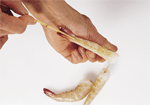
Following the illustration, insert a bamboo skewer into the prawn, starting at the tail end, and run it through its body closer to the belly side. Prepare all the remaining prawns in the same way.
Bring 3 quarts of water in a pot to a boil, add the salt and vinegar, and cook the prawns about 2 to 3 minutes. To check for doneness, remove one prawn from the water and press it between your thumb and index finger. It should feel firm but slightly tender in the center. Do not overcook (overcooking develops
a flaky flesh). Remove the prawns from the water, then drain and spread them
on a strainer to cool. If you are using frozen prawns, cook them for a full 3
minutes (they need to be cooked through). After removing them from the
water, cool them immediately in a bowl of cold water (natural flavor is lost
during freezing, so plunging into water to cool does no harm).
Cut off the head and peel each prawn whole, but do not remove the two large,
fanned-out parts of the tail. Cut open the prawn from the belly side and
butterfly it. Remove the brown vein, if present. Square off the head end of the
body. Prepare all the rest of the prawns in the same way. Spread them out on a
flat strainer or cookie rack without overlapping, sprinkle a little salt over
them, and let them stand for 5 minutes. Rinse the prawns in a bowl of cold water
and drain. Toss them in a bowl with the sweet vinegar marinade, then drain and
store in a container. Prawns, even when cooked, are very perishable; salting and rinsing them in the vinegar extends the storage period, up to 2 days in the
refrigerator.
Final preparation:
Use one prepared prawn for each nigiri-zushi.
|
|
| |
| |
3 small blue crabs
5 cups dashi (fish stock)
3 tablespoons to 1/4 cup shiromiso (white miso)
1/2 cup kaiware (daikon sprouts) or watercress leaves
Freshly ground black peppercorns
Makes 6 servings
|
|
Miso Soup with Crab
Bring a medium potful of water to a boil. Add the crabs and cook about 30 seconds. Remove them from the boiling water and rinse them under cold running
water. Tear off the apron from each crab, separate the shell from the leg
part, and remove the gills, discarding the apron, shell, and gills. Cut each crab into quarters.
Put the cold dashi and the crab pieces into a fresh pot, set it over
medium heat, and cook for 10 minutes. Add the miso, whisking until it is
dissolved.
Serve equal portions of the soup in six soup bowls with the crab pieces
garnished with the kaiware. Grind some black pepper over the top. Serve immediately.
|
Recipes excerpted from THE SUSHI EXPERIENCE by Hiroko Shimbo. Copyright 2006 by Hiroko Shimbo. Photographs by Jim Smith. Excerpted by permission of Alfred A. Knopf, a division of Random House LLC. All rights reserved. No part of this excerpt may be reproduced or reprinted without permission in writing from the publisher.
|
|






 IN THIS ISSUE
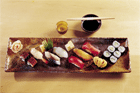 "Food trends come and go. Few suddenly fashionable foods survive long in a world of fickle tastes," says Hiroko Shimbo, a trained sushi chef and cooking instructor. "Sushi, though, is so healthy, delicious, attractive, and adaptable that its popularity only continues to expand."