A Letter to Thoreau
Excerpted from the Prologue
Henry!
I am at the site of your cabin on the edge of Walden Pond. I came
because of your stature in literature and the conservation movement. I
came because of all your contemporaries, you are the one I most need to
understand. As a biologist with a modern scientific library, I know more
than Darwin knew. I can imagine the measured responses of that country
gentleman to a voice a century and a half beyond his own. It is not a
satisfying fantasy: the Victorians have for the most part settled into a
comfortable corner of our remembrance. But I cannot imagine your
responses, at least not all of them. You left too soon, and your
restless spirit haunts us still.
I am here for a purpose: to become more Thoreauvian, and with that
perspective better to explain to you, and in reality to others and not
least to myself, what has happened to the world we both have loved. . .
The natural world in the year 2001 is everywhere disappearing before our
eyes--cut to pieces, mowed down, plowed under, gobbled up, replaced by
human artifacts.
No one in your time could imagine a disaster of this magnitude. Little
more than a billion people were alive in the 1840s. They were
overwhelmingly agricultural, and few families needed more than two or
three acres to survive. The American frontier was still wide open. And
far away on continents to the south, up great rivers, beyond unclimbed
mountain ranges, stretched unspoiled equatorial forests brimming with
the maximum diversity of life. These wildernesses seemed as unattainable
and timeless as the planets and stars. That could not last, because the
mood of Western civilization is Abrahamic. The explorers and colonists
were guided by a biblical prayer: May we take possession of this land
that God has provided and let it drip milk and honey into our mouths,
forever.
Now, more than six billion people fill the world. The great majority are
very poor; nearly one billion exist on the edge of starvation. All are
struggling to raise the quality of their lives any way they can. That
unfortunately includes the conversion of the surviving remnants of the
natural environment. Half of the great tropical forests have been
cleared. The last frontiers of the world are effectively gone. Species
of plants and animals are disappearing a hundred or more times faster
than before the coming of humanity, and as many as half may be gone by
the end of this century. An Armageddon is approaching at the beginning
of the third millennium. But it is not the cosmic war and fiery collapse
of mankind foretold in sacred scripture. It is the wreckage of the
planet by an exuberantly plentiful and ingenious humanity.
The situation is desperate--but there are encouraging signs that the
race can be won. Population growth has slowed, and if the present
trajectory holds, it is likely to peak between eight and ten billion
people by century's end. That many people, experts tell us, can be
accommodated with a decent standard of living, but just barely: the
amount of arable land and water available per person, globally, is
already declining. In solving the problem, other experts tell us, it
should also be possible to shelter most of the vulnerable plant and
animal species.
In order to pass through the bottleneck, a global land ethic is urgently
needed. Not just any global land ethic that might happen to enjoy
agreeable sentiment, but one based on the best understanding of
ourselves and the world around us that science and technology can
provide. Surely the rest of life matters. Surely our stewardship is its
only hope. We will be wise to listen carefully to the heart, then act
with rational intention with all the tools we can gather and bring to
bear.
Henry, my friend, thank you for putting the first element of that ethic
in place. Now it is up to us to summon a more encompassing wisdom. The
living world is dying; the natural economy is crumbling beneath our busy
feet. We have been too self-absorbed to foresee the long-term
consequences of our actions, and we will suffer a terrible loss unless
we shake off our delusions and move quickly to a solution. Science and
technology led us into this bottleneck. Now science and technology must
help us find our way through and out.
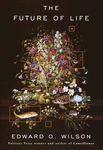
Excerpted from The Future of Life by
Edward O. Wilson.
Copyright 2002 by Edward O. Wilson. Excerpted by
permission of Knopf,
a division of Random House LLC. All rights reserved. No part of this excerpt
may be reproduced or reprinted without permission in writing from the publisher.