 |
|

Photo © Brice Hammack
|
 |
 |
Newly Discovered Primary Sources
Reinterpreting History: How Jesse James Differs from Standard Accounts
Photographs
EMANCIPATION IN MISSOURI: THE RADICAL TRIUMPH
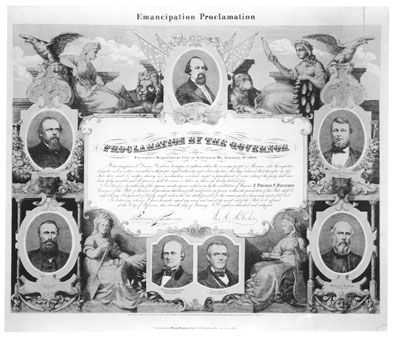
It is difficult to overstate the bitterness of the Civil War in Missouri, or how thoroughly it reshaped politics there. By 1865, approximately one out of three Missourians had disappeared from the state. They had died, fled, or been banished, like Jesse James's own family, the Samuels (exiled to Nebraska in January 1865 because of Jesse and Frank's guerrilla activities). The population had split into three political factions: the secessionists, the Conservatives, and the Radicals. In late 1864, the savagery of the war convinced a majority of Unionists (especially soldiers and militiamen) to vote for the Radicals, who swept the elections and won a mandate for a constitutional convention.
This commemorative lithograph heralds the Radical triumph. It shows the state's new Radical officials, including Governor Thomas C. Fletcher (who would personally direct the postwar hunt for the guerrillas associated with Jesse James). It also celebrates the ordinance of immediate emancipation enacted by the constitutional convention in January 1865. The law was no mere formality: Due to the proslavery conservativism of many Union militia commanders and local officials, tens of thousands of African Americans remained in bondage. The convention soon went much further, drafting a state constitution that extended new civil rights to African Americans and barred former Confederates from the ballot box, juries, public office, many professions, and the pulpit. The constitution became a rallying cry for Conservatives, and alienated former secessionists from politics (bringing to the fore the violent resistance of the old bushwhackers).
Next Photo.
|
|
|