 |
|

Photo © Brice Hammack
|
 |
 |
Newly Discovered Primary Sources
Reinterpreting History: How Jesse James Differs from Standard Accounts
Photographs
THE SCENE OF JESSE JAMES'S DEATH
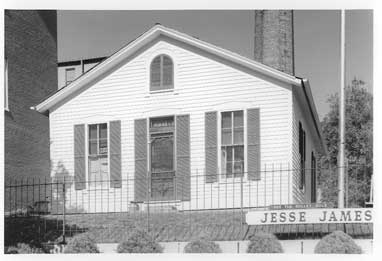
For almost three years after the Northfield catastrophe, Jesse James lived quietly in Nashville, occupying himself with gambling, horse racing, and agricultural speculation. In 1879, he returned to his life of crime, recruiting a new gang and robbing a train at Glendale, Missouri. From that point until his death in 1882, he never looked back. But his political role had disappeared with the end of Reconstruction, and Missouri's state and local authorities mobilized against him with far greater effectiveness.
In 1881, Governor Thomas T. Crittenden devoted much of his inaugural address to a virtual declaration of war against the outlaws. "No political affiliations," he baldly stated, "shall ever be evoked as the means of concealment of any class of law-breakers." He convened a meeting of executives of the express and railroad corporations (who for once took an interest in capturing the outlaws), and raised far more money for a reward than could be legally offered from the state's coffers. Meanwhile, Jesse's followers rapidly fell away--either arrested or murdered in internecine feuds. On Christmas eve of 1881, Jesse moved his wife and two children into this humble house in St. Joseph, Missouri (the building was relocated before this photograph was taken). Soon they were joined by Bob and Charley Ford. The Fords were the last two members of his gang, and they had already made a deal with the governor to assassinate Jesse for the reward (though Crittenden would later deny that he had agreed to the murder). On April 3, 1882, they finally found Jesse at his most vulnerable: his revolvers tossed aside, his back turned.
Despite the sign in front of the building, there was no bullet hole from the assassination.
Next Photo.
|
|
|