|
|
 |
|
|
|
|
|
|
 |
|

|
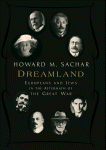
The Great War, as World War I was known in its time, was described by its survivors and contemporary historians as “the war to end all wars,” “the war to make the world safe for democracy.” By its end, in November 1918, Europe’s authoritarian old empires had fallen, and new and seemingly democratic successor states and governments were rising from the ensuing debris. In chronicling an era that was both visionary and tempestuous, Howard M. Sachar directs our attention to the fate specifically of Europe’s Jewish minority as a classic litmus test of the Continent’s transformation.
Writing with his characteristic lucidity and verve, Sachar enriches his narrative by focusing on the careers of some of its major players: Poland’s Józef Pi´lsudski, Rumania’s King Carol, Czechoslo-vakia’s Tomás? Masaryk, Austria’s Sigmund Freud, Germany’s Rosa Luxemburg, and France’s Léon Blum, among many other protean figures, Jews and Gentiles alike. With surgical precision, Dreamland traces the fate of Europe’s early postwar idealism under the pressures of demographic and political revolution, nationalist and economic frustration, and Depression-exacerbated xenophobia.
In the richness of its human tapestry and the acuity of its social insights, Dreamland masterfully expands our understanding of a watershed era in modern history.
|
|
|
|
|
|