|
Sally Denton and Roger
Morris share with you here their own experiences which led up to
the writing of THE MONEY AND THE POWER. Sally grew up in Nevada
and witnessed as a child the excess of the jeweled city in the desert.
Roger's service in the White House led him to see many trails of corruption
leading directly to Las Vegas. SALLY
DENTON on
growing up
in the glow of
Las Vegas
I never
thought I would write about Las Vegas, except as an adjunct to
some other story. As a third-generation Nevadan who grew up in
the 1960s in Boulder City--a tiny desert community 23 miles southeast
of Las Vegas--I viewed the neon city in the distance as a mishmash
of bad planning and ostentatious excess.
By stark contrast,
my hometown had a wholesomeness and banality at once safe and
excruciatingly mundane. The only municipality in the entire state
of Nevada with an ordinance against gambling, Boulder City is
an oasis of parks and manicured neighborhoods with the wonders
of Hoover Dam, Lake Mead, and the Colorado River nearby. Its old-fashioned
main street had the requisite movie theater, drug store, Coffee
Cup café, hotel, and tavern that boasted it would offer a free
drink on any day the sun didn't shine. We prided ourselves on
being a town of bureaucrats and respectable small businessmen,
of hydrologists and geologists, not gamblers, hucksters, and con
men. Yet we knew the rising city in the distance was always something
larger, more serious in its mystery and allure than anything in
our contained little world.
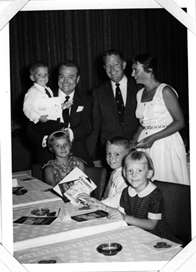 |
Left
to right (standing): Scott Denton, Red Skelton, Ralph
and Sara Denton. (seated) Gail Sawyer, Mark Denton, and
Sally Denton at the Riviera Hotel in 1958.
|
This was the backdrop
of my childhood, and one of the great good fortunes of my life
is that I have come to an understanding about the significance
and the role in the world of the strange city that lay just beyond
our horizon.
I grew
up in a very political household, but in Nevada it was politics
with a difference. From my earliest memories, there were two larger-than-life
men in that setting: my father, Ralph Denton, and his longtime
close friend, Grant Sawyer, who traced a dramatic career from
the office they shared as young prosecuting attorneys in the small
ranching community of Elko in northeastern Nevada to become governor
amid often sensational national controversy.
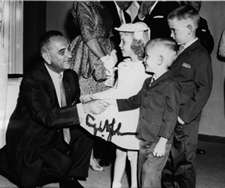 |
Left
to right: Presidential candidate Lyndon Johnson during a
visit to Las Vegas shaking hands with 7-year-old Sally Denton,
5-year-old Scott Denton, and 9-year-old Mark Denton. |
I spent much of my
childhood on the campaign trail in Nevada--an endless string of
parades in the cow counties, of small planes landing on dirt runways
lit by the headlights of the towns' Democrats, of union rallies
and West Side Las Vegas churches, of rodeos and gambling halls,
and dark desert bars inevitably called "Oasis." During those hot
dusty days, as Sawyer was facing defeat in reelection as governor
and as my father was twice running unsuccessfully for Congress,
I saw everywhere that it was a tough world for an honest man.
In a child's orbit of turmoil and upheaval, of gin and smoke,
joking and polling, speeches and leaflets, I recognized how corrupt
the system was by watching these two incorruptible men in it.
I was inspired by their example but very much aware of, and repelled
by, the enormous forces that were always arrayed against them.
Though I always loved Nevada, when I graduated from high school
in 1970, I couldn't wait to get away from the place and make a
life elsewhere. Still, like so many loyal Nevada kids, I began
at the University of Nevada at Reno, its charming old Ivy League-modeled
quad only a few blocks from the legendary Virginia Street with
its pulsing casinos in what was still advertised as "The Biggest
Little City in the World." But I soon went off to finish college
at the University of Colorado at Boulder, where for a brief time
the garish landscape of Las Vegas seemed far away.
Afterward, wherever
I went as a journalist and writer, Las Vegas followed me. After
a brief stint editing my hometown weekly newspaper, where I was
soon fired by the publisher for rather too candid coverage of
local politics, I went to work for a small paper in northern New
Mexico, the Rio Grande Sun, whose editor and publisher, Bob Trapp,
while largely unknown nationally, is one of the authentic legends
of integrity and independence in American journalism. Assigned
to cover the murder of one young woman, I soon encountered a string
of murders that led to a major exposé of drug trafficking in New
Mexico implicating individuals at the highest levels of state
government and law enforcement, and with unmistakable trails back
to Las Vegas. From New Mexico I went to work for the renowned
nationally-syndicated columnist Jack Anderson in Washington, D.
C., where in much the same way every major story I worked on had
inevitable Vegas connections. From the Anderson staff I moved
to become a television reporter in Lexington, Kentucky, and there,
too, what started as covering the disappearance of a young woman
led to one of the biggest stories of my career, involving drug
smuggling, gun running, and money laundering, and implicating
leading figures in Kentucky politics, a story that is told in
my first book, The Bluegrass Conspiracy, and in which,
yet again, Las Vegas played a major role. In short, from 1977
to 1995, every significant story I ever covered as a journalist
wound back to Las Vegas, including my first collaboration with
Roger Morris on drug trafficking and money laundering in Arkansas.
Against this background, coming together with Roger and deciding
to approach Las Vegas as a prism for the larger story of American
corruption over the last half of the 20th century was a natural
outcome of my writing career and experience. Because so many trails
seemed to lead to Las Vegas, we saw it as richly and ominously
symbolic.
Certainly this book
combines the unique mix of the perspective of a national historian
and presidential biographer with that of an investigative journalist.
But I hope that in the end I have brought something more as well.
I still hearken back to those cowtown parades, headlight-lit runways,
and the memory of men talking in smoky bars. This book is not
only an exposé of America's hidden history, of the larger dimensions
of money, power, and corruption. It is also very much the story
of the people of Nevada, of the flesh-and-blood triumphs and tragedies
that have accompanied the historic importance of this much visited,
yet still relatively unknown place. I take great pride in having
written a book that is true to my heritage and so deeply rooted
in my past, a book that never loses sight of the human dimensions
of the drama of Las Vegas. That's why The Money and the Power
is dedicated in part to the people of the "sweet promised land."
ROGER
MORRIS on
the dark trails to
Las Vegas
Two personal experiences--two
extraordinary women, really--drew me toward the perspective of
The Money and The Power, and particularly to the concept
of Las Vegas as a shadow capital of 20th- and 21st-century America.
Growing up in the
Midwest I was very close to my maternal grandmother, who as a
young widow running a small business in 1920s Kansas City had
known firsthand the old Pendergast regime and its classic combine
of politics and organized crime. For years she had been forced
to pay extortion kickbacks directly to an ambitious county politician
and after-hours bagman named Harry Truman (a subject, incidentally,
I plan to write about some day). From this rather remarkable grandparent
I got a very practical, vividly drawn, and colorfully told understanding
of American corruption. It was a candid picture of the profound
and pervasive enmeshment of underworld and upperworld, of the
real system within the system, and the fundamental reality of
American life not truly addressed in academia or in more elevated
precincts of government and journalism. I didn't heed or accept
her wisdom right away, of course. Through the haze of intellectual
pretension, a good deal of ignorance, and the larger cultural
complexity, I did not realize until my late 50s just how sadly,
sweepingly right she had been all along. The show line, as they
used to say on the Strip, is that a Missouri country girl goes
to the big city and ends up lighting my way to Vegas. Nothing
in this book--no matter how radical or startling or downright
unpalatable to my establishment colleagues--will surprise you,
grandmama.
The second influence
was equally humbling. About almost everything I did in a career
of seeming accomplishment and generous recognition--graduate study
at Harvard and abroad, service in the White House and National
Security Council under two presidents, work on Capitol Hill and
the foundation world, investigative journalism in both foreign
and domestic affairs, and several books as a political historian
and presidential biographer--there was a nagging and growing sense
of how much I didn't know, of ultimate points missed and connections
left dangling, of the darker, unmarked, unacknowledged trails
that always led off from what I was seeing and writing about;
trails that pointed, like my grandmother's wisdom, to Las Vegas.
It wasn't until after the Clinton book and I came together with
Sally--who has been very much my mentor and courageous guide as
well as co-author in all this--that I was intellectually open
to following those trails, and to accepting what the discovery
said about my country, my generation, my own work as a writer.
It was Sally who showed me, as a supposedly trained and award-winning
historian, much of authentic American history for the first time.
Of our America, as
we conclude in the book, Las Vegas is metaphor, symbol, chilling
and momentous reflection. Gaining that revelation was a somber
yet liberating discovery for me. I hope it'll be the same for
our readers.
|