|
|
 |
|
|
|
 |
 |
 |
|
Q: Let's begin with something obvious. You're in your forties, and
you're just publishing your first book of poems. And when I came across
your manuscript, I was surprised it was a first book. It has the
maturity, and the authority, the confidence in its own strangeness, of a
second or third book. How did it come about that you're doing this now?
How long has this book been in the making?
A: Two
decades ago I studied in the writing program at Columbia. Lucie
Brock-Broido and Henri Cole were my classmates. But I couldn't imagine
myself as a writer. For years I did various literary jobs around town,
translations of books and films. When I thought about writing my own
words, I imagined pressing down so hard on the pen that I broke the nib.
When I looked inward, I saw nothing but turmoil and grief. I couldn't
realize my thoughts; I had a voice but couldn't use it. I began a
psychoanalysis, on the couch, five times a week, as a training patient;
and I began studying my dreams. My dream associations surprised me:
not only did they tell me what I direly needed to know, but they leapt
from memory to idea, from color to shape, drawing connections. For the
first time, I found my own thoughts intriguing and even beautiful. It
was in that open, amazed mood that I began to hear the voices that
created these poems. That happened just after I turned
forty.
Q: Who are the visitors that speak to you throughout
these poems? We get various images of them, for example, when they say
"we wear no form or figure of our own ... to tell us from the
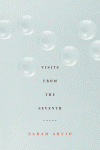
motions of the air... we'd love to live even in a bubble"—and
in another place, they come to you in their "inevitable rows of
seven." Do you see them as departed souls, or not that
ghostlike?
A: They're visitors; I hear words and
pick up a pen; they inhabit my hand when I write. They inhabit my hand
when they’re speaking; at other times, I inhabit my hand. The
difference is distinct. I don't know what they are; they're
disembodied; they may be spirits, if anyone can know what a spirit is.
Q: Are the voices, in a way, a metaphor for your poetic
process?
A: Auden has an ironic line: "All the
literati keep an imaginary friend." The visitors may be my notion:
a projection of my wish to hear them. But I've often been astonished by
what they've said to me, and can't imagine saying what they've said.
Their memory is stronger than mine, and their associative powers are
stranger and more vivid. After a while, the debate emerged in one of my
poems: Three Green Stars. The final line is, "Matter or
not, it's all material." Meaning that it doesn't matter what the
source is: anything is material for art. It doesn't matter whether it's
my notion or a notion accepted from some undefinable
elsewhere.
Q: These voices seem different from those that
James Merrill channeled at the Ouija Board with his willowware cup, but
I wonder if there's a relationship there. Was The Changing Light at
Sandover an influence on your life or your work?
A: I met James Merrill when he was still writing
The Changing Light at Sandover. I said to him, "I use a
pen." He replied, "I envy you, a cup is so cumbersome."
Then I said, "Mine talk to me only about love." "You're
young," he said, "love is the subject of the young. Later,
they'll talk about other things." I was fascinated by
Sandover; by the scope of what his visitors said to him. Mine
said so little to me; they mostly made idle predictions. And then
suddenly, years later, they began to speak the lines that make up this
book. As time passed, I noticed that their main concern was still love;
I hope that means I'm still young.
Our only real similarity I
think--Merrill's and mine--is the source: his visitors were his
friends, mine are mine.
Q: Your title is a nice mystery;
Visits From The Seventh. I think when I first signed your book up I
asked you, "seventh what?" And you replied,
"heaven?" Can you explain that a bit?
A: The
Seventh is the place they inhabit: an elsewhere. I was giddily
surprised when they told me that the extrasensory sense wasn't the sixth
sense at all, but the seventh sense, a more fitting number for a
mystical sense. The seventh sense is that uncanny sense of knowing what
you've learned you can't know. The sixth sense, on the other hand, is
sex. Have you ever wondered why sex, which subsumes all the other
senses, has never owned a sense in its own right?
Q: The
visitors are with the speaker of these poems in all kinds of situations.
They spy on her during sex, they walk with her up Park Avenue, they
ponder her dreams, they hash out her relationship with a
"murderous" mother. Yet there's something lonely about her.
Is this sequence of poems in part about intimacy? About the presence or
the lack of it? About the comforts available to the solitary
self?
A: No one well accompanied in life needs or
wants imaginary friends. Maybe my visitors came to me because I needed
others: interlocutors, confessors, consolers. They admonish me to live
better, and living better means living a loved life. For some people,
this comes naturally, others have to find their way to it.
Q:
Your poems, on first reading, did seem to me to be about love, without
really being love poems.
A: In a sense, you could
say the poems are odes: love poems to life; poems of longing for life.
I was brought up among radical Quakers. Although I renounced all that
long ago, I realized recently that some of those ideas had taken root in
me. Quakers assert, for instance, that there must be no mediator between
ourselves and god: only we--each of us--can know what god is. They also
believe in creating the kingdom of heaven on earth. Don't glorify an
afterlife; long for this life.
Q: In another part of your life
you work as a translator for the U.N. How does that work come into
these poems, if at all?
A: I think I learned to
entertain and enjoy abstract thought from working on the international
treaty bodies and from translating treaties. The poem Denmark
arose from the remarks of the Danish delegation before one of the human
rights committees: the "presumption rule" established the
relationship between international and domestic law. In the poem the
rule refers to the relationship between external and internal
strictures: what law is greater? "Will" is a sort of spoof on
treaties, which are arrangements between countries: the poem talks about
an arrangement between oneself and oneself, the parts or parties of
oneself. This reminds me of a line from the film Anatomy of a
Murder. The lawyer's secretary says something like, "The p key
on this typewriter is worn off: all my drafts read 'arty of the first
art.'"
Q: Do you write every day?
A:
When I'm writing, I write at dawn, before the day begins, wherever I
happen to be. First drafts, however, come when they come. I was often
traveling when I worked on this book, and many came to me on trains and
planes, in cafés and hotel bathtubs. When I hear a certain rhythm
or intonation, I know I'm hearing what I want to hear. Sometimes
another alien, singsong sort of sound intrudes: then I have to stop and
wait for it to disappear. I wrote these poems for two years without a
pause, and then stopped, and waited two years before I could begin
again. Then I wrote for two more years and was done. What did I do in
the meantime, when I wasn't writing? Try to live. Valéry said
that, "Il faut tenter de vivre!" (We must try to
live!)
|
|
|
|
|
|
|
|
|