|
 |

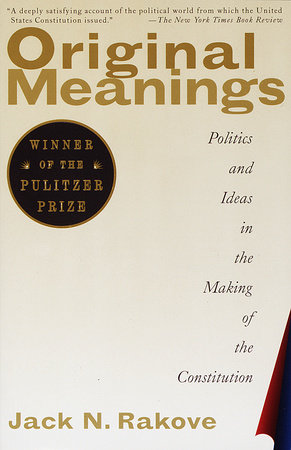
Winner of the Pulitzer Prize
What did the U.S. Constitution originally mean, and how can we understand the intentions of its framers? From abortion to same-sex marriage to gun control, today's most heated legal and political debates hinge on these questions. Rakove traces the complex weave of ideology and interests from which the Constitution emerged and shows how it has meant different things to different groups of Americans at different moments in its creation. Original Meanings examines all classic issues that the framers of the Constitution had to solve: federalism, representation, executive power, individual rights, and the idea that the Constitution itself should become supreme law. In the process, Rakove brings to life such personalities as George Washington, Alexander Hamilton, Benjamin Franklin, James Wilson, and, especially, James Madison--the Constitution's presiding genius--thus creating an accessible historical context in which students can consider the Constitution anew. It is essential reading for anyone hoping to understand the way American history, law, and politics intersect, as well as the issues that continue to rage around the Constitution today.
PRAISE FOR Original Meanings:
"A deeply satisfying account of the political world from which the United States Constitution issued--one in which members of a knowledgeable and experienced elite spoke with frankness of their fears.... It demonstrates convincingly that the world of our Founding Fathers is not ours." --The New York Times Book Review
"Rakove demonstrates the historical and theoretical complexity of the seemingly simple notion of a "jurisprudence of original intention"--the theory that judges can interpret the Constitution solely by reference to the opinions of its framers.... Rakove appears to contend that the Constitution was intended to be a living document, not a static, once-and-for-all enumeration of all individual rights and federal powers. "How," asks the author rhetorically, "could those who wrote the Constitution possibly understand its meaning better than those who had the experience of observing and participating in its operation?" A unique contribution to the historical and legal debate surrounding the Constitution." --Kirkus Reviews

WINNER 1997 - Pulitzer Prize
|
 |