
|
 |
 |
 |
|
|

Nowhere is the nature-nurture controversy being more arduously tested than in the labs of world-rennowned molecular scientist Dean Hamer, whose cutting-edge research has indisputably linked specific genes to behaviorial traits, such as anxiety, thrill-seeking, and homosexuality.
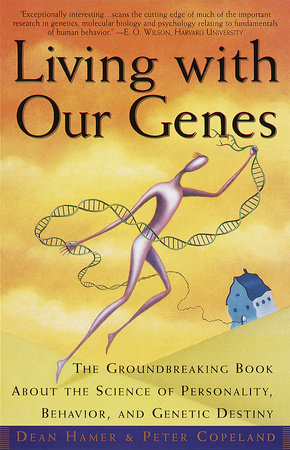
The culmination of that research is the provacative book, Living with Our Genes. In it, Dr. Hamer reveals that much of our behavior--how much we eat and weigh, whether we drink or use drugs, how often we have sex--is heavily influenced by our genes. Dr. Hamer also sheds light on some of the most compelling and vexing aspects of personality, such as shyness, aggression, depression and intelligence.
Living With Our Genes argues that genes are the single most important factor in the wondrous variability of human behavior. In the past, studies of twins supported the assumption that inheritance plays a major role in why we feel or behave the way we do. Now, scientists are developing an impressive arsenal of research to identify the individual genes that guide human behavior.
In the tradition of Listening to Prozac, this is an anecdote-filled book that attempts to explain how we arrive at the idea of self in an ever-changing scientific landscape.
PRAISE FOR LIVING WITH OUR GENES
"Compulsive reading, reminiscent of Jared Diamond, from a scientist who knows his stuff and communicates it well." --Kirkus Reviews
"A pioneer in the field of molecular psychology, Hamer is exploring the role genes play in governing the very core of our individuality. Accessible...provocative." --Time

Dean Hamer is Chief of Gene Structure and Regulation in the Laboratory of Biochemistry at the National Cancer Institute in Bethesda, Maryland. His a graduate of Harvard University and a pioneer in molecular genetics who has published over 100 research papers.
Award-winning writer Peter Copeland is managing editor of Scripps Howard News Service in Washington, DC. This is his fourth book. Hamer and Copeland also wrote The Science of Desire, a New York Times Notable Book, in 1994.
|
 |