 A Q&A with Steve: A Q&A with Steve:
Question: The subject of your new novel deals with the Knights Templar. Who exactly were they?
Steve Berry: The Knights Templar were a monastic military order formed in Jerusalem at the beginning of the twelfth century with the mandate of protecting Christian pilgrims on route to the Holy Land. Their full name was The Poor Fellow Soldiers of Christ and the Temple of Solomon at Jerusalem, but they came to be known as the Knights Templar. Never before had a group of secular knights banded together and taken monastic vows. They lived by a strict set of rules and went on to become the first standing army since Roman times, fighting alongside the Crusaders for the Holy Land. From humble beginnings (the original nine knights relied on alms from traveling pilgrims) the Templars rose to earn the backing of the Holy See and many European monarchs. Within two centuries of being formed, they became the owners of some 9,000 tax free estates, subject only to papal authority, powerful enough to defy all secular authority.
Q: Weren't they a bit before their time?
SB: No question. In fact, putting to use their vast wealth, the Templars essentially invented banking as we know it. The Church, of course, forbade the lending of money for interest. The Templars, being clever, changed the manner in which loans were paid, giving themselves room to charge impressive fees for their lending. In time, the Order routinely financed kings and nations. It also invented the check. Pilgrims headed to the Holy Land, instead of carrying their money for thieves to seize, deposited funds with the local Temple; obtained a receipt; then presented that receipt when they arrived, whereupon their funds were returned by that Temple. Quite an accomplishment for the twelfth century. The Templars also operated safe deposit boxes and helped perfect the concept of a security interest in personalty and land.
Q: So what happened to the Knights Templar?
SB: The Order simply became too powerful. Pope Innocent II exempted the Templars from all secular authority. This privilege bred an arrogance that was hard for the Templars to conceal. A few of the masters even openly challenged the authority of kings. The Order's private nature, reflected in secret meetings and rituals, also aided in its downfall. The King of France, Philip IV, used all this when he set out to destroy them. The Templars maintained a strong presence in France and Philip felt threatened by their presence. He also desperately needed funds to support his war against England. So, on October 13, 1307, Philip ordered all the Templars arrested on the grounds of heresy, since this was the only charge that would allow him to seize their money and assets. Many were tortured and, as a result, ridiculous confessions were given. These included trampling and spitting on the cross, committing acts of sodomy, and worshiping an idol.
Q: So what happened?
SB: Seven years of trial and tribulations followed the 1307 purge and, in 1311, Pope Clement V formally disbanded the Order. Several hundred Templars were eventually executed. Finally, on March 19, 1314, the last master, Jacques de Molay, was burned at the stake. De Molay is said to have cursed Philip and Pope Clement as he burned, asking both men to join him in death within a year. Whether he actually uttered the curse or if it's simply an apocryphal tale, we may never know. What's for certain is this: Clement died one month later and Philip seven months after that.
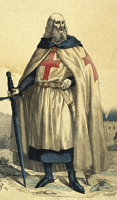 Q: Jacques de Molay figures prominently in The Templar Legacy, was he interesting to write about? Q: Jacques de Molay figures prominently in The Templar Legacy, was he interesting to write about?
SB: On the one hand he was a tough, defiant leader. On the other, he was politically inept and embarrassingly arrogant. His underestimation of Philip IV cost the Order dearly, but he's now generally regarded as a martyr. For seven years, after being arrested, de Molay suffered torture and inhuman conditions, but he never disclosed the location of the Order's wealth or knowledge. By all accounts, he died proud.
Q: What about that Templar treasure and wealth? Was any of it ever found?
SB: Philip looked in vain, but to this day no remnant of either has been discovered. There have been countless theories as to what the treasure and the knowledge entailed and where they might have ended up, everything from the European continent, to Scotland, to even America where the Templars supposedly sailed in the thirteenth century. But nothing has ever been proven. What better fodder for a novelist?
 Q: How did you become interested in The Templars? Q: How did you become interested in The Templars?
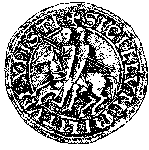
SB: I've always been fascinated with them, and writing this book gave me the chance to study the Order in detail. It was important that they be presented as they were, not some Hollywood stereotype, though a few liberties had to be taken to make sure the story remained a thriller. Their 686 Rules, though, are a fascinating read. Obedience was paramount. Contrary to Sir Walter Scott and Ivanhoe, they were forbidden from participating in tournaments; they spoke sparingly without laughter; they did not bathe; they slept with the lights on and dressed; and they were not allowed to gamble or hunt, play games, or grow their hair, though their beards could be unkept. By papal order the knights were allowed to wear a white mantle with a red cross, while the remainder of the Order wore differing colored mantles. Within The Templar Legacy there's an initiation ceremony which I tried to recreate accurately. That was quite an elaborate event. The hierarchy was simple: The master was in absolute charge, aided by seneschals, who commanded the knights (all of noble heritage) and the sergeants (warriors of non-noble background). Chaplains were the clerics and the rest of the Order were comprised of artisans, farmers, craftsmen, and administrators. Tens of thousands joined. Tens of thousands died fighting. Quite an organization. And the term 'warrior-monks'—what a marvelous contradiction.
Q: The French town of Rennes-le-Chateau is crucial to the story. What makes this place so mysterious?
SB: Rennes is located in the Languedoc, an unspoiled region of southern France. There are many mysteries surrounding this village that link it with everything from the Holy Grail to Noah's Ark, from the Ark of the Covenant to the treasures of the Temple of Solomon. In the 1950s the owner of a local hotel used the story of the priest Berenger Sauniere as an attraction to draw visitors. He suggested that, after finding parchments in an ancient pillar in the local church, Sauniere, sometime around 1891, found a great treasure. This story, published in the local newspaper, caught national attention. A French book by Gerard de Sede published in 1967 brought further attention. People started flocking to the area and serious treasure hunting got under way—so serious that, when people's houses began to collapse due to the tunneling, the town halted all unauthorized excavation.
Q: Has anything ever been found?
SB: Not a thing, but the myths and legends live on. Sauniere's renovated church is still there today. It is indeed a place of contradiction and perhaps sublime messages. More garish than beautiful, after a visit it's easy to see why conspiratorialists find fuel there for the imagination.
Q: What about Berenger Sauniere, what kind of man was he?
SB: A unique one. Sauniere was born in 1852, the eldest of seven children. He entered the seminary in 1874, was ordained as a priest in 1879, then was appointed abbe at Rennes-le-Chateau in June 1885. He was outspoken, an anti-republican, possessed of a glass eye, and often played the lottery. He also maintained an amorous relationship with Marie Denarnaud, who lived with him as his housekeeper. During his life, he openly spent huge amounts of money building and entertaining. Then he defied the Church and refused to account for his expenditures. Ultimately, he was relieved as a priest. His appeal went all the way to the Vatican but remained unresolved at the time of his death in 1917. Even in death, though, strange things happened. His body was laid out for viewing, covered by a cloth edged with red pom poms. As the locals walked by to pay their respects, inexplicably they each plucked the pom poms off one at a time. In another contradiction, he died absolutely penniless, as all of his assets had been transferred to Marie beforehand. It wasn't until forty years after he died that his tale took on mythical proportions. I had a lot of fun bringing him back to life and re-living his exploits.
Click here to read more of the interview.

|