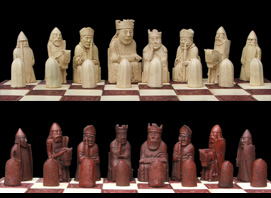


Despite appearances to the contrary, the rolling, uneven dunes on the west coast of the Isle of Lewis, about fifty miles west of the Scottish mainland, are not ancient burial mounds. They're natural formations, configured over thousands of years by the shifting water table and the terrific sea winds howling off the Atlantic.
But the dunes do have their powerful secrets, as an unsuspecting island peasant learned one day in the spring of 1831. At the base of a fifteen-foot sandbank near the south shore of the Bay of Uig, the interior was somehow exposed, and with it a nearly seven-hundred-year-old crypt. Our unwitting archaeologist stumbled into an ancient and cramped drystone room, six feet or so long and shaped like a beehive, with ashes strewn on the floor. The tiny room was filled, impossibly, with dozens of shrunken people: tiny lifelike statuettes, three to four and a half inches high, some stained beet-red and the rest left a natural off-white. The long hair, contoured faces, and proportionate bodies were eerily vivid, even animated, with wide-eyed, expectant expressions, battle-ready stances, and a full complement of medieval combat equipment and apparel. Hand-carved from walrus tusk and whale teeth, they wore tiny crowns, mitres, and helmets; held miniature swords, shields, spears, and bishop's crosiers; some rode warhorses.
They were chess pieces, a total of seventy-eight figurines comprising four not-quite-complete sets:
eight Kings (complete)
eight Queens (complete)
sixteen Bishops (complete)
fifteen Knights (one missing)
twelve Warders (as Rooks, four missing)
nineteen Pawns (forty-five missing)
No one living at the time had ever seen anything like them. The ornamentation had a medieval gothic quality that lent the pieces an ancient and even mythic aura. Experts pronounced them Scandinavian, probably mid-twelfth century, probably carved near the Norwegian capital Trondheim some seven hundred miles away by sea, where a drawing of a strikingly similar chess Queen was later discovered. Norway was a long way off, but the link did make historical sense. The Isle of Lewis had been politically subject to the Kingdom of Norway up to 1266, and the local bishop held allegiance to the powerful Archbishop of Trondheim.
These weren't nearly the oldest chessmen discovered—1150 put them somewhere in the middle of the chess chronology. But their abundance, origins, artistry, and superb condition made them among the most important cache of ancient pieces yet found. The modestly endowed Society of Antiquaries of Scotland tried immediately to buy them for display in Edinburgh, but before they could raise the funds, bigger fish swam in. A wealthy Scottish collector somehow plundered eleven of them for his private collection, and the British Museum in London bought the rest—sixty-seven pieces for eighty guineas (equivalent to £3,000 or roughly U.S. $5,000 in today's currency).
The museum immediately recognized not only the pieces' unique importance in the history of chess, but more importantly their profoundly palpable connection to life in the Middle Ages. "There are not in the museum any objects so interesting to a native Antiquary as the objects now offered to the trustees," wrote the museum's keeper of antiquities, Edward Hawkins, as he presented the pieces for the first time. The Lewis Chessmen were a priceless link to the past, and would become a signature draw at the museum.
There they now sit, sealed in a new glass crypt in the British Museum's Gallery 42. Anyone can visit them.
"When you look at them," suggests curator Irving Finkel, "kneel down or crouch in such a way that you can look through the glass straight into their faces and look them in the eye. You will see human beings across the passage of time. They have a remarkable quality. They speak to you."
Excerpted from The Immortal Game by David Shenk Copyright © 2006 by David Shenk. Excerpted by permission of Doubleday, a division of Random House LLC. All rights reserved. No part of this excerpt may be reproduced or reprinted without permission in writing from the publisher.