
|
dear cooks,
"Her handy little book grew out of the omnivore's real dilemma: what to do with all the expensive things you bought too many of at the farmers' market."-The New York Times
|



Everyday Food about the book No matter how busy you are, at the end of the day you want fresh, flavorful meals that are easy to prepare. And you want lots of choices and variations—recipes that call for your favorite foods and take advantage of excellent (and readily available) ingredients. In the first book from the award-winning magazine Everyday Food, you’ll find all of that: 250 simple recipes for delicious meals that are quick enough to make any day of the week. Because a change in weather affects how we cook as much as what we cook, the recipes in Everyday Food are arranged by season. For spring, you’ll find speedy preparations for main-course salads, chicken, and poached salmon that minimize time spent at the stove; summer features quick techniques for grilling the very best burgers and kabobs as well as no-cook pasta sauces; for fall, there are braised meats and hearty main-course soups; and winter provides new takes on rich one-dish meals, roasts and stews, and hearty baked pastas. Finally, a chapter on basics explains how to make year-round staples such as foolproof roast chicken, risotto, couscous, and chocolate sauce.
|
Cherries in Wine Makes 4 pints You know summer has finally arrived when the cherries start to come in. The season is short, so in the months that follow I am always grateful that I have taken the time to put some up. These preserves are great used in both savory and sweet dishes. I love having them on hand for unexpected company. All I have to do is dump 1⁄2 cup into a wineglass and top with whipped cream for a surprisingly elegant dessert. Cherries have high acidity, as do wine and orange juice, making this a safe product for water bath processing. I use an olive pitter to pit the cherries.
Place the wine, sugar, orange juice, cloves, and orange zest in a medium pot. Bring to a low boil over medium heat, stirring all the while to dissolve the sugar and ensure it doesn’t burn. Have ready 4 scalded pint jars and their bands. (To scald, simply dip the jars in boiling water. You don’t need to sterilize the jars, as you will be processing them for over 10 minutes.) Simmer new lids in a small pan of hot water to soften the rubberized flange. Add the cherries to the wine and simmer for 10 minutes, until they are soft but not collapsed looking. Remove the cherries with a slotted spoon and ladle them into the hot jars. Reduce the wine mixture remaining in the pot over medium-low heat to about half its volume, about 10 minutes. It will be rather viscous. Strain the wine mixture and pour over the cherries in the jars, leaving 1⁄2 to 3⁄4 inch of headspace. Wipe the rims, set on the lids, and screw on the bands fingertip tight. Place the jars in a big pot with a rack in the bottom and add enough water to cover the jars by 3 inches. Bring to a boil over high heat, then lower the heat to medium and gently boil the jars for 20 minutes. Turn off the heat, allow the jars to rest in the water for 5 minutes, and then remove. Allow the jars to cool, untouched, for 4 to 6 hours. Check the seals and store in a cool, dry place for up to a year. Refrigerate after opening. 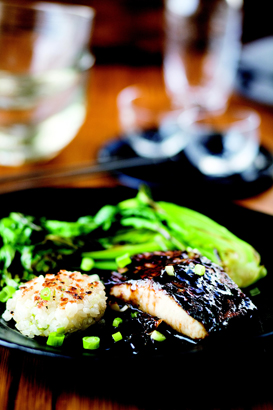
Teriyaki Black Cod with Sticky Rice Cakes and Seared Baby Bok Choy Serves 6 A staple of classic Japanese cooking, teriyaki is wonderful with not only seafood but also poultry, beef, vegetables, and tofu. Often, however, this versatile sauce can be quite sweet. My version uses fresh orange juice, which adds just a touch of natural sweetness as well as some acidity to temper the sweet mirin. Pouring some of the teriyaki sauce into the hot pan with the fish further reduces it so the sauce really coats the fish with a deep, caramel glaze that enhances the delectable moist, buttery, and tender qualities of black cod perfectly. Other good fish for this dish are Alaskan cod, true cod, sablefish, or wild salmon. Searing each side of the sticky rice cake gives a nutty flavor and crisp texture. I also like to serve these rice cakes with vegetable stir-fries in place of plain rice. If you have a rice cooker, use it to prepare the rice according to the manufacturer’s directions. If not, follow the instructions in the recipe to prepare it in a saucepan.
For the sticky rice cakes
For the black cod
Bring a large pot of water to a rapid boil. Prepare a bowl of ice water. Add the bok choy to the boiling water and cook for 30 seconds. Drain the bok choy and immediately transfer it to the ice water for 2 minutes to cool. Drain the bok choy and set aside on a clean kitchen towel to soak up excess moisture. Prepare the sticky rice cakes. Put the rice in a large bowl and cover with cold water. Use your hand to swish the rice around a few times. Drain and repeat until the water in the bowl is clear; you may need to rinse it several times. Put the rice in a small, heavy-bottomed saucepan and add water to cover by 1 inch. Cover the pan; for best results, do not uncover the pan at any time during cooking. Bring to a boil over medium-high heat, 4 to 5 minutes; you will be able to tell the water is boiling by the large amount of steam pouring out from under the lid. Reduce the heat to low and simmer, covered, for 10 minutes. Remove the pan from the heat and let stand, covered, for 15 minutes. Spray a small sauté pan with grapeseed oil and heat over medium heat. Add the scallions, garlic, and ginger and cook, stirring, until just softened and fragrant, about 30 seconds. Fold the scallion mixture into the warm, cooked rice along with the vinegar, mirin, salt, and pepper. Line a platter or baking sheet with parchment paper sprayed with oil or with waxed paper. Have a separate bowl of water ready. Dip your hands into the water and scoop up 1/4 cup rice. Form it into a tightly packed cake about 2 inches thick and place the cake on the platter. Repeat with the remaining rice to form five more cakes. Set aside in the refrigerator. Meanwhile, in a small saucepan, combine the soy sauce, orange juice, mirin, and ginger. Bring to a boil and reduce the heat to low. Simmer just until reduced by half, 30 to 40 minutes. In a small dish, mix the cornstarch and 1 teaspoon water and stir this slurry into the simmering sauce. Simmer 30 seconds and remove the pan from the heat. Preheat the oven to 400°F. Season each fillet with pepper. Spray an ovenproof sauté pan (preferably nonstick) with grapeseed oil and heat over medium-high heat until hot but not smoking. Lay the fish in the pan flesh side down (not the side where the skin was); you should hear a sizzle. Cook until golden brown, about 3 minutes. Turn the fish over and place the pan in the oven. Cook until the fish is just cooked through, 6 to 8 minutes. Pour half of the teriyaki sauce over the fish. The sauce will bubble and simmer. Gently turn the fish over and gently swirl the pan to coat the fish. Turn the fish over again. While the fish is cooking, finish the bok choy: spray a nonstick skillet with grapeseed oil and heat over medium-high heat until hot but not smoking. Place the bok choy in the pan cut side down and cook until deep brown, 3 to 4 minutes. Turn the bok choy over and cook 1 minute. Remove the bok choy from the pan. To finish the rice cakes, spray a nonstick skillet with oil and heat over medium heat until hot but not smoking. Add the rice cakes and cook until heated through and golden on both sides, 2 to 3 minutes per side. Divide the bok choy halves among six plates. Place a rice cake and a fillet of teriyaki cod next to the bok choy and drizzle teriyaki sauce around the plate and over the fish. Sprinkle each serving with sliced scallions and sesame seeds. Serve.
|
|
|
|
 | |

If this e-mail was forwarded to you and you would like to subscribe to the Potter Recipe Club,
send an e-mail to sub_potter@info.randomhouse.com
To unsubscribe, e-mail unsub_potter@info.randomhouse.com
Clarkson Potter is an imprint of the Crown Publishing Group, a division of Random House, Inc. • 1745 Broadway, New York, NY 10019