Random House: Bringing You the Best in Fiction, Nonfiction, and Children's Books
Authors
Books
Features
Newletters and Alerts

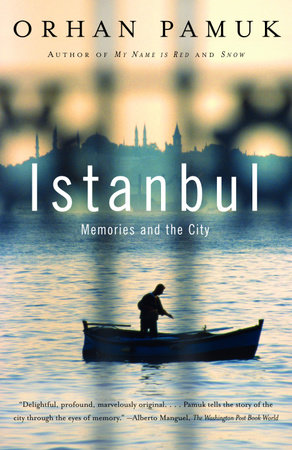
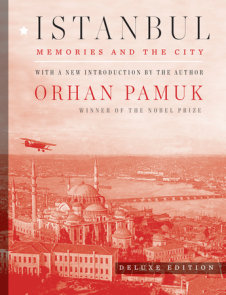
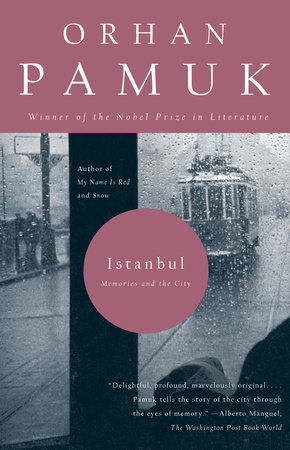
Istanbul

Memories and the City

Written by Orhan PamukAuthor Alerts:  Random House will alert you to new works by Orhan Pamuk

Istanbul Enlarge View
Upgrade to the Flash 9 viewer for enhanced content, including the ability to browse and search through your favorite titles
Istanbul
Written by Orhan Pamuk
Format: Trade Paperback
ISBN: 9781400033881
Our Price: $15.95
 Quantity: 1 
Buy From a Local Store

Also available as an eBook and a hardcover.

ABOUT THIS GUIDE

“Delightful, profound, marvelously original. . . . Pamuk tells the story of the city through the eyes of memory.” —Alberto Manguel, The Washington Post Book World

The introduction, discussion questions, suggested reading list, and author biography that follow are intended to enhance your group’s reading of Orhan Pamuk’s Istanbul, an intimate, richly rewarding tale of growing up in a city haunted by the ghosts of its glorious past.

ABOUT THIS BOOK

Blending reminiscence with history; family photographs with portraits of poets and pashas; art criticism, metaphysical musing, and, now and again, a fanciful tale, Orhan Pamuk invents an ingenious form to evoke his lifelong home, the city that forged his imagination. He begins with his childhood among the eccentric extended Pamuk family in the dusty, carpeted, and hermetically sealed apartment building they shared. In this place came his first intimations of the melancholy awareness that binds all residents of his city together: that of living in the seat of ruined imperial glories, in a country trying to become “modern” at the dizzying crossroads of East and West. This elegiac communal spirit suffuses Pamuk’s reflections as he introduces the writers and painters through whose eyes he came to see Istanbul. Against a background of shattered monuments, neglected villas, ghostly back streets, and, above all, the fabled waters of the Bosphorus, he presents the interplay of his budding sense of place with that of his predecessors’. And he charts the evolution of a rich, sometimes macabre, imaginative life, which furnished a daydreaming boy refuge from family discord and inner turmoil, and which continued to serve the famous writer he became.

Reader's Guide

1. “I can’t remember where I got this idea or how it came to me,” Pamuk writes, but from as early in life as he could remember he sensed the presence of a second self [p. 3]. When his aunt verified this notion by insisting that a strange boy in a photograph in her apartment was Orhan, the “ghost of the other Orhan” came to haunt him [pp. 4–5]. What interpretations might you suggest for this fascination with and fear of the double self? If you have read Pamuk’s fiction, which books does the story of “the other Orhan” bring to mind?

2. In saying “This book is concerned with fate” [p. 7], Pamuk suggests that fate consists largely in being born in a particular place at a particular time. If fate usually connotes a fixed course in life and a passive acceptance of circumstance, how does Pamuk, as a writer, manipulate his own fate? What does he make of the fate of being born an Istanbullu?

3. Why does Pamuk refer to his family-owned apartment building as “our bleak museum house” [p. 34]? What are the circumstances or physical details that convey the sense of bleakness or entrapment?

4. Readers familiar with Pamuk’s writing are aware of his delight in lists. What is the purpose of the list that runs from page 94 to page 99? What is its effect?

5. What do the photographs contribute to the book? Although the images come from a variety of sources, those of Ara Güler and those from the archives of Selahattin Giz are most numerous (see pp. 371–73). Do the photographs convey a certain mood or a certain perspective on Istanbul? What do they express about the city, particularly for readers who have never visited?

6. To what degree is Pamuk’s adult identity rooted in his childhood and adolescent experiences? If you have read Marcel Proust or other writers whose childhood memories are the source of their creative life, how does Pamuk’s writing compare?

7. How does nostalgia differ from memory? Throughout the book Pamuk expresses a painful nostalgia for the Istanbul of his past, as well as for the Istanbul that existed before he himself was born. What are the mixed emotions evident in the following passage: “To see the cypress trees, the dark woods in the valleys, the empty and neglected yalis, and the old weathered ships with their rusty hues and mysterious cargoes, to see—as only those who have spent their lives on these shores can—the poetry of the Bosphorus ships and yalis, to discard historical grievances and enjoy it as fully as a child, to long to know more about this world, to understand it—this is the awkward surrender to uncertainty that a fifty-year-old writer has come to know as pleasure” [p. 56]?

8. Pamuk is interested in the way that a place becomes part of a person, and believes that neither he nor his art would be the same without his having lived in Istanbul throughout his life: “There are writers like Nabokov and Naipaul and Conrad who exchanged their civilizations and nations and even languages. It is a very cherished and fashionable idea in literature and so in a sense I am embarrassed that I have done none of this. I have lived virtually in the same street all my life and I currently live in the apartment block where I was brought up. But this is how it has to be for me and this is what I do” [“Occidental Hero,” The Guardian (London), May 8, 2004]. Consider Pamuk in comparison both to writers who stayed home—like Flannery O’Connor and Jorge Luis Borges—and writers who left home for most of their lives—like James Joyce and Joseph Conrad. What are the relative advantages of lifelong immersion in one’s native city and culture versus lifelong exile for a writer’s work?

9. Does it seem that Pamuk possesses an extraordinarily extensive memory for the scenes and events he experienced as a child? Is it possible that children are far more sensitive to their surroundings than adults? If so, why?

10. For a person so rooted in his native culture, is Pamuk also alienated, in certain ways, from Turkish culture? What are the causes of his alienation? How does his status as a writer of international fame contribute to his isolation?

11. The concept of hüzün is perhaps the most important idea in the book. The sense of melancholy, of paralysis, of having been left behind by modernity, exists in many cultures—it even pervades James Joyce’s Dubliners. What is the cause of hüzün in Istanbul? Does this phenomenon have different causes and different manifestations in different cultures?

12. In an interview, Pamuk described the dual urges behind the writing of Istanbul: “Walter Benjamin says there are two kinds of city writing: those books written by people who come from outside, who tend to look for the exotic, and those written by the people who have lived in the city, which tend to be autobiographical. So I thought, why don’t I go ahead and write a book that would be ambitious as autobiography, and also ambitious as a strange essay about the town? I thought that if I tried to do this, I would find something new. And this is my attempt” [“A City of Constant Melancholy,” The Irish Times, April 23, 2005]. Does Istanbul come across as “something new” in its merging of two genres?

13. How does Pamuk relate himself to the four Turkish writers—Kemal, Tanpinar, Hisar, and Koçu—he discusses in chapter 11?

14. Pamuk notes that Antoine-Ignace Melling, who created beautiful scenes of Istanbul, was a European. What happens when Western visitors to Istanbul romanticize the city, and when natives see themselves and their city through Western eyes? What does Pamuk mean when he writes, “the roots of . . . hüzün are European” [p. 233]?

15. Pamuk is aware that his family was a privileged one that has come down in the world. He writes, “It was a long time coming . . . but the cloud of gloom and loss spread over Istanbul by the fall of the Ottoman Empire had finally claimed my family too” [p. 17]. How does his family history affect his view of himself and his city? How does his status as an internationally known writer affect his identity as an Istanbullu?

16. In chapter 5, “Black and White,” Pamuk writes, “To see the city in black and white is to see it through the tarnish of history: the patina of what is old and faded and no longer matters to the rest of the world. Even the greatest Ottoman architecture has a humble simplicity that suggests an end-of-empire gloom, a pained submission to the diminishing European gaze and to an ancient poverty that must be endured like an incurable disease” [pp. 39–40]. Is such a vision full of opportunities for a writer like Pamuk? How does the relative world-historical significance of his native land affect a writer’s creative outlook?

17. Speaking of the scenic paintings by Antoine-Ignace Melling, Pamuk says, “At times when I was most desperate to believe in a glorious past . . . I found Melling’s engravings consoling. But even as I allow myself to be transported, I am aware that part of what makes Melling’s paintings so beautiful is the sad knowledge that what they depict no longer exists. Perhaps I look at these paintings precisely because they make me sad” [p. 63]. Is this ability to take pleasure in melancholy perhaps a major reason that Pamuk has remained in Istanbul when many other writers might have left?

18. Pamuk has said, “It seems if you write fiction [in the West] your nationality is not that important, but if you write fiction in this part of the world your nationality and, even worse, ethnicity are important. When an English writer writes about a love affair he writes about humanity’s love affair, but when I write about a love affair I am only talking about a Turk’s love affair” [“Occidental Hero,” The Guardian (London), May 8, 2004]. Is this an accurate judgment of how non-Western writers are viewed by the West?

SUGGESTED READING

André Aciman, Out of Egypt; Edmondo de Amicis, Constantinople; Honoré de Balzac, Lost Illusions; Robert Burton, The Anatomy of Melancholy; Italo Calvino, Invisible Cities; Le Corbusier, Journey to the East; Gustave Flaubert, Flaubert in Egypt; Théophile Gautier, Constantinople; Adam Gopnik, Paris to the Moon; Elizabeth Hardwick, Sleepless Nights; Lawrence Kelly, A Traveler's Companion to Istanbul; Knopf Guide: Istanbul; Gérard de Nerval, Journey to the Orient; Jennifer Radden, The Nature of Melancholy: From Aristotle to Kristeva; Orhan Pamuk, The Black Book; Edward Said, Orientalism; Vladimir Nabokov, Speak, Memory; Marcel Proust, In Search of Lost Time; Mary Wortley, Lady Montagu and The Turkish Embassy Letters.

ABOUT THE AUTHOR

Orhan Pamuk, born in Istanbul in 1952 into a well-to-do secular family, studied painting and architecture before becoming a writer. He is the author of seven novels and his work has been translated into more than forty languages. He lives in Istanbul.

  • bookmark, share, and shelve:
  • Add to Good Reads
  • Add to Librarything
  • Add to Living Social
  • Add to Shelfari
  • Add to WeRead
  • (?)
PRINT THIS PAGE EMAIL THIS PAGE