Random House: Bringing You the Best in Fiction, Nonfiction, and Children's Books
Authors
Books
Features
Newletters and Alerts

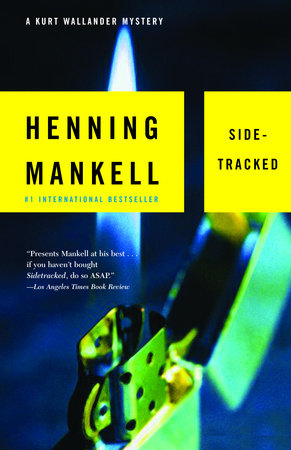
Sidetracked

Written by Henning MankellAuthor Alerts:  Random House will alert you to new works by Henning Mankell

Sidetracked Enlarge View
Upgrade to the Flash 9 viewer for enhanced content, including the ability to browse and search through your favorite titles
  • Category: Fiction - Mystery & Detective
  • Format: Trade Paperback, 432 pages
  • On Sale: May 13, 2003
  • Price: $14.95
  • ISBN: 978-1-4000-3156-6 (1-4000-3156-7)
Sidetracked
Written by Henning Mankell
Format: Trade Paperback
ISBN: 9781400031566
Our Price: $14.95
 Quantity: 1 
Buy From a Local Store

BEHIND THE BOOK

Give the Man a Break: KURT WALLANDER

The average American hard-boiled detective is as well known for busting wise-guys as he is for muttering wise-cracks, but Europe’s most recent hard-boiled incarnations are not so full of bravado. Rather, they seem to echo the sense of overwhelming chaos that has come with the quickening modernization of our world.

Kurt Wallander, Henning Mankell’s Swedish police commissioner from the small town of Ystad, is a perfect example. The over-tired policeman’s health is less than perfect given his preference for fast food, coffee, alcohol, and little sleep. Middle-aged and divorced from his wife Mona (which he still regrets), Wallander lives the familiar life of a solitary detective. Yet he is shy and longs for a woman who will understand him. He is the sort of man who asks each morning whether life has a purpose—not his life, but life in general.

Still more typical of modern life is Wallander’s strained relationship with his aging father, who lives on a farm near Ystad, where he paints Swedish landscapes, alternately with or without a wood grouse. His failed attempts to reconcile himself with his stern father’s disapproval of his career as a policeman remains a constant source of consternation for Wallander. Each time he fails to visit his father because of his job, readers cannot help but feel sympathy for this awkwardly helpless guardian of the law.

We can see less clearly into Wallander’s inner thoughts than we can the details surrounding him. It is common for Wallander’s interior dialogue to be disrupted by the cruelty of the gruesome murders he must investigate, as if he never has time to find himself. The society that Wallander must occupy is one that has fractured under cultural shifts in race, equality, and morality, and ceaselessly draws Wallander and his associates back into the savage brutality it reaps. Henning Mankell explains the force behind Wallander’s drive:

“I wanted to write about how difficult it is to be a good police officer. Police officers often tell me they know things are changing quicker than they can deal with, that society’s outracing them. But Wallander’s never cynical. He never says, “I don’t care about that.” Naturally that damages him, but he takes responsibility, and that’s what I love. He feels tired because the work is too much. But if he didn’t do the work, he’d feel worse, he would leave a big black hole in himself . . . I think a lot of people are struggling to manage now—feeling they are running for a bus they’ll never catch. In that sense, he’s a very common man. In Sweden, people write to him as if he’s alive, and can help them.”
(The Guardian, January 12, 2002)

So Kurt Wallander approaches each new case more skeptically, with increasing determination and ingenious intuition, which is to say, not so different from the likes of Sam Spade and Philip Marlowe. In the end, the case is always put to rest, but Kurt Wallander is simply very tired.

  • bookmark, share, and shelve:
  • Add to Good Reads
  • Add to Librarything
  • Add to Living Social
  • Add to Shelfari
  • Add to WeRead
  • (?)
PRINT THIS PAGE EMAIL THIS PAGE