Random House: Bringing You the Best in Fiction, Nonfiction, and Children's Books
Authors
Books
Features
Newletters and Alerts

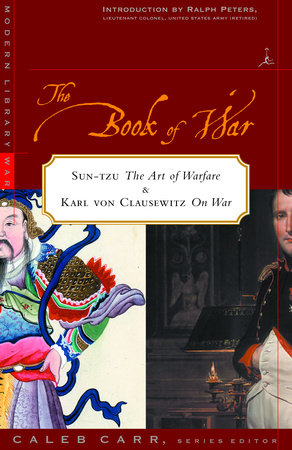
The Book of War

Sun-tzu The Art of Warfare & Karl von Clausewitz On War

Written by Modern LibraryAuthor Alerts:  Random House will alert you to new works by Modern Library
Introduction by Ralph PetersAuthor Alerts:  Random House will alert you to new works by Ralph Peters

The Book of War Enlarge View
Upgrade to the Flash 9 viewer for enhanced content, including the ability to browse and search through your favorite titles
The Book of War
Written by Modern Library, Introduction by Ralph Peters
Format: Trade Paperback
ISBN: 9780375754777
Our Price: $19.95
 Quantity: 1 
Buy From a Local Store

What's this? Tags for this book (Powered by LibraryThing)

EXCERPT

THE SEEKER AND THE SAGE

Ralph Peters

This book allies humankind's two most powerful works on warfare. Distant in time, space, and culture, Karl von Clausewitz and Sun-tzu offer dueling visions, with the Prussian appalled by fantasies of bloodless war and the Chinese crying that bloodless victory is the acme of generalship, and with Clausewitz anxious to increase military effectiveness, while Sun-tzu pleads, cleverly, for military restraint. Such discord assures their relevance to our time.

There is also plentiful agreement between Clausewitz's On War and Sun-tzu's The Art of Warfare, from their mutual vilification of heads of state who attempt to micro-manage distant battles to their similar emphasis on the key role of the commander. In the end-and I speak as a soldier, after decades of consideration--these two books complete each other, like a perfect couple formed of opposites. Between them, the two texts cover myriad aspects of the human experience of war-as well as reflecting the temperaments of their divergent civilizations. Clausewitz, the Western man, sought the grail of knowledge and found the pursuit endless, bottomless, and obsessive, while the Eastern sage who wrote down the sayings attributed to Sun-tzu polished what he knew until it shone. Each attained the universal, transcending personality and the particularity of experience. In the study of warfare, they have no peers, and these works remain the brightest lanterns we have to light our darkest endeavor.

The Western text embraces war's necessity, while the Eastern one despairs of its inevitability, but they are united by the recognition that the human remains at the heart of each combat encounter and every campaign. Each holds a flank in our approach to war: Clausewitz is the apostle of the relentless will, convinced there is no substitute for victory, while Sun-tzu seems a closet pacifist, wary of victory's hollowness. The first sought to sharpen the sword, the second to restrain it. The Prussian saw the power of the armed mass, while the Chinese pitied the suffering of the common man. Sun-tzu believed that the outcome of a campaign was predictable, but Clausewitz insisted that, although the odds can be improved, risk is inherent in warfare. This debate across millennia continues today, and placing these two works together highlights the strengths and weaknesses-and the inestimable value--of each book.

Each must be read. No cram notes will do, and summaries badly serve their genius. Clausewitz appears difficult, only to yield a hard, thrilling clarity; while Sun-tzu, a quick swallow, takes a lifetime to digest. One text is long, the other appealingly short. Both are inexhaustible.

Excerpted from The Book of War by Sun-tzu and Karl von Clausewitz Modern Library Copyright © 2000 by Sun Tzu and Carl von Clausewitz. Excerpted by permission of Modern Library, a division of Random House, Inc. All rights reserved. No part of this excerpt may be reproduced or reprinted without permission in writing from the publisher.
  • bookmark, share, and shelve:
  • Add to Good Reads
  • Add to Librarything
  • Add to Living Social
  • Add to Shelfari
  • Add to WeRead
  • (?)
PRINT THIS PAGE EMAIL THIS PAGE