Author Q&A
A Conversation with the Readers
Wherever I go to talk about King David–bookstores and book clubs, colleges and libraries, synagogues and churches–I am gratified (but not really surprised) to find a lively interest in a man who lived three thousand years ago yet seems as fully alive today as he does in the pages of the Bible itself.
Here are some of the questions I have been asked by readers of King David, and the answers that I have given. I have also suggested a few topics for discussion with your fellow readers of the book. I hope they will prompt you to ask other questions–and to come up with answers–of your own.
–Jonathan Kirsch
Q: From among all the men and women in the Bible, why did you choose to write about David?
JK: The best way to explain my decision to write a book about King David is that I snuck up on him–or, perhaps more accurately, he snuck up on me! My first book about the Bible, The Harlot by the Side of the Road, focuses on seven "forbidden" tales of the Bible. Only one of the stories–the rape of Tamar, David’s daughter–features David himself. But, as I explored the origins and meanings of these seven "forbidden" tales, I began to see David beneath the surface of the biblical text. As Gerhard Von Rad (a modern Bible scholar) puts it, an "undersong" about David can be detected throughout the Bible. And so I found myself drawn to David himself, and I decided to explore and try to explain the crucial role that David plays, both in the Bible and in our lives.
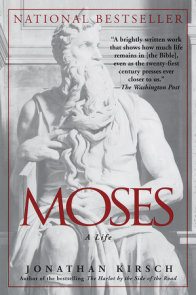
Q: You’ve also written a biography of Moses [Moses, A Life]. Who do you feel is more important, Moses or David?
JK: Of all the figures in the Hebrew Bible, Moses is the most commanding, but David is the most intriguing. Moses has been favored over David among deeply religious people in Judaism, Christianity, and Islam because he is presented as a pious man, a prophet, and a lawgiver. His story is full of shocks and surprises–as I pointed out in Moses, A Life–but it is somewhat easier to overlook the more unsettling aspects of his life and character and focus only on the sacred law that he offered to humankind, starting with the Ten Commandments but also the bulk of biblical law.
David, by contrast, is a far more troubling and even tantalizing figure. He is presented in the Bible, with perfect candor and in sizzling detail, as a man of both truly heroic achievement and scandalous conduct. His ambitions and appetites–as a warrior, as a lover, as a king–are gargantuan and irresistible. Of course, if we read only the biblical passages that are favored in sermons and Bible study, David comes across as a heroic figure–the man who literally invented biblical Israel, turned it from a band of rival tribes into a strong nation, and made himself both a king and an emperor. But if we read the whole story of David, if we read the Bible with open eyes and an open mind, we see that he is also portrayed, at moments, as a voyeur, an exhibitionist, an adulterer, a trickster, an extortionist, even a murderer.
The fact, however, is that David was just as fascinating to the original authors of the Bible as he is to modern readers. His biblical biographer was compelled to record all the dirty little secrets of David’s private life as well as the mighty achievements of his public life, and every biblical author who came along later seemed to have David in mind as he–or she–added new passages or whole new books to the Bible. That’s what explains the "undersong" of David–he can be detected in passages of the Bible where he is not even mentioned.
Q: If David’s life is so scandalous, why is he described in the Bible as "a man after [God’s] own heart"?
JK: The single most tantalizing theological puzzle in the Bible is the contrast between David’s real life, which is full of human flaws and failings, and David’s high standing as God’s favorite. God enters into covenants with Abraham and Moses, for example, but they are strictly conditional–if the Israelites obey God’s law, then God will bless them; if not, God will curse them. But God’s promise to David is unconditional: David and his heirs will always reign as kings of Israel. Nothing that David does, as shown in the Bible, prompts God to revoke his blessing.
One way to work out the puzzle is to credit God with the insight that a human being is not capable of being, or expected to be, a plaster saint. A single human life may have moments of moral grandeur and moments of moral failing, and one does not necessarily cancel out the other. That’s certainly true in the life of David as it is reported in the Bible–he is described as both "a bloody fiend from hell" and "a man after God’s own heart."
Another way to understand the attitude of the Bible toward David is that, as one scholar puts it, David is "the quintessential winner." And, then as now, nothing succeeds like success. So the biblical author is willing to praise David for his earthly accomplishments and overlook his earthly failings, and he reports that God feels the same way toward David.
The same is true of our attitude toward many political and military leaders–Franklin Roosevelt and Dwight Eisenhower, for example, both conducted extramarital affairs during World War II, but very few of us condemn them for their moral failings when we consider their role in defeating Nazi Germany and its allies.
Q: If God’s promise of kingship to David was eternal, what explains the fact that the dynasty of King David eventually came to an end?
JK: The contradiction between God’s promise and the historical record is undeniable, and it caused plenty of consternation among the biblical authors. Eventually, the apparent contradiction was resolved by focusing on the doctrine of the Messiah–God will one day send a Messiah to reign over us, and he will be a descendant of King David. Thus, in both Jewish and Christian tradition, the eternal kingship of David is understood to mean that, one day, a descendant of David will return as the Messiah.
According to Christian tradition, of course, the Messiah is Jesus of Nazareth, and that is why the Gospels trace the genealogy of Jesus all the way back to David. According to Jewish tradition, the Messiah has yet to come, but when the Messiah does finally come, he will be a descendant of David or, according to a mystical tradition in Judaism, the resurrected David himself.
The idea that the Messiah is a descendant of King David, therefore, is one of the very few points of theology upon which Christians and Jews agree!
Q: Was David gay?
JK: The Bible plainly reports that men as well as women fell in love with David, and David describes his love for Jonathan, son of King Saul, in tender and even passionate terms: "Wonderful was thy love to me, passing the love of women." (2 Sam. 1:26) According to pious tradition, David is speaking of a pure and platonic love. More recently, however, some Bible scholars have been willing to wonder out loud whether the two men were more than just friends. Certainly some of their encounters with each other suggest an intimacy that may have gone beyond friendship, and sexual relations between men were hardly unusual in the ancient world. Of course, David was just as passionate about the women in his life, and he clearly engaged in a great many sexual relationships with women. Still, if we read with an open mind what the Bible actually says, we have to entertain the idea that David may have been bisexual.
Q: Was David abusive or exploitive toward women?
JK: David’s relationships with the women in his life were highly passionate but also deeply troubled. He was capable of falling deeply in love with a woman, but he was also capable of acting imperiously and even abusively toward women.
The marriage between David and Michal, for example, is an example of a relationship that begins in the thrall of spontaneous affection and ends up in bitterness and estrangement. The courtship between David and Abigail, if we can call it a courtship, shows David as a coarse and even threatening figure. That’s why some feminist Bible scholars regard the Bible as a whole and the life story of David in particular as the work of authors who were hostile toward women.
Still, the bond between David and Bathsheba, which begins in adultery, bastardy, and murder, was clearly a heartfelt and lifelong commitment between the two of them. At the end of his life, David is unable to summon up any carnal desire for the beautiful young Abishag, for example, but he readily gives Bathsheba everything she demands, including a crown for their son, Solomon.
Q: Do you believe that David really existed?
JK: When I wrote about Moses, I was compelled to report the scholarly consensus, and my own conviction, that Moses is a legendary or even a purely mythic figure. But David, by contrast, is almost certainly a flesh-and-blood human being. The Tel-Dan inscriptions that I describe in chapter sixteen of King David are compelling evidence that David really lived and reigned, but the evidence is not merely archaeological. David comes across as a real human being precisely because the Bible gives us such rich and convincing details about his life, his deeds, his emotions, and his relationships. Unlike most other biblical figures–including, for example, Moses–David is fully three-dimensional. I agree with Freud when he insists that the Book of Samuel is "real history."
Q: What is the connection between King David and the Star of David?
JK: As it turns out, this is the single most frequently asked question that I encounter when I talk about King David! The question is answered in detail in chapter sixteen of the book, but the short answer is that the Star of David has no historical connection with David. The six-sided star, which has come to symbolize Judaism in general and the State of Israel in particular, was first linked to David by medieval alchemists and magic-users in Christian and Islamic circles in the Middle Ages. Not until the fourteenth century was it first used in Jewish settings, and not until the late nineteenth century was it adopted as a symbol of Judaism. In fact, virtually all the sites in Jerusalem that are traditionally associated with David have no real historical connection with him.





 QUICK VIEW