



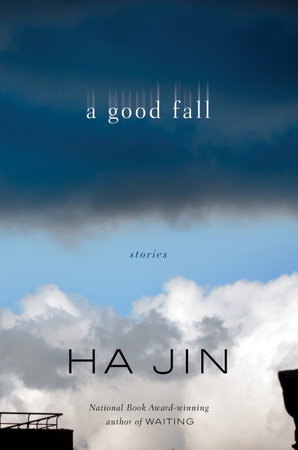

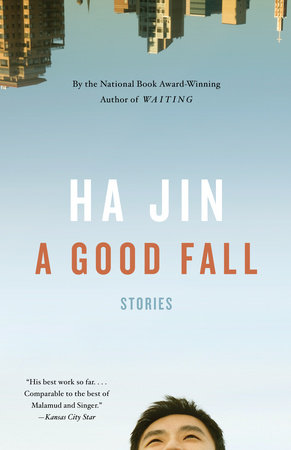
A Good Fall
By Ha Jin
By Ha Jin
By Ha Jin
By Ha Jin
Part of Vintage International
Part of Vintage International
Category: Short Stories
Category: Short Stories
-
$16.00
Oct 19, 2010 | ISBN 9780307473943
-
Nov 24, 2009 | ISBN 9780307378699
YOU MAY ALSO LIKE
 QUICK VIEW
The Anchor Book of Modern Arabic Fiction
QUICK VIEW
The Boat
QUICK VIEW
The Delight of Being Ordinary
QUICK VIEW
Testimony and Demeanor
QUICK VIEW
Mixology
QUICK VIEW
Brief Encounters with the Enemy
QUICK VIEW
Burning House
QUICK VIEW
The Half-Life of Happiness
QUICK VIEW

Golazo!
QUICK VIEW
Return Trips
Praise
“His best work so far. . . . Comparable to the best of Malamud and Singer.” —Kansas City Star
“Captivating. . . . Ha Jin captures a new, growing slice of America. . . . The storyteller’s art is richly on display here. Ha Jin has a singular talent for snaring a reader. His premises are gripping, his emotional bedrock hard and true.” —The Washington Post
“Engaging,. . . . Funny and tender at the same time. . . . The stories in this collection deal with what all good stories deal with: love, death, freedom and hope.” —The Dallas Morning News
“Quiet, careful, restrained prose—prose whose absence of flourish can, at times, make it all the more eloquent.” —The New York Times Book Review
“Skillful and deeply felt. . . . The collection as a whole celebrate[s] immigrant resilience: the courage to embrace calamity, hit the pavement and keep walking toward a brighter future.” —The Los Angeles Times
“Ha Jin’s masterful storytelling persists—meticulous, droll, convincing, populated with memorable characters—not to mention the indelible portrait of an immigrant life he gives us.” —San Francisco Chronicle
“[Jin] writes with warmth and humor about what it means to be a bewildered stranger in a strange land, no matter where one is born.” —People Magazine
“Engrossing, visceral. . . . All [stories] come across with the straightforward declarative immediacy of a videotaped interview or testimonial. . . . [An] illuminating, well-integrated collection.” —The Christian Science Monitor
“[A] fine collection. . . . Jin is a master of the straightforward line . . . . [and] a significant American writer. . . . As in Chekhov’s late work, his writing covers a lot of ground quickly.” —The New Republic
“A collection of sublime moments. . . . With moments of stark insight. . . . A message worth hearing.” —The Denver Post
“Every story . . . offer[s] evocative snapshots of the lives of contemporary first-generation Chinese immigrants. . . . [They] will take up quiet residence in your consciousness, shining a light into lives that too often go unseen.” —The Boston Globe
“Ha Jin continues his intimate, up-close look at Chinese immigrant life. . . . All [are] artfully turned out in Jin’s quietly seismic style.” —Elle
“Included are the rich imagery, attention to detail, and wry humor that are Jin’s stock in trade and that, when taken together, offer—as fellow writer Francine Prose has noted—‘a compelling exploration of the . . . terrain that is the human heart.’” —Fredericksburg Free Lance-Star
“Jin’s carefully constructed worlds offer the reader so much pleasure.” —Pittsburgh Post-Gazette
“[Jin’s] unvarnished prose adds a no-nonsense charm to the stories. . . . He just leans on simple phrasing that could come out of Sherwood Anderson or Ernest Hemingway. . . . Jin’s approach is the more honest one, and the one more likely to endure.” —Chicago Sun-Times
“Ha Jin’s new book of stories rises way above the ordinary or merely good. . . . The embarrassments and jokes and adulteries and frustrations of these characters in their little prosaic spaces convey the sense of how each human being is like and unlike all others.” —New York Post
“This may be Ha Jin’s best work yet, his stories often ascending to the mystical penumbra we expect of singer, Malamud, or O’Connor. . . . Ha Jin is equally good as a novelist and a short story writer. . . . Stories still allow him to get to the heart of the matter in a more piercing manner.” —The Huffington Post
“Jin writes with a twinkle in his eye.” —Cleveland Plain Dealer
“The understated clashes of culture [in A Good Fall] reveal careful thematic design and provide an almost 360-degree view of this select human experience: The concerns of people everywhere trying to make a better life come alive, one deceptively simple story at a time.” —The Miami Herald
“[Jin’s] work is shot through with a sense of isolation, melancholy and sacrifice: what it means—and costs—to be different. . . . There is a seriousness present. . . . And there is occasional humor or at least irony.” —The Seattle Times
Table Of Contents
The Bane of the Internet
A Composer and His Parakeets
The Beauty
Choice
Children as Enemies
In the Crossfire
Shame
An English Professor
A Pension Plan
Temporary Love
The House Behind a Weeping Cherry
A Good Fall
21 Books You’ve Been Meaning to Read
Buy Now


Just for joining you’ll get personalized recommendations on your dashboard daily and features only for members.
Find Out More Join Now Sign In