A New York Times Notable Book
One of the Best Books of the Year: Chicago Tribune, Chicago Sun-Times, Entertainment Weekly, Slate
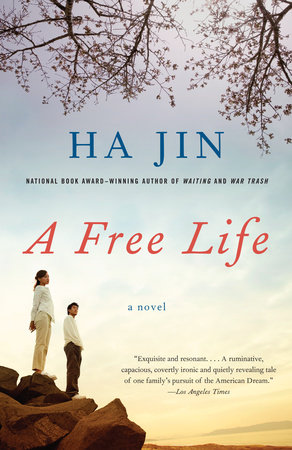
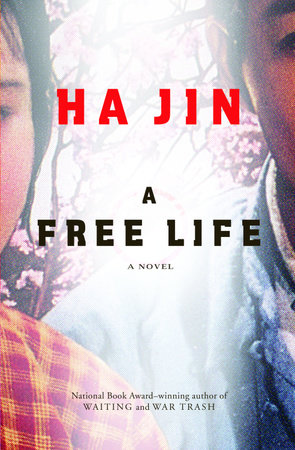
In A Free Life, Ha Jin follows the Wu family — father Nan, mother Pingping, and son Taotao — as they sever their ties with China in the aftermath of the 1989 massacre at Tiananmen Square and begin a new life in the United States. As Nan takes on a number of menial jobs, eventually operating a restaurant with Pingping, he struggles to adapt to the American way of life and to hold his family together, even as he pines for a woman he loved and lost in his youth. Ha Jin's prodigious talents are in full force as he brilliantly brings to life the struggles and successes of the contemporary immigrant experience.
Excerpted from A Free Life by Ha Jin. Copyright © 2007 by Ha Jin. Excerpted by permission of Vintage, a division of Random House, Inc. All rights reserved. No part of this excerpt may be reproduced or reprinted without permission in writing from the publisher.
HA JIN's previous books include the internationally best-sellingWaiting, which won the National Book Award; War Trash, which won the PEN/Faulkner Award; the story collections Under the Red Flag, which won the Flannery O’Connor Award for Short Fiction, and Ocean of Words, which won the PEN/Hemingway Award; and three books of poetry.
Ha Jin is represented by Random House Speakers Bureau (www.rhspeakers.com).
1. From the beginning, the novel presents a structure of very short chapters. Why might Ha Jin have chosen this means of organizing his story, and what is its effect? In what ways does the pace of the novel reflect the rhythms of daily life?
2. What is likable about Nan's character, and what is less so? Do his continuing infatuation with Beina, his lack of love for Pingping [pp. 23, 57–60], and his emotional distance from his son affect your opinion of him, and if so, how?
3. The use of language is an important focus of A Free Life. Ha Jin writes Nan's mistakes and mispronunciations into the dialogue when Nan is speaking in English; when characters speak in Chinese their speech appears in italics. What is the effect of the occasional misuse or noncolloquial use of a word or phrase in English, as when Nan says, for instance, that Sam is “bibulous” [p. 260], that a poet is “well endowed” [p. 305], or when he says in a job interview that he and his co-workers “all got laid together” [p. 25]?
4. The Wus' friendship with Janet and Dave Mitchell involves them in the emotional events of Hailee's adoption from China, as well as the discovery and treatment of her leukemia. At one point Nan is amazed at how emotional Dave becomes when having to choose between two orphan girls; he thinks, “Probably it was their Christian faith that had instilled in them the sense of guilt and enabled them to commiserate with the babies more than they—the Wus—could” [p. 313]. Do you think Christianity is the reason for the Mitchells' sensitivity? Does the episode suggest something about cultural difference or about Nan's own powers of empathy?
5. Responding to Mr. Liu's statement that China should attack Taiwan to maintain its territorial integrity, Nan says, “For the individual human being, what is a country? It's just an idea that binds people together emotionally. But if the country cannot offer the individual a better life, if the country is detrimental to the individual's existence, doesn't the individual have the right to give up the country, to say no to it?” [p. 320]. Do you agree with this statement? What are the reasons that Nan feels he must say no to China?
6. When they deposit the $50,000 check and the woman at the bank looks at them strangely, Pingping realizes, “There was no way this woman could imagine the sacrifice and labor this check embodied” [p. 185]. Would you agree that most native-born Americans are no longer capable of the self-sacrifice and unremitting labor that the Wus engage in? What are the effects of a capitalist and consumerist economy on people's values and behavior, as seen through the eyes of Nan and Pingping?
7. Throughout the story, Nan holds onto the memory of Beina and wants to see her again “in order to preserve her in his memory as a lovely woman beyond his reach, as someone who still possessed his soul, so that the flames of inspiration would blaze in him again” [p. 562]. How do his feelings change after he sees Beina in Illinois [pp. 586-90]?
8. Nan tells Dick that “zer core of American culture” is “obsessed with two s's ... self and sex” [p. 307]. How does Nan react in episodes related to sex [pp. 31–34, 86–90, 544–46, 595–99]? What is the difference between Nan's self-absorption and the self-obsession he sees in Americans?
9. When the Wus sell their restaurant to their friends Shubo and Niyan they are shocked to learn that Shubo won't let Pingping work there [pp. 613–15]. What does this incident, as well as Nan's later visit to his parents in China [pp. 557–60] make clear for Nan about the bonds of friendship and family? How does he respond to the celebration of Halloween in their suburban neighborhood [pp. 271–73], and why?
10. After paying off the mortgage on their house, Nan has a brief period of elation which is followed by a profound sense of disappointment: “The struggle had ended so soon that he felt as though the whole notion of the American dream was shoddy, a hoax. . . . He should feel successful. But somehow the success didn't mean as much to him as it should” [p. 418]. What is the cause of his dismay? How is his distress affected by his conversation with Shubo about the idea that immigrants must sacrifice their own dreams for their children and grandchildren [pp. 420–21]?
11. Observing the culture of moneymaking on his trip to China, Nan thinks, “Now he wanted all the more to live and die in America. How he missed his home in Georgia” [p. 568]. Throughout the story, Nan has felt almost no nostalgia for his life in China. Is this lack of emotional connection to his native culture partly the reason that Nan is willing to risk writing in English? What had come to define “home” for Nan?
12. The story's arc brings to Nan's attention only belatedly what the reader perhaps already feels: that Pingping has proven herself from the beginning the stronger and steadier character. She has left her native country to be with a husband she knows does not love her, she accepts his moods and his anger, and she works daily with their son to make sure he succeeds at school. How do Pingping's pregnancy and the loss of the baby girl affect their marriage [p. 469]? How does Nan come to realize Pingping's worth [p. 612]? What does his poem “Belated Love” [pp. 619–20] express about his new knowledge?
13. How would you describe the prose style of the novel? What are the notable aspects of the narration and what kinds of details does it bring into focus? Do you assume that the narration is mainly from Nan's point of view; is it a more objective third-person narration, or does it shift between the two?
14. Regarding his poetic vocation, Nan thinks, “The truth was that he had been frightened by the overwhelming odds against writing in English artistically, against claiming his existence in this new land, and against becoming a truly independent man who followed nothing but his own heart. To date he had tried every way to wriggle out of the struggle” [p. 472]. How do the poems at the end of the volume reflect Nan's new independence? What does the “free life” of the title mean for him?