Author Q&A
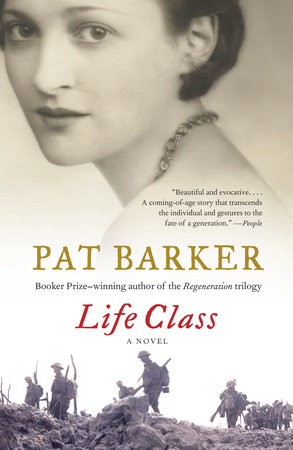
1. With Life Class, you’ve returned to the World War I setting of your Regeneration trilogy. What is it about the Great War that you find so compelling? Why do you think readers are still interested in one of the last century’s many great conflicts?
The Great War was the first time most people were made aware of the terrible effects of modern weapons on fragile human bodies. The shock of this still lingers.
It’s war as a human experience that I find compelling. All wars are different but they are also alike. It’s the inhumanity of man to man that interests me along with all the attempts by organizations such as the Red Cross and Red Crescent to lessen its impact on the most vulnerable.
I would expect readers to go on being interested in the conflicts of the last century because we know more about them than we do about contemporary conflicts which are obscured by propaganda and disinformation and this enables us two think about the dilemmas of conflict more clearly.
2. As you did in Regeneration, you’ve incorporated some real–life characters into Life Class. Can you tell us something about Slade professor Henry Tonks and his role in your novel? About Lady Caroline? What’s the dramatic or strategic rationale for interweaving fact and fiction? And, if you’re willing to tell us, are some of the main characters based on historical figures (is, for example, Elinor Brooke based on Dora Carrington)?
Henry Tonks was a practicing artist—as all Slade teachers had to be—and agood one, but his real genius was for teaching. He began life as a surgeon, teaching anatomy to medical students, but abandoned that career when he was offered a post at the Slade. He taught almost every distinguished British artist in the years after1880, though he didn’t always approve of their subsequent development. “What a brood I have reared!” he said.
During the war years he worked as medical artists at a hospital for facial injuries and while there drew a remarkable series of portraits of disfigured young men which he refused to have exhibited on the grounds that they were too distressing. They are very remarkable, combining as they do a great sensitivity to the personality of the sitter with an unflinching depiction of the wound.
Lady Ottolone Morrel was a great patron of the arts and friend of impoverished artists and writers, some of whom pilloried her many eccentricities in their work.
Some of my other characters have real people as their starting points but they also differ from them in many ways and their lives quickly diverge from the originals.
I try to be accurate in my depiction of characters who are called by their own names, but the others are fiction and I invent freely.
I use real people because it sometimes seems that inventing a character to fill the role of real historical figure is rather futile. Henry Tonks was the Slade, and his high standards and exacting eye are fixed reference points around which the fictional characters revolve.
3. Your heroine Elinor Brooke seems particularly determined not to let the War interfere with her pursuit of her art. What is the role of art in the face of the collective trauma that is war? Frankly, I was surprised that there would be any female students at the Slade in that era; how unusual would Elinor have been?
Elinor wasn’t unusual. The majority of Slade students were female. They received the same tuition as the men though life classes were segregated. Some upper class girls used a year as the Slade as part of their finishing or to pass time till the right man came along. Others, like Elinor, took their art very seriously indeed.
The previous generation of Slade students also contained many talented women artists,. most notably Gwen John, Augustus John’s sister who went to the Slade in 1895.
As to the role of the arts in wartime—that’s a huge question. Some of oinks pupils’s became official war artists and there’s no doubt the Government’s motive was to mobilize the arts behind the war effort. But many of the paintings move far beyond propaganda which is why we continue to value them today.
I find Elinor’s resolute refusal to accept the war as a possible subject for art interesting. It sounds trivial and selfish at first but I think it’s got something to recommend it. It’s rather like WB Yeats refusal to regard trench warfare as a suitable subject for poetry on the grounds that it involved merely passive suffering. It also has echoes of Virginia’s Wolf’s concept of war as a purely masculine activity from which women should turn away.
4. Both your male protagonists, Paul Tarrant and Kit Neville, work with the wounded in Belgium; they aren’t soldiers, though they certainly experience the horrors of trench warfare. But why don’t you situate them right in the thick of battle as combatants?
I wanted Life Class to hinge on a stark contrast between the pre–war life of art students at the Slade and the opening weeks and months of the war. But men who volunteered for the army in August 1914 didn’t arrive in France until spring 1915 at the earliest because they had to train first. The soldiers fighting in 1914 were professionals. The only way I could get Paul and Kit out to France almost immediately was to have them volunteer to work as orderlies and drive ambulances where they were caught up in the chaos and virtual breakdown of the medical services which were trying to cope with a far higher level of casualties than anybody had foreseen. Paradoxically, although not soldiers when they return to London in early 1915 they are the only people in their circle to have any actual experience of the war.
5. I’m struck by the fact that your fictional worlds are largely dominated by big events—World War I, murder, 9/11 and the war in Afghanistan—which sets your work apart in today’s literary landscape. Most current fiction seems to be more introspective, even egocentric. Do you view contemporary fiction in a similar way? Do you have a sense about why so many serious writers today are focusing more on the self and less on the events that shape society as well as the self?
I agree that much contemporary fiction is egocentric and introspective, partly perhaps because individual writers typically do not have a sense of connection to major events which they usually experience as passive observers via the television. This is in marked contrast to the two world wars which made demands on individuals which transformed their lives.
Contemporary writers who have been born in one society and either voluntarily or as refugees have been transplanted to a different culture find it easier to link their individual experience to a world wide trend of mass migration and dislocation. It’s no accident that much of the strongest contemporary writing deals with themes of uprooting and transformation.
You’ve obviously done plenty of research on the experience of World War I, for those in the action and those in England. Do you ever wonder why there wasn’t some kind of mass mutiny or widespread rebellion? It all seems so unbelievably dire—so callously cruel—that it’s sometimes hard to believe that people kept on for all those years.
There were some mutinies and rebellions. The British and French armies both had mutinies, though not on a large scale—and Russia’s involvement ended in revolution.
But in wartime people close ranks. A war needs to drag on for some considerable time before the voices questioning its purpose make themselves heard.
7. Are you working on a new book yet? Are you staying in the historical mode or moving back to a more contemporary setting?
I’ve started work on my next book which will remain in the First World War period and contain some of the same characters as Life Class. It’s set partly in a hospital which specialized in plastic surgery and also employed artists who worked alongside surgeons in the operating theatre—most notably Henry Tonks.
I’m fascinated by the interface between the arts and medicine. There are many contemporary initiatives exploring the role of the arts in healing and in preparing medical students for the emotionally testing aspects of their work, but the interface has never been closer than it was in that hospital in 1917.




 QUICK VIEW