Random House: Bringing You the Best in Fiction, Nonfiction, and Children's Books
Follow Us On TwitterFan Us On Facebook
Authors
Books
Features
Newletters and Alerts

Buy now from Random House

  • A Natural History of the Piano
  • Written by Stuart Isacoff
  • Format: Hardcover | ISBN: 9780307266378
  • Our Price: $30.00
  • Quantity:
See more online stores - A Natural History of the Piano

Buy now from Random House

  • A Natural History of the Piano
  • Written by Stuart Isacoff
  • Format: eBook | ISBN: 9780307701428
  • Our Price: $15.99
  • Quantity:
See more online stores - A Natural History of the Piano

Buy now from Random House

  • A Natural History of the Piano
  • Written by Stuart Isacoff
  • Format: Trade Paperback | ISBN: 9780307279330
  • Our Price: $16.95
  • Quantity:
See more online stores - A Natural History of the Piano

A Natural History of the Piano

    Select a Format:
  • Book
  • eBook

The Instrument, the Music, the Musicians--from Mozart to Modern Jazz and Everything in Between

Written by Stuart IsacoffAuthor Alerts:  Random House will alert you to new works by Stuart Isacoff

eBook

List Price: $15.99

eBook

On Sale: November 15, 2011
Pages: 384 | ISBN: 978-0-307-70142-8
Published by : Knopf Knopf
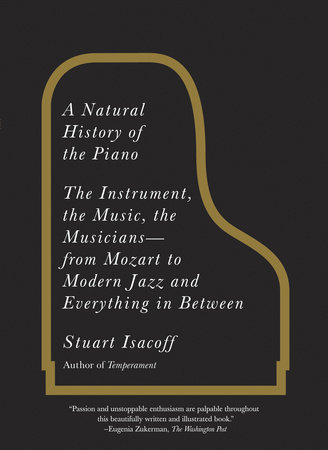
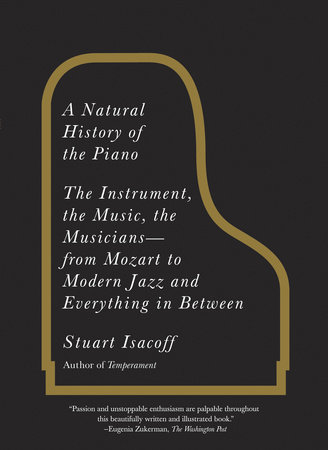
A Natural History of the Piano Cover

Bookmark,
Share & Shelve:

  • Add This - A Natural History of the Piano
  • Email this page - A Natural History of the Piano
  • Print this page - A Natural History of the Piano
ABOUT THE BOOK ABOUT THE BOOK
ABOUT THE AUTHOR ABOUT THE AUTHOR
PRAISE PRAISE
Synopsis

Synopsis

A beautifully illustrated, totally engrossing celebration of the piano, and the composers and performers who have made it their own.
 
With honed sensitivity and unquestioned expertise, Stuart Isacoff—pianist, critic, teacher, and author of Temperament: How Music Became a Battleground for the Great Minds of Western Civilization—unfolds the ongoing history and evolution of the piano and all its myriad wonders: how its very sound provides the basis for emotional expression and individual style, and why it has so powerfully entertained generation upon generation of listeners. He illuminates the groundbreaking music of Mozart, Beethoven, Liszt, Schumann, and Debussy. He analyzes the breathtaking techniques of Glenn Gould, Oscar Peterson, Vladimir Ashkenazy, Arthur Rubinstein, and Van Cliburn, and he gives musicians including Alfred Brendel, Murray Perahia, Menahem Pressler, and Vladimir Horowitz the opportunity to discuss their approaches. Isacoff delineates how classical music and jazz influenced each other as the uniquely American art form progressed from ragtime, novelty, stride, boogie, bebop, and beyond, through Scott Joplin, Fats Waller, Duke Ellington, Bill Evans, Thelonious Monk, Chick Corea, Herbie Hancock, Cecil Taylor, and Bill Charlap.
 
A Natural History of the Piano distills a lifetime of research and passion into one brilliant narrative. We witness Mozart unveiling his monumental concertos in Vienna’s coffeehouses, using a special piano with one keyboard for the hands and another for the feet; European virtuoso Henri Herz entertaining rowdy miners during the California gold rush; Beethoven at his piano, conjuring healing angels to console a grieving mother who had lost her child; Liszt fainting in the arms of a page turner to spark an entire hall into hysterics. Here is the instrument in all its complexity and beauty. We learn of the incredible craftsmanship of a modern Steinway, the peculiarity of specialty pianos built for the Victorian household, the continuing innovation in keyboards including electronic ones. And most of all, we hear the music of the masters, from centuries ago and in our own age, brilliantly evoked and as marvelous as its most recent performance.
 
With this wide-ranging volume, Isacoff gives us a must-have for music lovers, pianists, and the armchair musician.
Stuart Isacoff|Author Q&A

About Stuart Isacoff

Stuart Isacoff - A Natural History of the Piano

Photo © Michael Lionstar

Stuart Isacoff, a pianist and writer, was the founder of Piano Today magazine, which he edited for nearly three decades. A winner of the ASCAP Deems Taylor Award for excellence in writing about music, he is a regular contributor on the arts to The Wall Street Journal and has written for The New York Times, Chamber Music, Symphony, Musical America, Stagebill, and The New Grove Dictionary of American Music. Mr. Isacoff is also the author of Temperament: How Music Became a Battleground for the Great Minds of Western Civilization. He is on the faculty of the SUNY Purchase College Conservatory of Music. He lives in Closter, New Jersey.

Author Q&A

A Conversation with

Stuart Isacoff
author of

A Natural History of the Piano

Q: You call the piano the most important instrument ever created. How so?

A:
It could perform so many different roles: as a solo instrument, as an accompaniment to singers and other instrumentalists, serving as a member of a chamber ensemble. And, unlike the harpsichord, its sound could easily be shaped by the player to render thunderous storms, soulful melodies, or the airy tones of a music box; it filled ordinary homes with grand symphonies and operas (bringing the masterpieces of music to people who could not hear them in concert halls), along with Baroque fugues, sentimental waltzes and novelty rags. That is, it put the whole world of music in the hands of millions of people.

Q: You say that the piano was “born of the odd pairing of a little-known instrument maker and a dissolute prince.” How intriguing. Tell us a little more on how the first piano came to be?

A:
The Medici family had ruled Florence since the thirteenth century, producing popes, a bank of unrivaled power, and an astounding number of artworks commissioned from the greatest painters of the age. Ferdinando de Medici was also a collector of gadgets and musical instruments. But another Medici trait was a history of failed marriages, and in 1688, Ferdinando sought temporary escape from his problems by going to Venice for the Bacchanalian celebration known as Carnival.

Apparently he had a rollicking good time. And it was likely on his way back home that he stopped in Padua and first heard about a topnotch instrument technician named Bartolomeo Cristofori. It so happened the prince had lost his technician and was in the market for one. “The prince was told that I did not wish to go,” reported Cristofori some years later; “he replied that he would make me want to.” Medici made him an offer he couldn’t refuse.

The two didn’t get along at first, but Cristofori did a good job, the prince rewarded him, and the technician not only serviced the instruments but also created some new ones. His most astounding was an ordinary looking keyboard made of simple cypress, covered with red leather and lined with green taffeta. It was called “a keyboard of cypress with piano [soft] e [and] forte [loud].” And it revolutionized the practice of music.

If it hadn’t been for Medici’s love of gadgets, or his poor marriage and roving eye, the piano might not have been brought into existence.

Q: You describe the inside of a piano as “a miracle of invention.” What is so miraculous about it, technically speaking?

A:
Various kinds of keyboards had been around for quite a while before the piano came into being, but none could offer the expressive possibilities of this new invention. Organs were overwhelmingly powerful, and lacked the musical nuances of the more delicate piano; harpsichords, which employed quills to pluck the strings, had a strident, nasal tone and couldn’t shift easily between soft and loud sounds; clavichords, which used metal “tangents” to strike the strings, offered a greater range of musical possibilities at the player’s fingertips, but it was far too soft to be used in concert.

Precursors to the piano abound in the literature. The fourteenth century gave rise to the “checker” (possibly because it looked like a black-and-white chessboard), and blind musician Francesco Landini’s unique instrument, which he named “the joyous of joyous, the sirens of sirens”; the fifteenth century offered a keyboard called the “dulce melos,” (sweet song). But the ingenious mechanism that allowed the piano’s hammers to strike the strings with greater or lesser force at a pianist’s will, while allowing them to fall back in preparation for the next strike, opened up new musical horizons, and produced a sound that eventually seduced the entire world.

Q: You write about the political and social forces that brought pianos into the home and made them part of domestic life.  How important was this shift for the future of the piano?

A:
Victorian England was the site of dramatic changes in the status of the piano. The London debut of the instrument was in 1768, when only a handful of craftsmen were turning out around thirty-to-fifty per year. By 1798, one piano maker, trying to keep up with demand, wrote, “Would to God we could make them like muffins!” Five decades later, there were some two hundred manufacturers.

It wouldn’t have happened for musical reasons alone. The social status of instruments became a major obsession for families seeking to better their fortunes. Young ladies from fine families were expected to learn to play the piano, especially those on the prowl for a husband. Publications cited the piano as essential for social harmony, and every Victorian home was expected to display it prominently.

The same trends took hold in the New World, and the instrument even made its way to log cabins on the Western frontier.

Q: You open this book talking about Oscar Peterson—why did you choose him as the first, of numerous, people you write about in the book?

A:
Oscar Peterson was a truly great artist. He was the first jazz musician I ever listened to and it so happens I was the last to interview him before his death. Just as importantly, he bridged the false divide that is so often assumed to lie between classical music and jazz. When he complained to me, during our interview, that they don’t play “our kind of music” on the radio much anymore, he was talking about masterful music from both ends of the spectrum.

Using his example allowed me to muse a bit about the relationship between the two traditions, to convey the excitement of top-level piano artistry, and to introduce some key elements in the story that follows.

Q: You write about so many musicians who have been instrumental (pun intended) in the history of the Piano and divide them into four styles—The Combustibles; The Alchemists; The Rhythmitizers; and The Melodists. How did you come up with these four categories?

A:
My first objective was to find a way of writing about composers and performers from different genres without segregating them into little insular boxes. Most of the jazz artists, for example, are from the twentieth century, and I didn’t want to give readers a sensation of whiplash, forcing them to scan back and forth between eras. In addition, the usual categories of Baroque, Classical, Romantic, and Modern don’t always work so well: contemporaries of Haydn and Mozart thought they were Romantics, while later generations saw them as Classical. The lines that are often drawn are fairly arbitrary.

So, if I was not going to organize the material chronologically, I needed to find another way of discussing commonalities and differences. I hit on the idea of analyzing the sound of the piano itself—the shape of each individual tone as it is struck (with a percussive pop), sings out, wobbles a bit, and decays. It seemed to me that these individual elements, and the piano’s unique ability among keyboards to vary dynamics, each serve as the basis for a musical approach, and that artists from different eras and genres often share those approaches in surprising ways.

Q: Tell us a little about what characterizes each and some of the people that best exemplify the category?

A:
Each of these categories can be seen in the light of the four elements described by Empedocles in the fifth century BCE: Earth, Water, Air and Fire. There are the Combustibles (fire), for example, who bring edge-of-your-seat volatility to the keyboard, exploiting the piano’s vast dynamic range to create music that can smolder and explode. Beethoven, jazz pianist Cecil Taylor and rocker Jerry Lee Lewis all belong here; this may raise a few eyebrows, but I think it is legitimate.

The supple nature of water suggests the quality of the Melodists, whose streams of singing tones seem to form sinuous waves and soft arabesques. Musicians in this category include Franz Schubert, George Gershwin and George Shearing.

Air befits the world of the Alchemists—musicians like Claude Debussy, Bill Evans, Alexander Scriabin and Herbie Hancock, who are all masters of atmosphere, combining tones and silence in mysterious ways to create haunting, resonant worlds.

And the solidity of the earth is the fundamental quality of the Rhythmitizers—including rock performer Fats Domino, Latin-jazz pianist Arturo O’Farrill, and classical composers Bela Bartok and Sergei Prokofiev: musicians who take the percussive “pop” that brings every piano tone to life and places it center stage.

Q: You write that the piano’s “ease in shifting between the ‘cultivated’ and the ‘vernacular’ traditions made it ripe for appropriation by the Holy Rollers, the high rollers, and rock’ n’ rollers.” What made the piano so beloved by both pulpit and pleasure house?

A:
Mid-nineteenth century hymnists like William Batchelder Bradbury found it unobtrusive; Bradbury used it with his thousand-voice children’s choir at the Broadway Tabernacle. Similarly, Charles M. Alexander of Tennessee, who became known as the father of evangelical pianism, found that it had the advantage of holding the singing of a large crowd together, and unlike the organ, didn’t overwhelm.

Meanwhile, the piano was so prevalent in pleasure houses for the same reason it could be found in homes: it offered a world of music through the hands of a single player. What better way of entertaining guests? In New Orleans, artists like Willie “Drive ‘Em Down” Hall and Kid Stormy Weather took advantage of the proliferation of the piano to earn some money and hone their skills. In the process, they developed a special style based on the fact that most of these instruments fell into disrepair and the music had to be as full and loud as possible. The rollicking New Orleans sound that came out of Storyville—was partly a result of musicians finding ways to force music out of those battered remnants whose keys often failed to sound, and playing very full harmonies and doubling up on melodies and bass lines was one way to do it.

Q: Why do you think the Russians and Germans came to dominate the musical stage from the mid 19th to 20th century? What about those two countries in particular produced such talent?

A:
Both countries had a long history of cultural achievement in a wide range of activities, including music, poetry, literature, the plastic arts, and aesthetic philosophy. And their national inclinations happened to place them in opposing camps: the Germans on the analytical side, and the Russians on the emotional (of course, these are primitive stereotypes and need to be taken with a grain of salt).

As a result, the virtuosos of each nation who traveled to these shores gained their followers through particular qualities: German Hans von Bülow, for example, was much admired but described by critics as a “musical refrigerator,” while Russian Anton Rubinstein “stirred up emotional cyclones wherever he went.”

Q: How has the digital revolution and technology changed the history as well as the future of the piano?

A:
Electronic keyboards have, by now, evolved to the point that digital sampling and other refinements make very realistic imitations of the acoustic piano possible. And the new instruments don’t require tuning, are lightweight, and take up very little space. The advantages are obvious.

What’s more, they offer enhancements like accurate recording and playback technology, the ability to produce other instrumental sounds, and push-button ease in changing keys. One concert pianist I know uses an electronic piano to practice at night, utilizing headphones so the neighbors won’t be disturbed. It’s a new world. Nevertheless, I’ll take my acoustic piano any day.

Q: How important a role has the piano played in your personal history? And as a pianist yourself, who are your personal favorites and what your favorite pieces to play?

A:
The piano has shaped my life. I fell in love with it as a child (there was an upright in the apartment in which I grew up), then left it during various periods, but it never left me. I can’t imagine living away from one for any length of time.

I have too many favorites to name. My love of all kinds of music continues to grow exponentially, and since I play both classical music and jazz, and compose as well, there is no end to the discoveries I make. The piano recitals I play combine classical repertoire with improvisation, exploring connections between radically different composers and eras—because the primary building blocks of music are essentially the same, whether one is playing a piano sonata by Domenico Scarlatti or a song by Jerome Kern.


For booking information: 
Gabrielle Brooks / 212-572-2152 / gbrooks@randomhouse.com

Praise

Praise

“Like listening to a fascinating raconteur who informs and entertains and really knows his stuff . . . Passion and unstoppable enthusiasm are palpable throughout this beautifully written and illustrated book . . . Isacoff’s heartfelt history of the piano will make you want to Stop! Read! and then go Listen!”
            -Eugenia Zukerman, The Washington Post
 
“That rarest of treats: a substantial book about music that’s actually easy to read . . . The book’s strongest passages are those in which Isacoff dwells on the instrument itself, relating several fascinating tales about its invention, metamorphosis and extra-musical developments . . . As a primer on the piano and music history . . . it executes the job with distinction.”
            -Zachary Lewis, Cleveland Plain Dealer
 
“Isacoff follows the piano into the honkytonk, the drawing room, the middle-class home and the jazz club, tracking the evolution of the physical instrument itself as well as the composers and performers who made the piano an emblem of cultural variety and a laboratory for musical form . . . His discussion of jazz piano reflects an intense affection for the music and its practitioners.”
            -James Penrose, The Wall Street Journal
 
“Deft . . . In A Natural History of the Piano, Isacoff proves as fleet-fingered as any virtuoso.”
            -Peter Monaghan, The Chronicle of Higher Education
 
“A history written by a pianist and historian with a lively touch and a reach that spans octaves of science, culture and politics . . . A generous, welcoming book, full of oddities and insights.”
            -Bill Marvel, The Dallas Morning News
 
“An exhaustive and entertaining cultural history of the piano . . . ‘Sparkling discourse’ is his aim, and he succeeds . . . An enjoyable read.”
            -Susan E. Saltus, Newark Star-Ledger
 
“Entertaining . . . Crammed with great anecdotes and mini-essays.”
            -Melinda Bargreen, The Seattle Times
 
“Informative, comprehensive, and conversational . . . Refreshing . . . A deft rendering.”
            -Choice
 
“The perfect gift book . . . A Natural History of the Piano, so layered with anecdote that it reads like a novel or a good biography, explores the story of the piano: its players, composers, and inventors, teachers and students, patrons, critics, and performers . . . Wonderful.”
            -Ann La Farge, Hudson Valley News
 
“A lively, virtually all-inclusive survey of all things pianistic . . . Isacoff’s ability to convey his formidable erudition in the most engaging terms, coupled with his infectious enthusiasm for music of all kinds, make this a charming and highly readable potpourri. Informative fun for every variety of music lover.”
            -Kirkus
 
“Engrossing . . . Witty . . . Pianists at all levels, music history buffs, and academics will appreciate Isacoff’s insights and clever way with words; this is an enjoyable and informative book.”
            -Library Journal
 
“An encyclopedic and argumentative overview of all things piano . . . [Isacoff’s stylistic] groups—combustibles, alchemists, rhythmizers, and melodists—shape a piano gestalt through which readers will be impressed . . . by the depth and diversity of Isacoff’s research and references.”
            -Publishers Weekly
 
“Dizzy Gillespie used to tell his musicians, whatever their instruments, to come to the piano with him as he said, ‘The music is all there.’ In Stuart Isacoff’s A Natural History of the Piano, never before have I learned and enjoyed so much about the instrument and its most distinctive practitioners—transcending so many categories of music. Whether the subject is jazz or classical music, the writing is unfailingly engaging and revealing.”
            -Nat Hentoff
 
“Anybody who cares about the piano—past, present and future—will find this book irresistible reading. I always learn so much from Stuart Isacoff and have a good time in the process.”
            -Tim Page
 
“Stuart Isacoff’s A Natural History of the Piano is a dazzling structural juxtaposition from Mozart, Liszt and Horowitz to Joplin, Tatum and Jerry Lee Lewis, written with verve and sensitivity. Piano lovers will eat it up!”
            -David Dubal, author of The Art of the Piano
 
“Every page of this book is filled with the poetry of Isacoff’s writing as he outlines the fascinating development of the piano and its effect on music tradition throughout the centuries. The research is of great depth: how Isacoff weaves what he has discovered into a gripping and entertaining narrative is sheer magic. Essential reading for anyone who embraces not only the piano, but music, history, and culture. Bravo, Maestro Isacoff!” 
            -Frank Brady, author of Endgame
 
“I loved this book. Isacoff tells the story of the piano through every conceivable device and viewpoint: profiles of the jazz and classical masters of the instrument, technical details, social history, anecdotal sidebars, interviews and unexpected digressions. And he never forgets that piano lore includes the highest of high culture as well as the pop-est of pop. It’s a terrifically enjoyable read.”
            -Sara Fishko, Producer/Host, WNYC (New York Public Radio)
 
“Supremely informative as well as fascinating and entertaining—highly recommended.”
            -Vladimir Ashkenazy
 
“Stuart Isacoff’s great meditation on all piano-related matters is a delight, both informative and entertaining. To borrow the author’s categories, I find the writing both melodic and combustible.”
            -Dick Hyman
 
“Irresistible! Stuart Isacoff charts the three-century evolution of the world’s most popular instrument with insight, love, and wit, garnished with the wisdom of today’s foremost masters of classical and jazz.”
            -Sedgwick Clark, editor, Musical America International Directory of the Performing Arts  


Your E-Mail Address
send me a copy

Recipient's E-Mail Address
(multiple addresses may be separated by commas)

A personal message: