Author Q&A
A Conversation with Aaron Hamburger
Francine Prose is the author of A Changed Man,
Blue Angel, and The Lives of the Muses.
FRANCINE PROSE:What attracts you to the theme of cross-cultural
divides?
AARON HAMBURGER: Growing up, I often felt like an outsider
and an observer, so that when I first traveled outside the United
States, it was a welcome surprise to be in a situation where I was
supposed to feel that way. I also found that when I came back
from traveling abroad, I had a new appreciation for the unique
qualities of place in the seemingly boring, placid suburb where
I’d grown up. I think these clashes of culture are great opportunities
for revealing character and for instigating growth and
change, essential qualities for fiction.
FP:Why do you refer to the main character as Mrs. Michaelson
and not Helen?
AH: To suggest the importance of formality and good manners,
which are Mrs. Michaelson’s guiding principles. She believes
that if everyone would just behave and say “please” and “thank
you,” we’d have a better world. Of course, she’s right. If everyone
obeyed the rules, we wouldn’t have terrorism, drug abuse, or
murder, or other unpleasantness. Her problem is she can’t comprehend
why it is that so many people choose not to say “please”
and “thank you,” or choose to engage in behavior that’s harmful
to themselves or to others. Another reason was that I enjoy the elegance
of formality in fiction. I love that there are certain characters
we think of only as “Mr. Darcy” or “Madame Bovary.”
“Fitzwilliam” and “Emma” just don’t have the same ring to
them.
FP: Who were some of your influences in writing the novel?
AH: I always have to laugh a little when people ask how autobiographical
my work is because when I write I’m much more
conscious of books I’ve read than of people I’ve known. This
book is my love letter to upper-middle-class literary heroines
like Virginia Woolf’s Mrs. Dalloway and Evan S. Connell’s Mrs.
Bridge, and E. M. Forster’s Mrs. Wilcox, Miss Schlegel, and
Mrs. Moore. I value their common sense and goodwill as well as
their earnest desires for everyone to play fairly with one another.
That impulse seems all the more noble to me because
most people don’t want to play fair. They’d rather get the upper
hand than play fair, and these middle-class women have benefited
from their husbands’ investment in the class system. But
instead of just enjoying their good fortune, the women above
try to, within certain bounds, rectify injustice. With Mrs.
Bridge, it’s more of an internal struggle, yet all the women
grapple seriously with morals and ethics, and in their own limited
ways try to build a better world.
FP: Each chapter begins with a small anecdote or legend about
Israel. Why did you use that device?
AH: Because for me, a fundamental part of visiting Israel is the
difference between the dream of Israel and the reality of the
place once you’re standing there.
I’d grown up with images of the Middle East that were inspired
by the hokey illustrations in children’s bibles and by
Charlton Heston movies. Somehow I imagined that in Israel,
life would be more meaningful and inspired, that there I’d be
surrounded by idealistic pioneers and shepherds who’d invite
me to break bread with them under palm trees and sing hymns.
But modern Israel feels strikingly ahistorical. In contrast to Europe,
for example, it’s much more like America, with the usual
fast food shops, ads for blue jeans, and pop music playing full
blast everywhere you go. It can be disappointing if you’re expecting
religious inspiration at first glance. So for me, the anecdotes
juxtaposed with the text were a way to give the reader the
experience of disjunction between the fantasy and reality of Israel.
Also, as the book goes on, the anecdotes get increasingly
dark and even violent, which I hope gives a sense to the reader
of the darker turn the plot takes as well.
FP: How did you get into the heads of the different characters?
Were any easier to write than others?
AH: I tried to invest each character with some aspect of myself
that I could use as a way into them, so that no character ended
up being simply a villain or an object of scorn. I also tried to
think about people I’ve met, not only in Israel but also in New
York, especially the immigrants from the Middle East and their
attitudes about life.
I suppose everyone will think that the young man is me and
the parents are my parents, and nothing I can say will dissuade
them. But what actually is autobiographical in the book is the
father’s illness. My father was diagnosed with cancer when I
was in college and has been living with it for more than ten
years now. It’s a terrible burden for him to suffer, though thankfully
he’s been in relatively good health lately. Still, the shock of
seeing my father with a potentially mortal illness has been difficult
for me as his child to accept, especially because he has
been such a forceful presence in our family. Also, it’s hard
watching him try to manage the discomforts of his disease as he
gets older. In writing this book, I wanted to explore how one
deals with the idea of one’s parents’ mortality, and then by extension,
one’s own mortality.
My father was also responsible for how I shaped the character
of Mr. Michaelson in a different way. When I was a very
young writer, I used to write a lot of things directly inspired by
my family. My father would read my work and complain, “You
always make me the villain. Just once can’t you make me look
good?” Of course I can’t tailor my fiction to suit every reader’s
feelings, but my father did tap into something there. We’re not
used to reading about gentle fathers in fiction. The gruff, old
dad-knows-best model, both as an object of veneration and of
scorn, is much more comforting. But in this book, it’s the
mother, Mrs. Michaelson, who drives this family, economically
as well as spiritually.
FP: Have you gotten any surprising responses to the book so far?
AH: I’m always pleasantly surprised by the various reactions to
my work. I thought everyone would fall in love with Mrs.
Michaelson, but a surprising number of readers really like
Jeremy more.
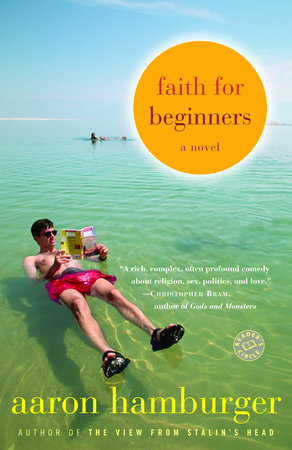
So far, the most surprising and telling reaction for me has
been to the cover. I showed it to a Palestinian friend of mine,
who said, “I guess it’s alright if you want to appeal to a certain
sector of the population.” I asked her what was wrong with it,
and she said, “Why does the book held by the young man floating
in the Dead Sea say ‘Israel’ instead of ‘Palestine’?”
At that point, I hadn’t even noticed what the book’s title
said because the lettering was so small, but it was the first thing
that stood out to her. I think that gives an idea of how much
tension there is about this subject matter.
FP: Your first book was set in Prague, this one was set in
Jerusalem, and now you’re working on a novel set in Berlin. Do
you ever think you’ll write something set in the United States?
AH: I think every book I write is set in the United States, in the
sense that the U.S. dominates the world in a way no other country
has in a very long time, not only with our military might
but also with our culture, our way of life, our ideas, our way of
doing business. And with the Internet, our influence only increases.
This year I’m living abroad again, and I’ve noticed how
different the experience is from how it used to be. I read the
New York Times online, just as I used to at home. I can email
all my friends, every day if I want to, and send digital pictures
home seconds after they’re taken. I go outside and buy Diet
Coke and eat sushi or Pringles and hear Madonna’s songs playing
in cafes. The advertising is filled with English words. The
TVs and theaters are filled with American movies. So, I think
it’s getting harder and harder to get away from the United
States, even if you want to, and in a way, you can actually see
the U.S. a bit more clearly from a distance.




 QUICK VIEW