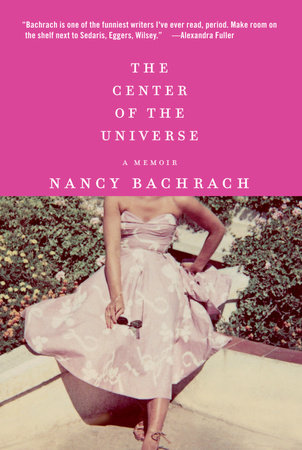
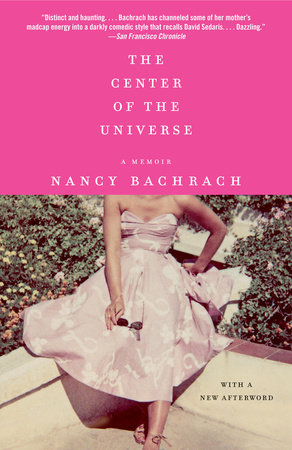
Excerpted from The Center of the Universe by Nancy Bachrach. Copyright © 2009 by Nancy Bachrach. Excerpted by permission of Vintage, a division of Random House, Inc. All rights reserved. No part of this excerpt may be reproduced or reprinted without permission in writing from the publisher.
Q: You worked in advertising. For how long? We’re all imagining three-martini lunches a la Mad Men. Was this your experience?
A: Before I got into advertising, I taught philosophy, but I was barely a chapter ahead of my class, and it didn’t take me long to realize I wasn’t serious enough for academia. A friend suggested I try advertising because it was “a business of ideas.” That sounded like fun, and it was, even though the ideas were mostly small. I worked on everything from denture adhesives to Star Wars, and during my thirty years in the business, I did witness a few liquid lunches. But if I’d drunk my way through them, I wouldn’t have remembered enough of my career to write about it. That said, I may have had a martini or two on the way home at night.
Q: Was there a moment in your advertising career where you thought to yourself: “I want to write a book”?
A: The idea was anything but sudden—writing a book about my mad, brainy mother was a compulsion that began in kindergarten. I started taking notes the minute I learned the alphabet, and before that, I drew hieroglyphics that got me sent to the school nurse. I finished my first draft while I was working full-time by writing before dawn, during vacations, and in my sleep. The only way I could forget my crazy job was to refocus on something more lunatic.
Q: The dream of most people is to write the great American novel, yet you chose to write nonfiction. Why?
A: Truth is stranger than fiction. My mother’s madness—and the freak accident that altered her personality and killed my father—were wilder than my imagination. To get to the bottom of an incredible story, I thought that fact would be a better route than fiction.
Q: Where does the title come from? Who or what is the center of the universe?
A: My mother was the self-proclaimed “center of the universe,” a fact she declared when I was about ten. She was very convincing—brilliant, bigger than life and charismatic—but she was intermittently unhinged. We were in our old Chevy when she made the pronouncement, and she was twirling her fingers in dainty arcs, demonstrating the rotation of the solar system around her, right there in the front seat. She was the axis of a magical orbit—spinning, spinning—and I rotated around her.
Q: Perhaps the most surprising thing about your memoir, given the subject matter, is how funny it is. Have you always been able to laugh at the dysfunctions in your family—if I may call them that—or is this the gift of hindsight?
A: I had some outrageous material. To paraphrase a famous quote, laughing well is the best revenge. It certainly beats self-pity.
Q: Was the process of writing this memoir painful? Cathartic? Did you feel like it had to be done?
A: “Catharsis” is the right word. I won’t say that writing purged my feelings about my childhood, but it transformed them. The first draft erupted from me like a volcano. I had misgivings about writing anything so honest it would be cruel, but by the time I completed the second draft, the anger was gone, and it was replaced by understanding and forgiveness.
Q: You write in your Author’s Note: “Memory is so fragile that even perspective can distort it but this is a work of nonfiction, mostly about my mother.” How much of THE CENTER OF THE UNIVERSE is true?
A: This story is as “true” as memory can be. I transcribed dialogue and incidents that were seared in my brain during childhood, but we’re not exactly disinterested observers of our own lives, and the passage of time airbrushes whatever we call “reality.” Telling a chaotic story in an orderly manner mutates it—since life is messier than prose. But no non-existent apple was thrown over a metaphorical fence.
Q: Are there any favorite anecdotes about your mother that got lost on the editorial cutting room floor?
A: There’s enough material about my mother for a sequel and a bad cookbook. And I cut most of the prequel— the stories about her ancestral psychodrama, which resembled the chapter headings of a psychiatric manual—from Aunt Flossie’s vapors to Aunt Lily’s neurasthenia and Aunt Annie’s dipsomania. Uncle Larry (a sociopath?) was a jailed judge, Uncle Bill an assassin at large, and their nephew embezzled from the mob. What kind of people embezzle from the mob?
Q: What do you hope readers of THE CENTER OF UNIVERSE will take away from the book?
A: Most families have their share of dysfunction, although mine is admittedly over the top. I hope readers will take away hope. No one should be counted out while they’re still breathing, even if they’re breathing on a ventilator. The brain is resilient, and despite what one well-meaning doctor told me, hope is never “counterproductive.” No one has a crystal ball.
From the Hardcover edition.
1. Tolstoy wrote that “All happy families are alike, and all unhappy families are unhappy in their own way.” How is the family in this book unique?
2. Lola, the book’s main character, proclaimed herself to be “The Center of the Universe.” Why was this traumatic for her family?
3. The author’s father, Mort, was nicknamed “Mr. Fix It.” Was his death just bad luck? An unavoidable accident? Predictable? Fate?
4. “Lies have latitude and longitude. Lies can be extended, magnified, hedged, contradicted, circumvented, and denied. The truth, on the other hand, is a forkless road with a dead end.” Whose philosophy is this in the book? And how does it shape her life and her family’s?
5. The author’s brother Ben—who was born with three thumbs—was a piano prodigy and eventual surgeon. Did his handicap add to his motivation?
6. Ben “made Chopin the sound track of my childhood—and the melancholy nocturnes and heartbreaking ballades that poured out of him poured right into me.” What role does music play in the book, and how does it help heal the family?
7. Writing about her little sister, Nancy says: “Poor Helen was born after the roles of ‘smart’ and ‘musical’ were already cast and had to create a new identity from scratch.” How did being the third child shape “Hellish”?
8. This is a story about a family that healed itself. What resources did the author and her siblings call upon to turn their dysfunctional childhood into highly-functioning adult lives? Do you think the problems they faced contributed to their close bond?
9. “Play the hand you’re dealt,” Nana said. “Count. Don’t try to beat the odds. No bluffing. And you gotta know when to fold.” How were Nana’s rules of poker a metaphor for guiding her three grandchildren? Was she their “savior?”
10. Describing Lola after the accident, Nancy writes: “Lola’s mind may lack torque, but her heart is a cheerful rudder.” Given a choice between brains and heart, which would you prefer?
11. After all the years of treating her mother “like she was a virus I might catch,” what precipitated Nancy’s realization that she loved Lola?
12. “This is a book about second chances,” the author has said. How does she use her second chance with her mother?
13. Lola wanted the memoir’s title to be Love Story. In what ways is this book a “love story”?
14. Nancy learned from a high school science experiment that “you never really know what’s going on inside anything.” How does that shape her thinking about Lola after the accident?
15. After the accident, when Lola began to deteriorate, Nancy writes: “I may represent Disaster, but I am also Rescue.” Was this true?
16. After the accident , the neurologist told Nancy that “hope would be counter-productive.” How would you react if a doctor said that to you?
17. Despite the gravity of the subject—life with a charismatic but mentally ill mother—this memoir is filled with humor. The author has commented that her family wasn’t laughing at the time, “but through a long lens (and after enough therapy), this tragedy revealed a comic underbelly.” How did her dark humor affect you?
18. James Thurber wrote that humor is chaos in retrospect. How did Nancy’s chaotic childhood shape her voice and her perspective?
19. A reviewer commented that this book “says the unsayable.” Do you agree? Can you give examples? What impact did that have for you when you were reading the story?
20. Another reviewer called the story “unsentimental – and all the more moving for it.” How did the author’s restraint (and lack of self-pity) affect your enjoyment in reading the book?
21. During a radio interview with Nancy Bachrach, the interviewer asked whether Lola had ever “apologized” to her children. Did Lola owe her children an apology for the way they were raised?
22. One reviewer wrote: “By the time the book ends, love has conquered chaos, tenderness flows like a healing balm and Lola's insistence that she is ‘the center of the universe’ doesn't seem so crazy after all.” Do you agree?
23. What role do dreams play in the story? Does Nancy’s dream on the plane home from Paris (about “the old woman in the hospital bed, and the blank newspaper that only the nun could read, and the clock without hands”) portend the future?
24. In the Author’s Note, Nancy writes: “Memory is so fragile that even perspective can distort it.” What does it mean to write a memoir after admitting that memory is flawed?
25. Nancy writes that her ancestors’ craziness was their “biochemical itinerary.” How much do genes control character? What role does experience play? And how did Lola’s childhood environment affect her sanity?
26. The author summarizes a major theological argument: If God is good and has unlimited power, why is there evil in the world? “Is god up there listening, but not interested in helping? Or would he like to help but he’s unable to intervene? Which is worse? Does it matter?” How would you respond to these questions?
27. “We all believe what we need to believe no matter how cultivated our skeptical principles.” Is this a definition of hope? Is it true in your own life?