Excerpt
First StepsParliamentary democracy is an easy concept to grasp but a difficult one to sustain. Throughout the twentieth century, and into our present twenty-first century, the institutions and ideals of parliamentary democracy have been under continual threat. The power of totalitarian regimes to dominate their own people is – and remains – attractive to those who wish to control the life of a nation without checks and balances.
In Europe, for many decades of the twentieth century, Communism, Fascism and Nazism ruled through small elites, backed by secret police to ensure their dominance. An independent judiciary and a free press were both anathema to the rulers. In the twenty-first century, these democratic values, which are universal in their implications for the quality of life and fulfilment of each person on the planet, are still under threat in many lands.
Dictatorships of one form or another continue to control their people in many of the countries of the United Nations. The world’s most populous country, China, is a closed society. Fundamentalist Islamic nations adhere to anti-democratic norms. The rule of law and the rights of the individual are upheld in only a minority of the countries on the globe. Yet these principles have their champions everywhere, even in prison camps and under house arrest.
Parliamentary democracy celebrates diversity and dissent. It seeks to exclude no one from the benefits and protections of citizenship. Today, as in every decade in the past, its basic tenets are under threat: the male and female electoral franchise, the cut and thrust of parliamentary debate, the value of peaceful public criticism and opposition, the evolution of practical and egalitarian legislation, and, above all, the belief in impartial justice and the right of every adult citizen to determine his or her own destiny. The twin pillars of parliamentary democracy are the secret ballot and open debate.
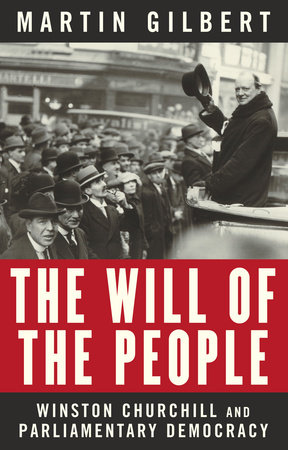
More than a hundred years ago, this same system of parliamentary democracy, facing similar threats as it does today, including the apathy of those who are its beneficiaries, was championed by Winston Churchill. He was the scion not only of an aristocratic British lineage but also, on his mother’s side, of an American heritage. He was only twenty-five years old when he first entered Parliament and eighty-nine when he left it.
By far the largest part of Churchill’s life – of his working days and nights – was spent in the interchange of parliamentary debate. Legislation and the governance of Britain were his constant companions, the objects of his persistent work and evolving expertise. Elections and electioneering were part of his life-blood. His fellow parliamentarians were among his closest, lifelong friends.
Throughout his long life, Churchill considered the people to be sovereign, through Parliament, in deciding the destiny of the nation. During more than fifty years of political life, he did his utmost to ensure that the efforts of Parliament were effective and that its will was not undermined or bypassed.
The defeat of the Conservative Party in the General Election of 1945, which ended his wartime premiership, in no way altered Churchill’s faith in parliamentary democracy or its procedures. Reflecting on his defeat the day after the results were known, he told a small gathering of family and friends: “It is the will of the people.”
Not only did Churchill serve as a parliamentarian for more than half a century but he faced the electorate and campaigned for election or re-election eighteen times. In five of those campaigns he was unsuccessful. Those five defeats – the first, in 1899, a year before he entered Parliament – did not deter him. Nor did the defeat, twice, of his party, first in 1922 (the Liberal Party, of which he was a stalwart), and then in 1945 (the Conservative Party, of which he was then leader). Indeed, each of these defeats spurred him on to make effective use of the democratic and parliamentary process, to make democracy work.
For just over five years during the Second World War, Churchill headed an all-party coalition. Within it, Conservative, Liberal and Labour politicians all had important positions in every aspect of his administration, from the War Cabinet to the running of government departments. His path to the leadership of these combined political forces – hitherto almost always beset by disagreement – had begun almost forty years earlier, in 1901, shortly after the death of Queen Victoria. That year, after six crowded years as a soldier and journalist, he entered the House of Commons. From that moment, he was first and foremost a parliamentarian: a supporter, practitioner and upholder of parliamentary democracy and the rule of law.
–––
Even before he entered Parliament, Churchill knew, and had become steeped in, many aspects of the parliamentary world. When he was nine years old, Woodstock, the parliamentary constituency represented by his father, Lord Randolph Churchill, was abolished. It was one of the notorious “rotten boroughs” whose electorate was small and controlled by the local landlord: in this case, his grandfather, the seventh Duke of Marlborough. Lord Randolph had therefore to find a constituency with an independent electorate. He chose to fight a largely radical Birmingham seat and, defiantly, to raise the flag of Tory Democracy there.
The young Churchill watched this process with fascination. When his headmaster’s wife visited the Midlands, Churchill wrote to his mother, “they were betting two to one that Papa would get in for Birmingham.” Lord Randolph was indeed successful. The concept of Tory Democracy, whereby Conservative Party policy could encompass all classes in the nation, was one that attracted the young Churchill. It enshrined one of his basic understandings of parliamentary democracy: that no one class, no one interest – economic, social or political – no one segment of the political spectrum could use the system for its own exclusive interests
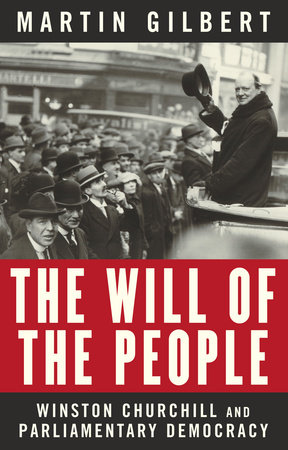
Excerpted from The Will of the People by Martin Gilbert. Copyright © 2006 by Martin Gilbert. Excerpted by permission of Vintage Canada, a division of Random House, Inc. All rights reserved. No part of this excerpt may be reproduced or reprinted without permission in writing from the publisher.